


👋 Hey, Sahil here - welcome back to Venture Curator, where we explore how top investors think, how real founders build, and the strategies shaping tomorrow’s companies.
Big idea + report of the week :
Could AI handle a month-long project without human help by 2027?
Why is $3 trillion of Venture Capital still waiting to be returned?
Frameworks & insightful posts :
What did 7,200 developers reveal about AI coding?: The State of Web Dev AI 2026 report.
How fast should founders ship features in the AI era? A framework from a former Facebook executive.
Why nobody wants to build this boring AI category (Even though it’s worth billions.)
Get access to 150+ premium archive posts, 100+ startup & VC resources, investor databases, fundraising templates, and exclusive startup research - all in one place.
FROM OUR PARTNER - TYKR
💹 Investors are backing Tykr’s mission to simplify stock investing

Tykr is the premier stock screening and education platform designed to take the guesswork out of the stock market. Today, we have over 13,000 customers in over 50 countries.
We stand by our tagline, “clear confident investing,” as we empower retail investors to find high-quality Stocks, ETFs, and Mutual Funds with ease. By simplifying complex financial data into actionable insights, Tykr helps you reduce risk and maximise returns.
Plus, we are seamlessly connected to 30+ brokers, including Schwab, Fidelity, E*TRADE, and Robinhood, allowing your Tykr portfolio tracker to automatically update every day. Tykr is raising capital on Wefunder with the goal of achieving a $1B valuation in the next 5-10 years.
WORK WITH US
🤝 Partnership With Us
Get your product in front of over 120,000+ audience - Our newsletter is read by thousands of tech professionals, founders, investors and managers worldwide. Get in touch today.
START WITH
🧠 Big idea + report of the week
Could AI handle a month-long project without human help by 2027?
Most people still think of AI as something that helps with small tasks - writing emails, generating code snippets, answering questions, or summarizing documents.
But what if the more important question isn’t how smart AI is, but how long it can work independently before needing human intervention?
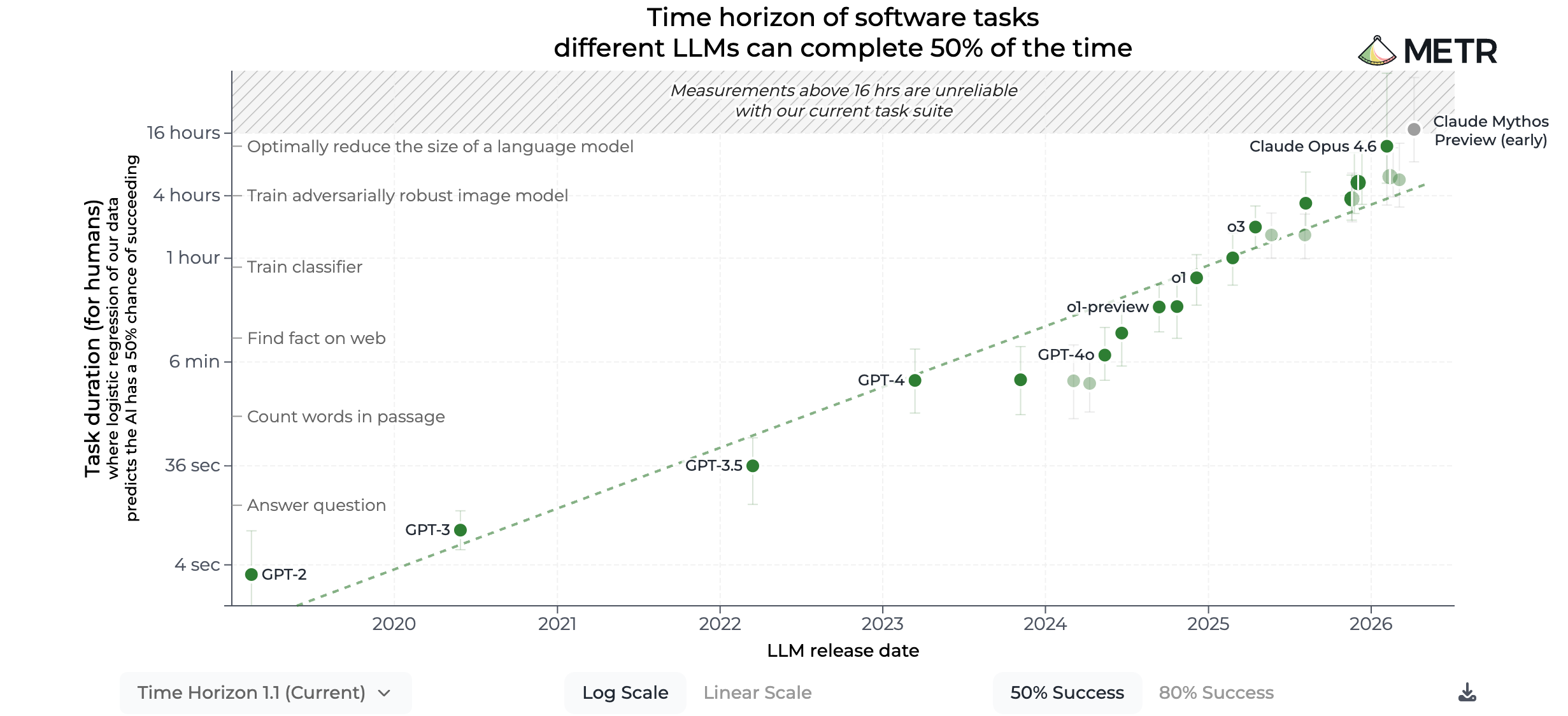
A new study from METR suggests that this “task horizon” may be improving far faster than most people realize.
METR (Model Evaluation & Threat Research) recently published an updated version of its Measuring AI Ability to Complete Long Tasks research, tracking how quickly frontier AI models are improving at completing increasingly complex tasks from start to finish.
AI’s working time is growing faster than expected
The headline finding is striking.
METR’s earlier research estimated that AI task-completion capability was doubling roughly every seven months. After expanding the dataset and testing newer frontier models, the updated estimate is now 130 days (around 4.3 months).
In other words, the amount of work an AI can successfully complete before failing is growing significantly faster than researchers previously thought.
The acceleration is also recent.
The strongest improvements occurred between 2024 and 2025, suggesting the curve is still steepening rather than flattening.
Researchers made the benchmark harder and AI still improved
What’s interesting is that this wasn’t achieved by making the test easier.
METR expanded its evaluation suite from 170 tasks to 228 tasks, while more than doubling the number of long-duration challenges.
Some key changes:
Total tasks increased from 170 to 228
Tasks requiring 8+ hours of human work increased from 14 to 31
More complex software engineering and reasoning tasks were added
Despite the harder benchmark, frontier models continued pushing the curve upward.
Claude Opus 4.6 achieved an estimated task horizon of roughly 718 minutes, meaning it can successfully complete tasks that would take a human nearly an entire working day.
Not all AI capabilities are improving equally
The research also shows a growing gap between digital work and physical-world tasks.
Software engineering and reasoning benchmarks are improving at an extraordinary pace, with task horizons doubling every few months.
Meanwhile:
Visual computer-use tasks remain 40-100x behind software tasks
Self-driving progress is improving much more slowly
Physical-world interaction continues to be a major bottleneck
This suggests AI may transform knowledge work long before it masters the physical world.
The bigger implication
If current trends continue, today’s multi-hour AI agents could evolve into systems capable of handling multi-day and eventually multi-week projects.
METR notes that month-long task completion may become realistic around 2027.
That doesn’t mean AI will replace every worker.
But it does mean the conversation may soon shift from “Can AI do this task?” to “How much of this project can AI own from beginning to end?”
And that is a very different future than the one most people are imagining today.
Why is $3 trillion of Venture Capital still waiting to be returned?
For decades, venture capital followed a relatively simple cycle.
Investors backed startups, companies went public or got acquired, and capital flowed back to LPs who reinvested into the next generation of funds.
That cycle is now breaking down.
A new report from the World Economic Forum and Stanford GSB, titled The Future of Venture Capital: Unlocking Liquidity and Growth, highlights a growing bottleneck inside the venture ecosystem: trillions of dollars in startup value exist on paper, but very little of it is being converted into actual cash returns.
Venture has created enormous value, but much of it remains locked up.
The report estimates there are now roughly 1,920 VC-backed unicorns globally, representing more than $7.3 trillion in private-market value.
The challenge is that most of this value has not been realized.
According to the research, venture funds are currently sitting on approximately $3 trillion of unrealized NAV (Net Asset Value) - assets that exist on balance sheets but have not yet generated distributions back to investors.
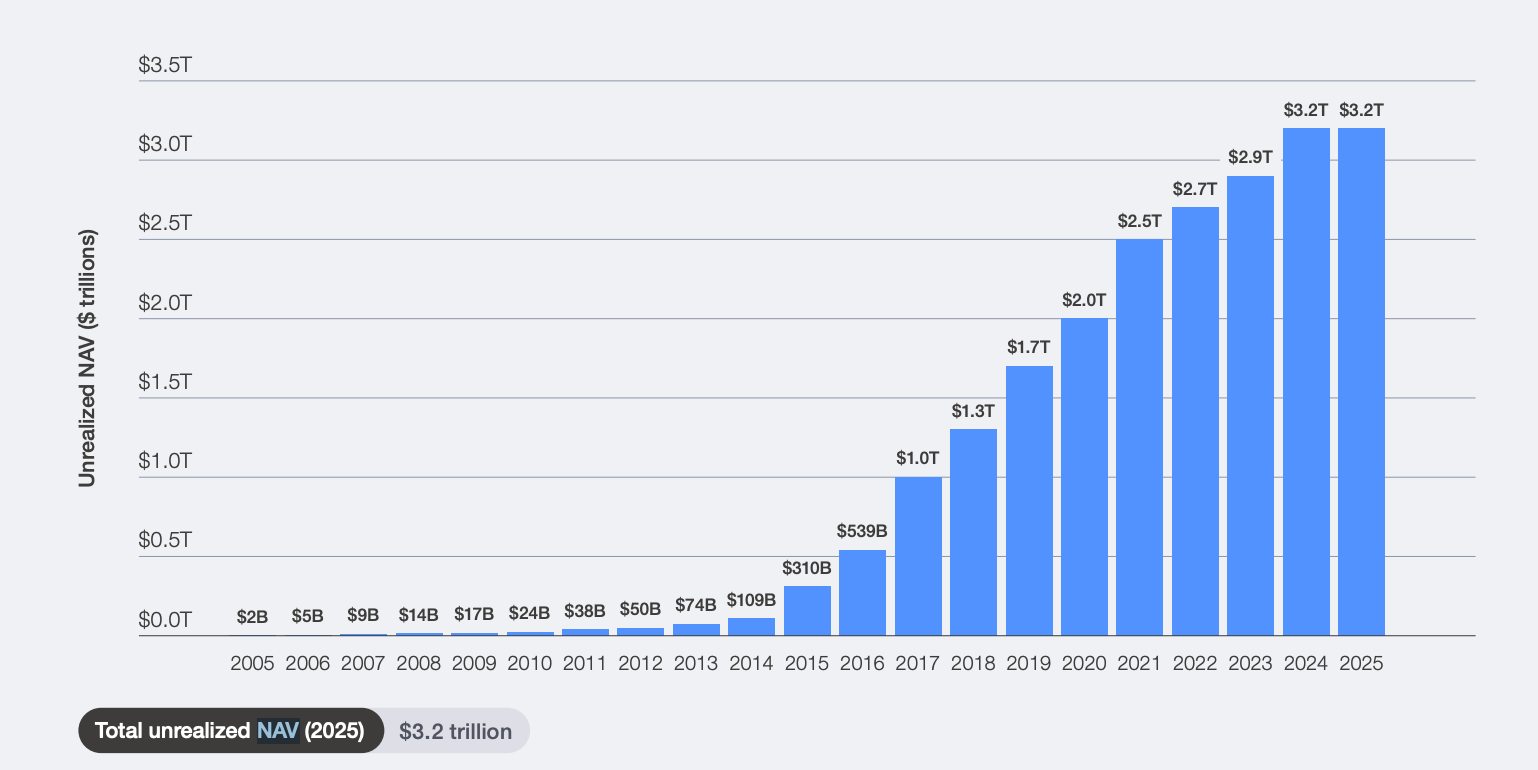
What’s even more surprising is how old many of these companies have become.
59% of unicorns are now more than 10 years old
20% are more than 15 years old
Many remain private despite reaching enormous scale
The traditional path from startup to public company is taking longer than ever.
LPs are waiting much longer to get their money back
This liquidity slowdown is beginning to show up in fund performance metrics.
The report highlights a sharp decline in DPI (Distributed to Paid-In Capital), one of the most important measures LPs use to evaluate venture returns.
Historically, funds in their prime return years typically distributed around 20% of value back to LPs. By the end of 2025, that figure had fallen to approximately 12%.
The trend is even more visible in recent vintages.
Among 2021 funds, roughly 75% had returned less than one-quarter of LP capital by year four, compared with about half of 2017 funds at the same stage.
The result is a growing mismatch between paper gains and actual cash returns.
Venture capital is becoming increasingly concentrated
It also highlights how capital is flowing toward a smaller number of firms and companies.
Fundraising has become significantly harder across the industry.
The 10 largest venture funds captured nearly 43% of all venture capital raised in 2025, while the median time required to close a US venture fund stretched to a record 15.3 months, up from 9.7 months just three years earlier.
At the company level, concentration is becoming even more extreme.
AI accounted for more than 50% of global venture deal value, with just five companies - OpenAI, Anthropic, xAI, Scale AI, and Project Prometheus - absorbing roughly 20% of total global VC funding through a handful of mega-rounds.
In many ways, venture capital is increasingly becoming a game of a few giant funds backing a few giant companies.
The industry’s biggest challenge isn’t funding - it’s liquidity
The common narrative is that venture capital has too little money. The data suggests the opposite.
There is enormous value sitting inside private markets, but far less liquidity than investors expected when those investments were made.
The real question facing venture over the next few years isn’t whether startups can raise capital.
It’s whether the industry can create enough exits - through IPOs, acquisitions, or secondary markets - to unlock the trillions of dollars currently trapped on balance sheets.
Because until that happens, much of venture’s success remains theoretical rather than realized.
📬 Upgrade to Venture Curator Premium
Get access to 150+ premium archive posts, 100+ startup & VC resources, investor databases, fundraising templates, and exclusive startup research - all in one place.
SOMETHING MORE
🧩 Frameworks & insightful posts
What did 7,200 developers reveal about AI coding?: The State of Web Dev AI 2026 report.
A few years ago, AI coding tools were mostly autocomplete on steroids.
Today, they’re becoming a core part of how software gets built.
The team behind the State of Web Dev AI 2026 surveyed more than 7,200 developers to understand how AI is changing software development. One finding stood out immediately:
Just one year ago, developers said AI generated about 28% of their code on average. Today that number has climbed to 54%.
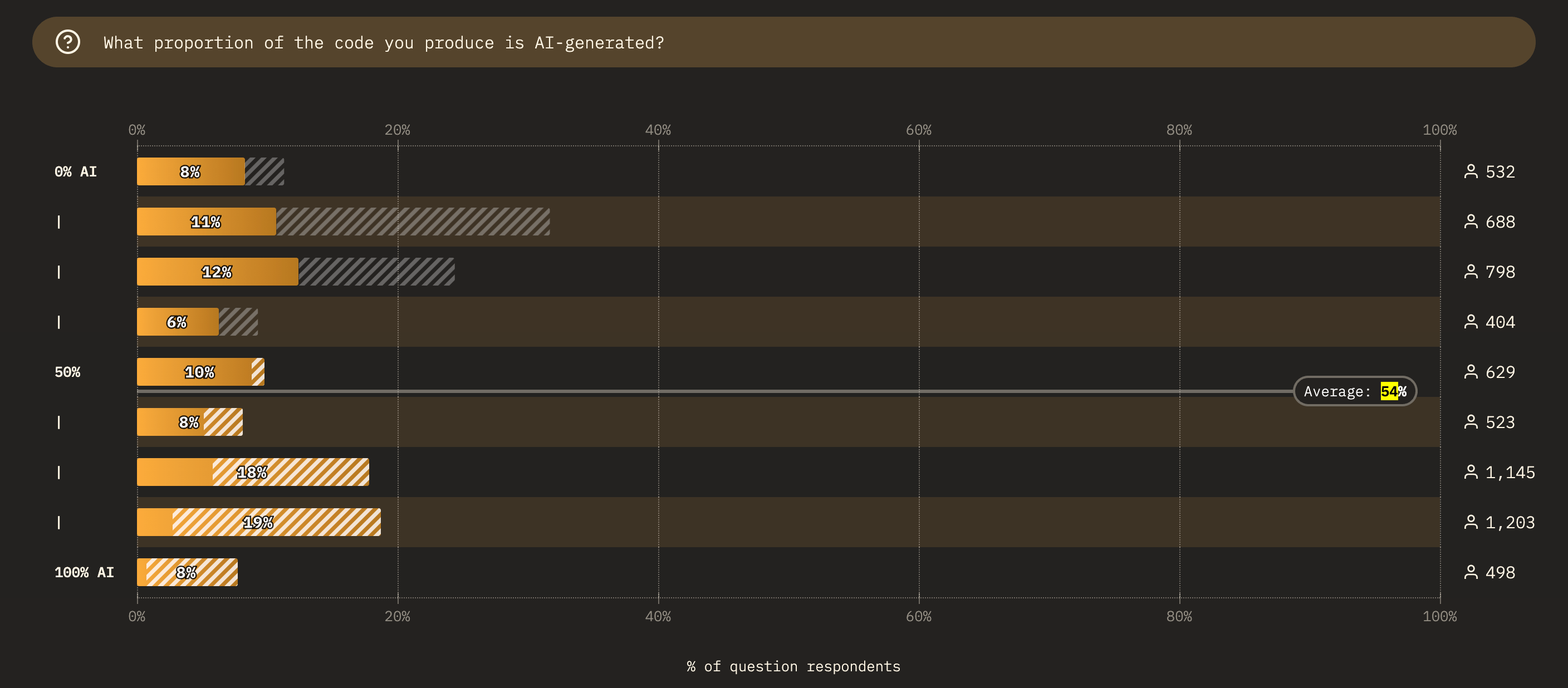
In other words, the average developer now produces more code with AI than without it.
The biggest growth came from developers who say more than 75% of their code is AI-generated. At the same time, the number of people using AI “constantly” while coding doubled year-over-year.
But the more interesting shift is not just how much AI is being used.
It’s how developers are choosing to use it.
Coding agents are replacing chatbots
The early AI era was dominated by chat interfaces. Developers copied code into ChatGPT, asked questions, received suggestions, and manually implemented changes.
Now a new category is emerging: coding agents.
Among all coding tools surveyed, Claude Code received the highest positive sentiment score, ahead of OpenAI Codex and GitHub Copilot.
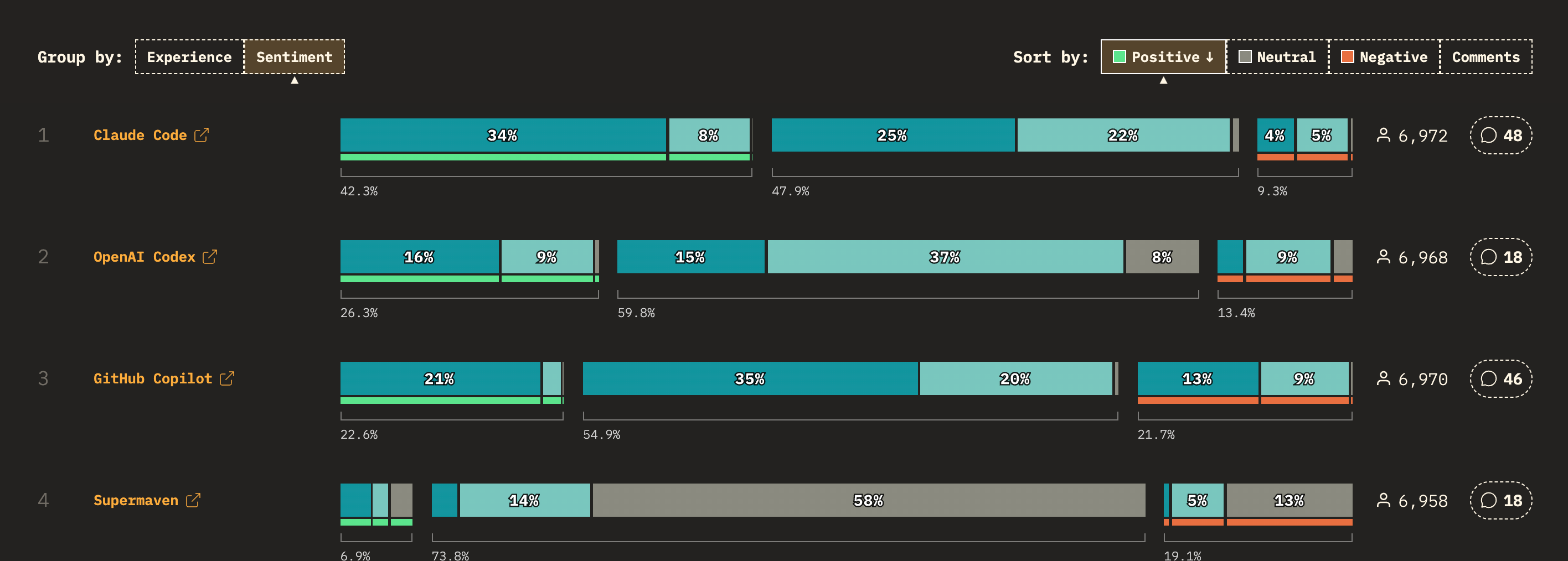
Instead of simply answering questions, these agents can navigate repositories, edit files, execute tasks, and work across larger parts of a codebase.
The interface is shifting from “ask AI a question” to “assign AI a task.”
That’s a very different product category.
Claude is winning where developers spend money
ChatGPT remains the most widely known AI product. But when respondents were asked which AI tools they actually pay for, Claude ranked first.
More developers reported paying for Claude than ChatGPT, Gemini, Copilot, Perplexity, or any other AI product.
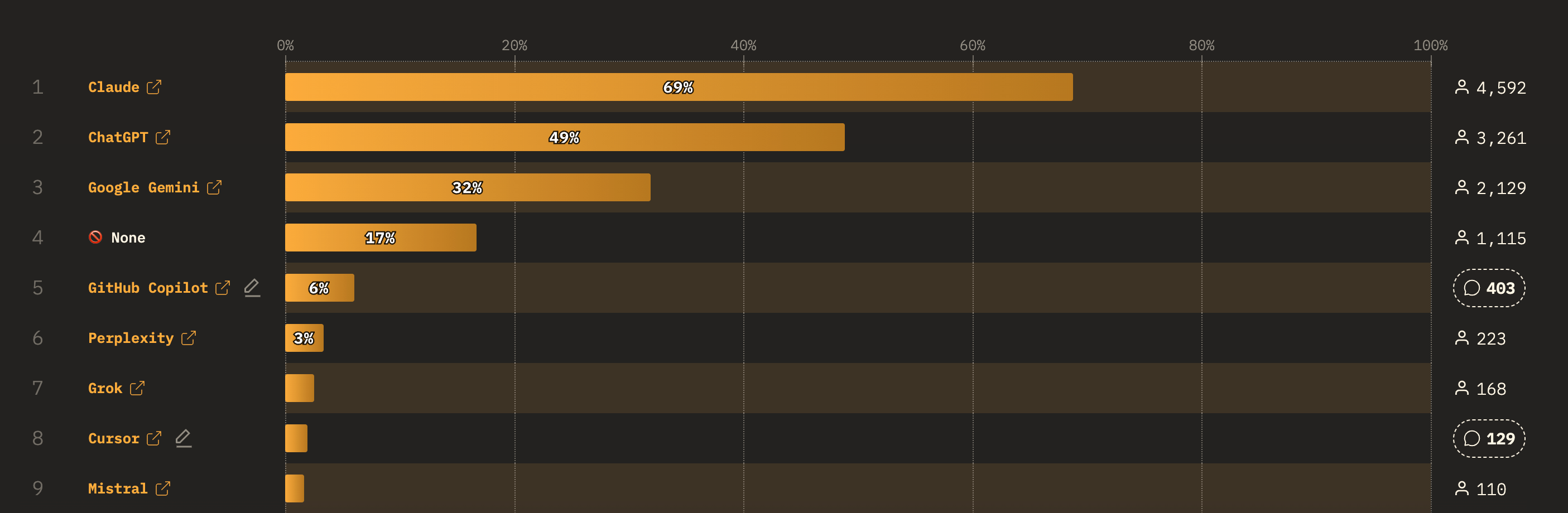
This matters because consumer popularity and willingness to pay are not the same thing.
Developers appear to be rewarding products that directly improve workflow productivity rather than general-purpose assistants.
It’s one reason why Anthropic has been gaining momentum inside engineering teams over the past year.
Developers are spending more on AI
The era of cheap AI is slowly ending. As adoption grows, AI companies are becoming more aggressive about monetization.

The survey shows growing numbers of developers spending between $50 and $500 per month on AI tools.
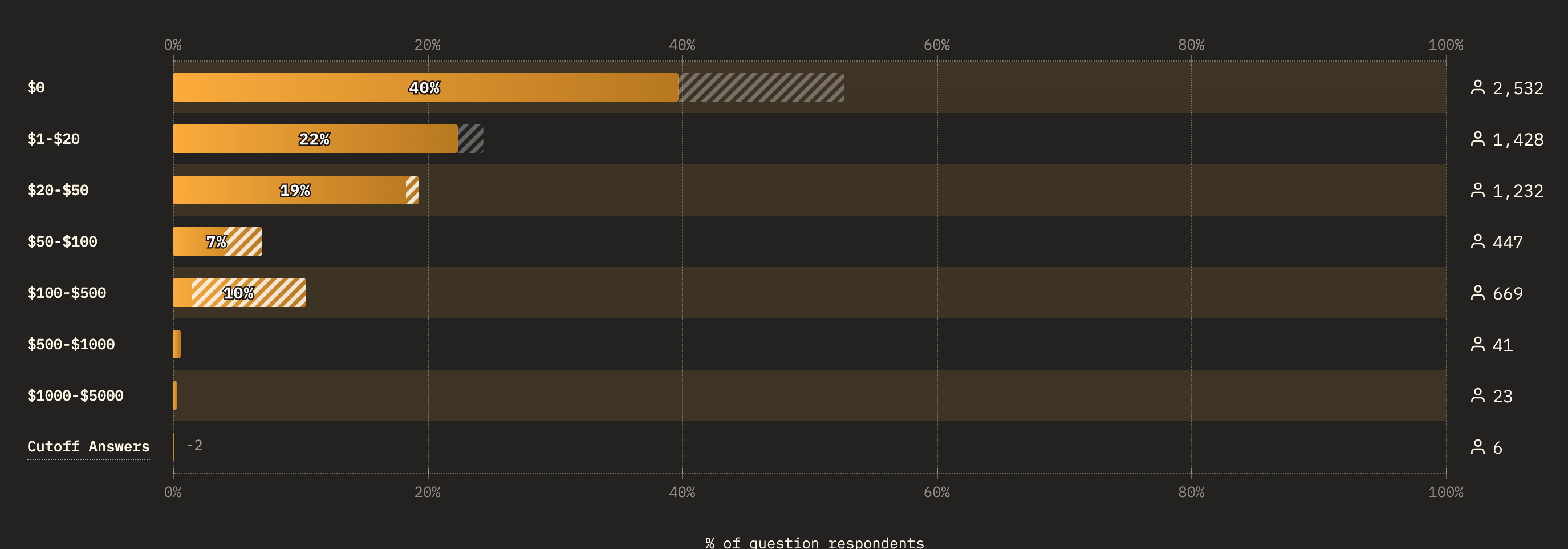
Many teams now view AI subscriptions the same way they view cloud infrastructure, GitHub, or productivity software: a standard operating expense.
The question investors are asking is whether this spending growth can eventually justify the enormous valuations assigned to AI companies.
Developers aren’t convinced. A majority of respondents either agreed or strongly agreed that we’re currently living through an AI bubble.
The biggest fear isn’t technology. It’s jobs.
Despite widespread adoption, developers remain worried about what comes next.
Job displacement ranked as the most concerning AI risk, ahead of military applications, environmental impact, security risks, and AI-generated misinformation.
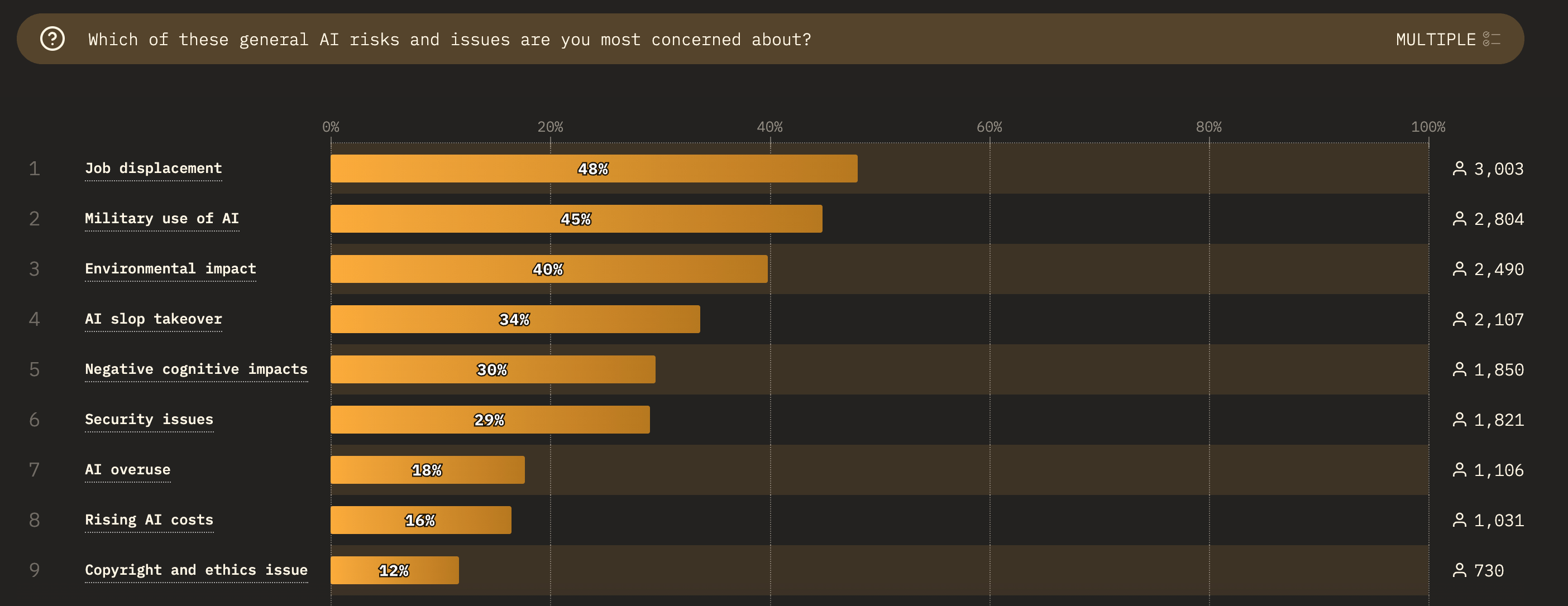
The concern isn’t necessarily that AI can already replace engineers. It’s that managers may eventually believe it can.
That distinction matters. Technology adoption often changes labor markets long before technology fully replaces labor.
AI still has a trust problem
For all the progress made by modern models, developers continue to report the same core frustration.
Hallucinations remain the number one pain point. Respondents also highlighted poor code quality, lack of context, privacy concerns, and rising costs as major issues.
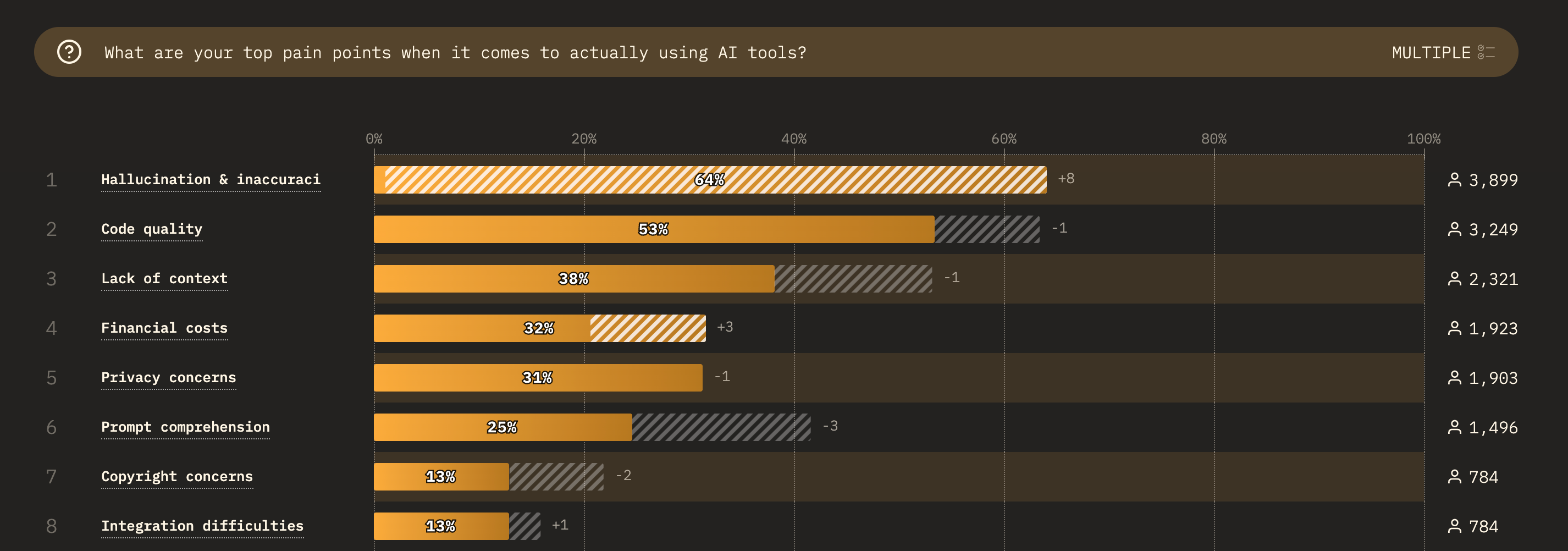
The industry has largely solved the “can AI generate code?” question. The next challenge is solving “can developers trust the code it generates?”
That may end up being a far bigger challenge than model intelligence itself.
What this signals
The most important takeaway from this year’s survey is that AI adoption is no longer a future trend. It’s already happening.
Developers are generating more than half their code with AI, paying for AI tools at increasing rates, and integrating coding agents directly into their workflows.
The debate is shifting away from whether AI will become part of software development.
The real questions now are:
Which AI companies capture the developer workflow?
Can AI businesses justify their valuations through monetization?
And how much of software engineering eventually becomes agent-driven?
Those questions will define the next chapter of the AI industry.
How fast should founders ship features in the AI era? A framework from a former Facebook executive.
AI has dramatically reduced the time it takes to build software.
A solo founder can now ship features in days that previously required entire engineering teams. As a result, many startups are treating speed itself as the competitive advantage.
But faster building doesn’t automatically mean faster shipping.
Recently, Gokul Rajaram - who held leadership roles at Google, Facebook, and Square, and is now a founding partner at Marathon Management shared an interesting framework for deciding how often companies should ship products.
The insight came from his own experience.
When he left Facebook for Square in 2013, one thing immediately surprised him. Facebook engineers shipped updates multiple times a day, while Square often released customer-facing updates only every few weeks.
His first reaction was simple: Square needed to move faster. Over time, he realized the opposite.
Both companies had intentionally chosen different shipping philosophies because their customers had very different needs.
At Facebook, speed mattered.
Users primarily visited the platform for entertainment, social interaction, and discovery. New features were usually welcomed. Customers had time to explore new experiences, learn new functionality, and adapt quickly to changes.
At Square, reliability mattered far more than novelty.
Small businesses depended on Square to process payments, manage transactions, and run daily operations. A bug wasn’t merely annoying - it could directly impact a merchant’s revenue.
For those customers, reliability was the product.
That led Square to build extensive quality assurance processes, human review stages, alpha testing, beta testing, and deliberate release schedules before new features reached customers.
There was another important difference. Many Square customers simply didn’t have time to absorb constant product changes.
A new feature often required updating workflows, retraining staff, adjusting business processes, or reconfiguring third-party software integrations.
Even if Square could ship daily, their customers couldn’t keep up.
This led Gokul to propose a simple framework built around two questions:
How critical is your product?
If your product is mission-critical to your customers, quality and reliability should outweigh speed.
Examples include:
Payments
Banking
Healthcare
Infrastructure
Security software
In these categories, getting something wrong can be extremely costly.
If your product is primarily used for entertainment, communication, or productivity, speed becomes more valuable because the consequences of mistakes are lower.
How much time do your customers have?
Some customers are busy operators. They don’t have time to learn new workflows every week.
Others actively enjoy exploring new features and experimenting with products.
This distinction matters more than most founders realize.
Combining these two variables creates four different shipping models.
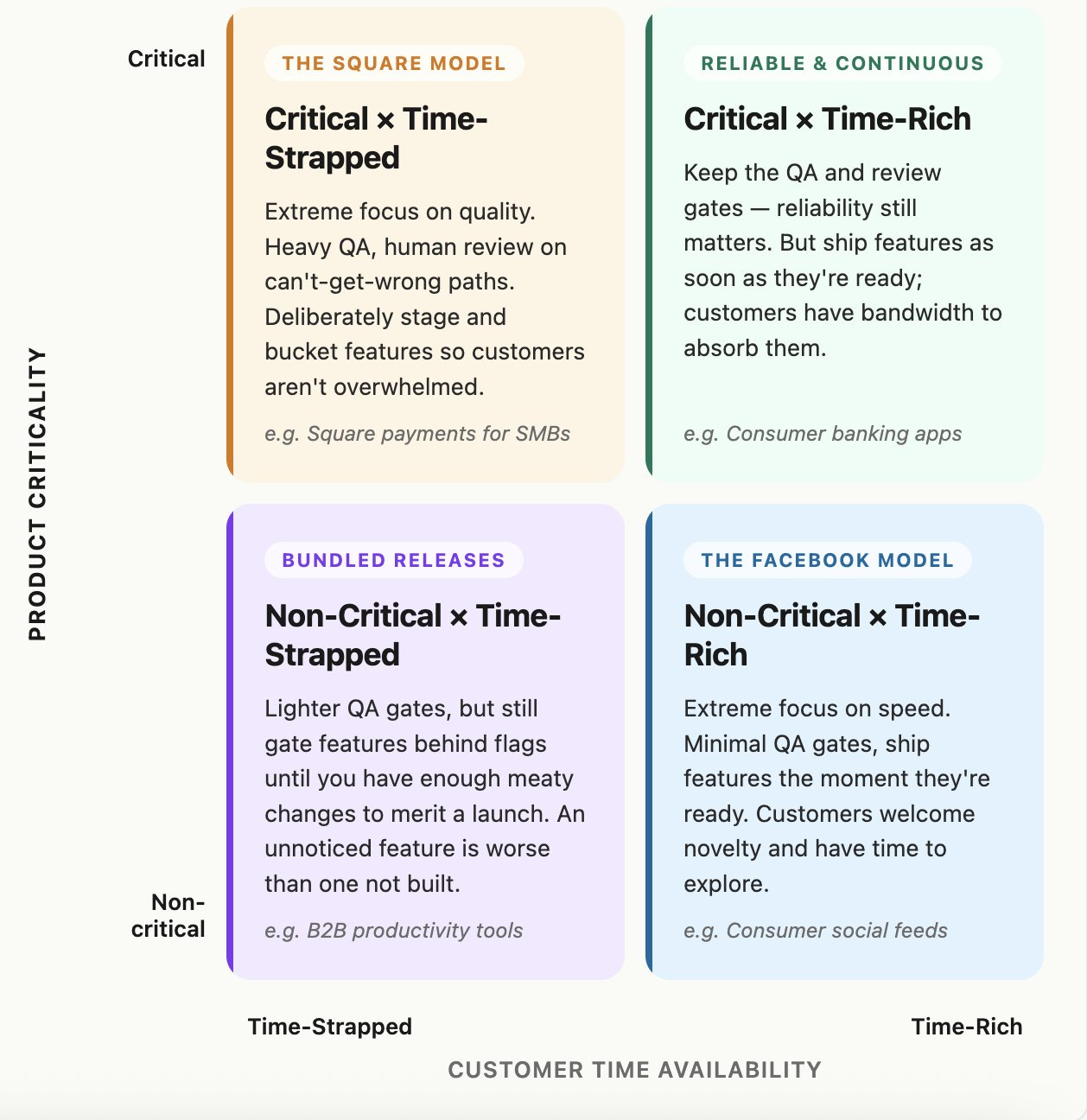
The Square model - Critical product + Time-strapped customers
Examples:
Payments
Financial infrastructure
SMB operating systems
Prioritize reliability.
Use extensive QA processes, human review, staged rollouts, and carefully package new functionality into larger releases.
Bundled releases - Non-critical product + Time-strapped customers
Examples:
B2B productivity software
Workflow tools
Move quickly internally, but bundle customer-facing releases.
A feature customers never notice may provide less value than founders assume.
The Facebook model - Non-critical product + Time-rich customers
Examples:
Social media
Consumer apps
Entertainment platforms
Optimize for speed. Ship features as soon as they are ready. Users enjoy discovering what’s new.
Reliable and continuous - Critical product + Time-rich customers
Examples:
Consumer banking
Financial apps
Maintain strong quality controls, but release features once they’re ready because customers have enough bandwidth to adopt them.
The broader lesson is simple. AI has changed how fast software can be built. It hasn’t changed how customers consume software.
The best founders won’t simply ask: “How quickly can we ship?”
They’ll ask: “How quickly should our customers receive change?”
Those are often very different answers.
Why nobody wants to build this boring AI category (Even though it’s worth billions.)
Most founders want to build the next AI coding tool, AI design platform, or AI productivity app.
Very few wake up thinking about payroll compliance, anti-money laundering reviews, regulatory filings, audit trails, or employee monitoring.
That’s exactly why the opportunity is interesting.
Behind the scenes, every large company is spending enormous amounts of money on compliance. Every employee payroll run, customer onboarding process, bank transfer, insurance claim, mortgage application, tax filing, and regulatory report has compliance requirements attached to it.
As companies become larger and regulations become more complex, the default solution has been simple: hire more people.
Recently, James da Costa and Angela Strange shared a fascinating breakdown on why compliance may become one of the biggest AI categories in enterprise software over the next decade.
The numbers are staggering.
There are now more than 400,000 compliance officers in the United States alone, representing over $40 billion in annual labour costs.
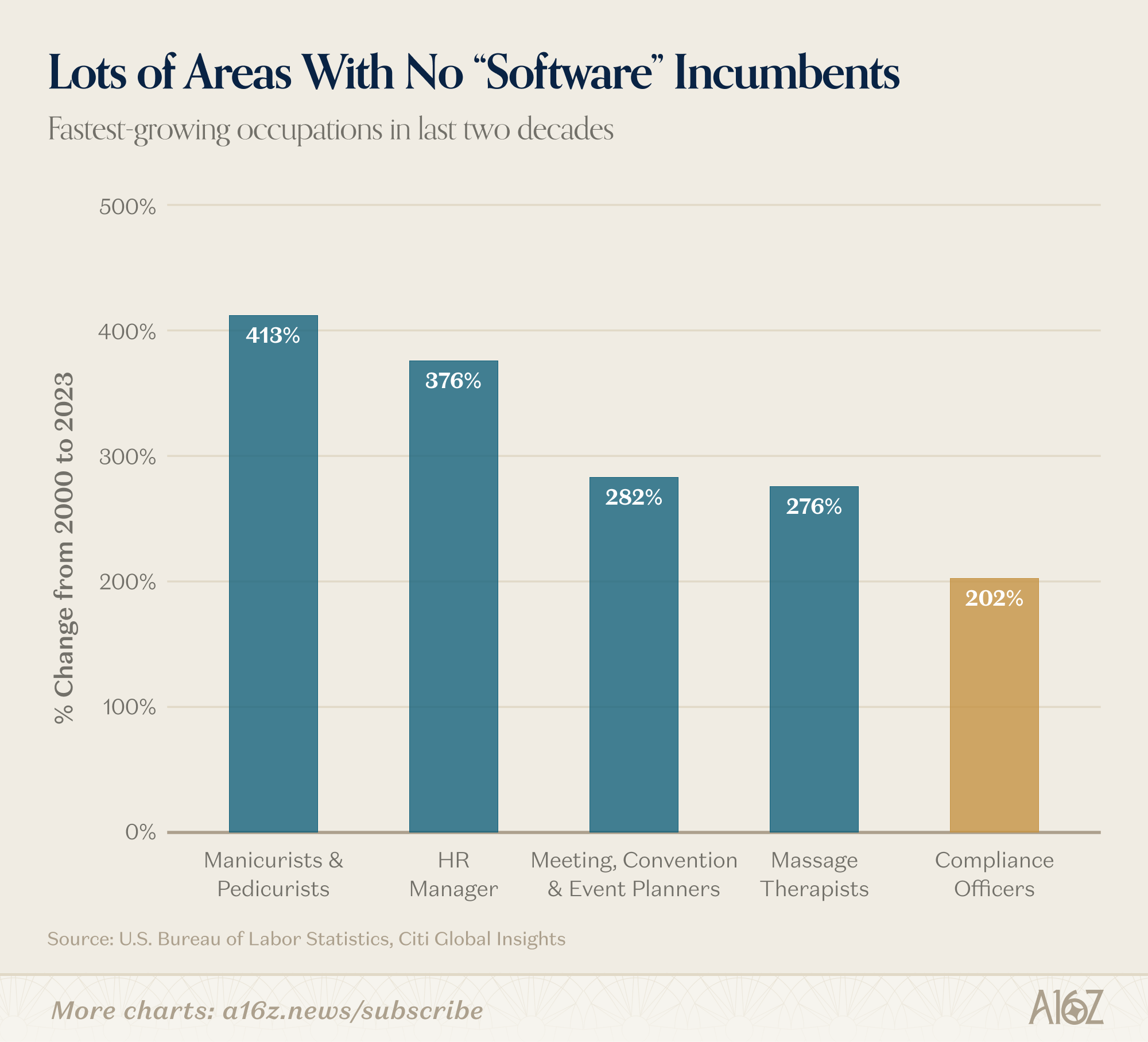
The U.S. Bureau of Labour Statistics projects more than 33,000 new compliance openings every year for the next decade.
Yet despite all this hiring, the industry still struggles.
Compliance teams face constant backlogs, talent shortages, rising regulatory complexity, and costly mistakes. In 2024, TD Bank received a $3 billion fine after failing to monitor the vast majority of its transactions and accumulating tens of thousands of unresolved alerts.
The problem isn’t a lack of people. The problem is that much of compliance work still looks exactly the same as it did years ago.
People manually read documents.
People copy information between systems.
People compare records across databases.
People monitor regulatory updates.
People write reports.
In other words, much of compliance consists of repetitive, document-heavy workflows that AI is increasingly good at handling.
What’s changing now is that AI has crossed an important trust threshold. For years, technologies like OCR could extract information from documents, but “mostly correct” wasn’t good enough for compliance.
A mortgage application can’t be 90% accurate. A regulatory filing can’t be mostly complete. An anti-money laundering review can’t miss critical information.
Modern AI systems can now read, understand, extract, summarise, and reason over complex documents with near-human accuracy. A 400-page regulatory document that once required days of review can now be analysed in minutes.
That changes the economics entirely.
The authors break the opportunity into three major startup categories.
Turn regulation into code
Every year, governments publish thousands of pages of new regulations. Today, humans read those documents, interpret them, update internal policies, and manually ensure compliance.
AI allows regulation itself to become machine-readable.
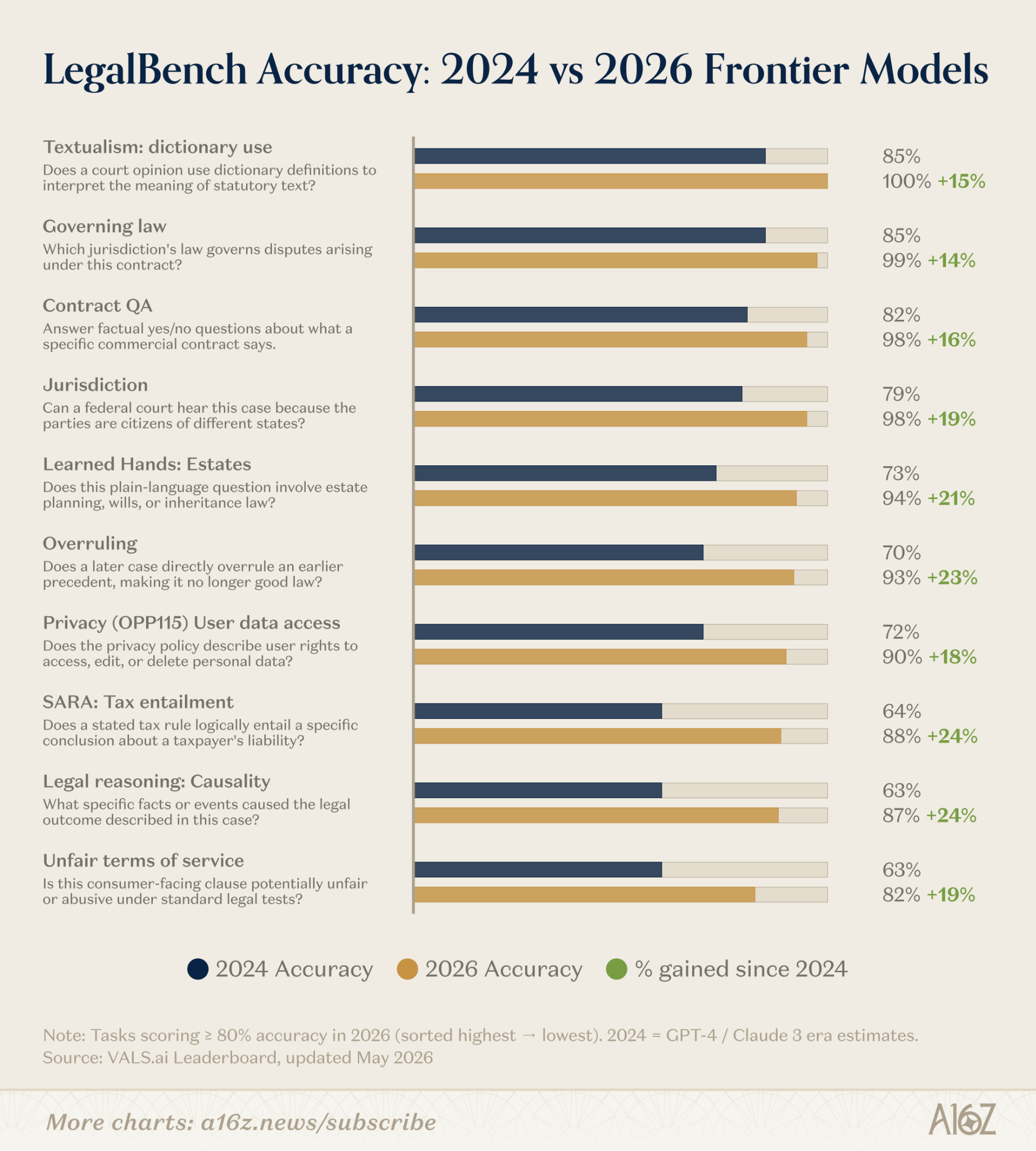
Instead of treating regulations as PDFs, companies can convert them into structured rules that software can monitor automatically.
One example is Tako, which helps businesses navigate Brazil’s notoriously complex labour regulations. Rather than forcing HR teams to manually track thousands of union rules and hundreds of annual changes, the system continuously audits compliance and flags potential issues in real time.
The bigger idea is that regulations become executable software rather than static documents.
Replace legacy compliance systems
One of the most overlooked realities in enterprise software is that many compliance departments still operate on infrastructure built decades ago.
The integration layer isn’t software.
It’s a human.
Employees spend their day moving information between systems because the systems themselves don’t communicate effectively.
This creates a massive opportunity for AI-native replacements.
Companies like Valon, Vesta, and Sardine are rebuilding compliance infrastructure from scratch.
Sardine, for example, can reduce the time required to prepare a Suspicious Activity Report from more than 30 minutes to less than one minute by automatically gathering information from multiple systems and generating the required documentation.
That’s not just efficiency.
That’s an entirely different operating model.
Augment compliance workers with AI agents
The most immediate opportunity may simply be helping existing compliance teams do more work with the same number of people. A compliance officer reviewing a customer onboarding case typically needs to:
Review documents
Extract information
Verify identity
Check sanctions databases
Cross-reference internal systems
Prepare reports
AI agents can handle most of these repetitive tasks automatically and escalate only exceptions that require human judgment.
Instead of replacing compliance professionals, AI allows them to focus on decisions rather than paperwork.
One insight from the article stood out.
Every compliance function is built from three layers:
Regulation
Software
People
Most startups will initially attack one layer.
The biggest companies may eventually own all three.
They’ll translate regulation into code, build the system of record, and deploy AI agents that operate on top of it.
That’s what makes this opportunity so interesting.
Compliance doesn’t look exciting from the outside.
But neither did payroll software, accounting software, or cloud infrastructure in their early days.
Sometimes the largest opportunities are hidden inside the workflows everyone else wants to avoid.
FEATURED POSTS
📄 Must Read Post


NEWS RECAP
🗞️ This week in startups & VC
New In VC
Ghost Angels, a venture fund launched by a group of 20 former Snap employees and led by ex-Snap partnerships executive Max Rivera, is backing the next generation of AI-powered social and consumer startups. (Link)
Atomus, a Menlo Park, CA-based newly formed venture capital firm, is reportedly raising a $500m fund. (Link)
Mouro Capital, a Madrid, Spain- London, UK- and San Francisco, CA-based venture capital firm, has secured $400m from Banco Santander for the first close of its third fund. (Link)
Veriten, a Houston, TX-based research, strategy and investment firm, held the initial close of its second flagship energy venture fund at over $105m. (Link)
Haun Ventures, a Menlo Park, CA-based venture capital firm, closed Fund II at over $1 billion. (Link)
New Startup Deals
Invertix, a Munich-based startup building an autonomous AI workforce platform for the renewable energy sector, raised €1.7M in Pre-Seed funding. (Link)
Stellar Alpina, a Zurich-based aerospace startup developing compact rotating detonation rocket engines, raised CHF 3.5M in Pre-Seed funding. (Link)
Daloopa, a NYC-based financial data infrastructure company powering AI workflows, raised $47M in Series C funding. (Link)
Triomics, a NYC-based oncology AI company, raised $22M in Series B funding. The round was led by Battery Ventures. (Link)
Caudal Energy, an Oxford-based renewable energy company, raised £4.3M in funding. (Link)
WeRoad, a Milan-based travel-tech company, raised $58M in Series C funding. The round was led by Airbnb. (Link)
TODAY’S JOB OPPORTUNITIES
💼 Venture capital & startup jobs
All-In-One VC Interview Preparation Guide: With a leading investor group, we have created an all-in-one VC interview preparation guide for aspiring VCs. Don’t miss this. (Access Here)
Executive Assistant - Pear VC | USA - Apply Here
Technical Investment Operations Associate - Alpaca VC | USA - Apply Here
Program Manager - Yale | USA - Apply Here
Head of Platform - Springdale Venture | USA - Apply Here
Venture Capital Expert - Mercer | Australia - Apply Here
Venture Fellow - Entrepreneur First | France - Apply Here
Investment Intern - 6 Degree Capital | UK - Apply Here
Investment Team - Antler | Germany - Apply Here
Investor (Senior Associate/Principal) - Square Peg | USA - Apply Here
Founding Investor - Discipulus Ventures | USA - Apply Here
Senior Analyst - ICONIQUE Capital | USA - Apply Here
Venture AI & Operations Specialist - Blum Venture | Austria - Apply Here
Senior Associate - New York Life Venture | USA - Apply Here
Program Manager - a16z | USA - Apply Here
Associate - Manhattan Venture | USA - Apply Here
VP — Finance & Compliance - Transition VC | India - Apply Here
Senior Associate - ICONIQUE CAPITAL | USA - Apply Here
Venture Capital Analyst - MicroVentures | USA - Apply Here
Partnership With Us
Get your product in front of over 120,000+ audience - Our newsletter is read by thousands of tech professionals, founders, investors and managers worldwide. Get in touch today.
Upgrade to Venture Curator Premium
Get access to 150+ premium archive posts, 100+ startup & VC resources, investor databases, fundraising templates, and exclusive startup research - all in one place.
(Subscribe to Venture Curator Premium and get 15% off forever.)
How do I get in with VCs???
LinkedIn.com/in/iamfouad