


👋 Hey, Sahil here - welcome to today’s edition of Venture Curator, where we break down how great startups grow, how top investors think, and what’s shaping the future of tech.
P.S. Get access to 100+ startup & VC resources, investor databases, fundraising templates, 150+ premium archive posts and exclusive startup research - all in one place.
FROM OUR PARTNER - ATTIO
🤝 Introducing Attio: the agentic CRM

Attio’s new workflows engine just made it a lot easier for you to accelerate deal flow, from source to close.
Describe the process you need, and Attio builds it end-to-end, ready for your approval. Agents run deal triage, diligence prep, LP reporting, and more, handling the work that used to take your team days.
Agents handle the work, so you can unlock context across your entire deal flow and act on it instantly.
If you can describe it, Attio can build it.
Partnership With Us
Get your product in front of over 125,000+ audience - Our newsletter is read by thousands of tech professionals, founders, investors and managers worldwide. Get in touch today.
📜 DEEP DIVE
What is your investor actually trying to win in a term sheet negotiation?
You’ve probably already read a term sheet guide. Maybe three of them.
So you know what a liquidation preference is. You know 1x non-participating is standard, you know what pro rata means, you could define anti-dilution if someone asked.
That’s the problem. Almost everything written about term sheets explains what the terms mean. Almost none of it tells you which ones your investor can actually move - and when you’re sitting across the table, that’s the only thing that matters.
I’ve sat on the investor side of these conversations, and I’ve talked it through with people who still do. What strikes me every time is how much of the negotiation is decided by information that never leaves that side of the table. Not because anyone’s hiding it. There’s just no reason to volunteer it, and the people writing the guides are teaching vocabulary rather than describing a negotiation.
Here’s the shape of it. There are around twenty terms on that page, and to the fund they are nowhere near equal. A handful are effectively fixed - the partner has already committed to them internally and genuinely cannot move. Several are wide open. And a few are in there because it’s standard paper, and they fully expect to hand some back.
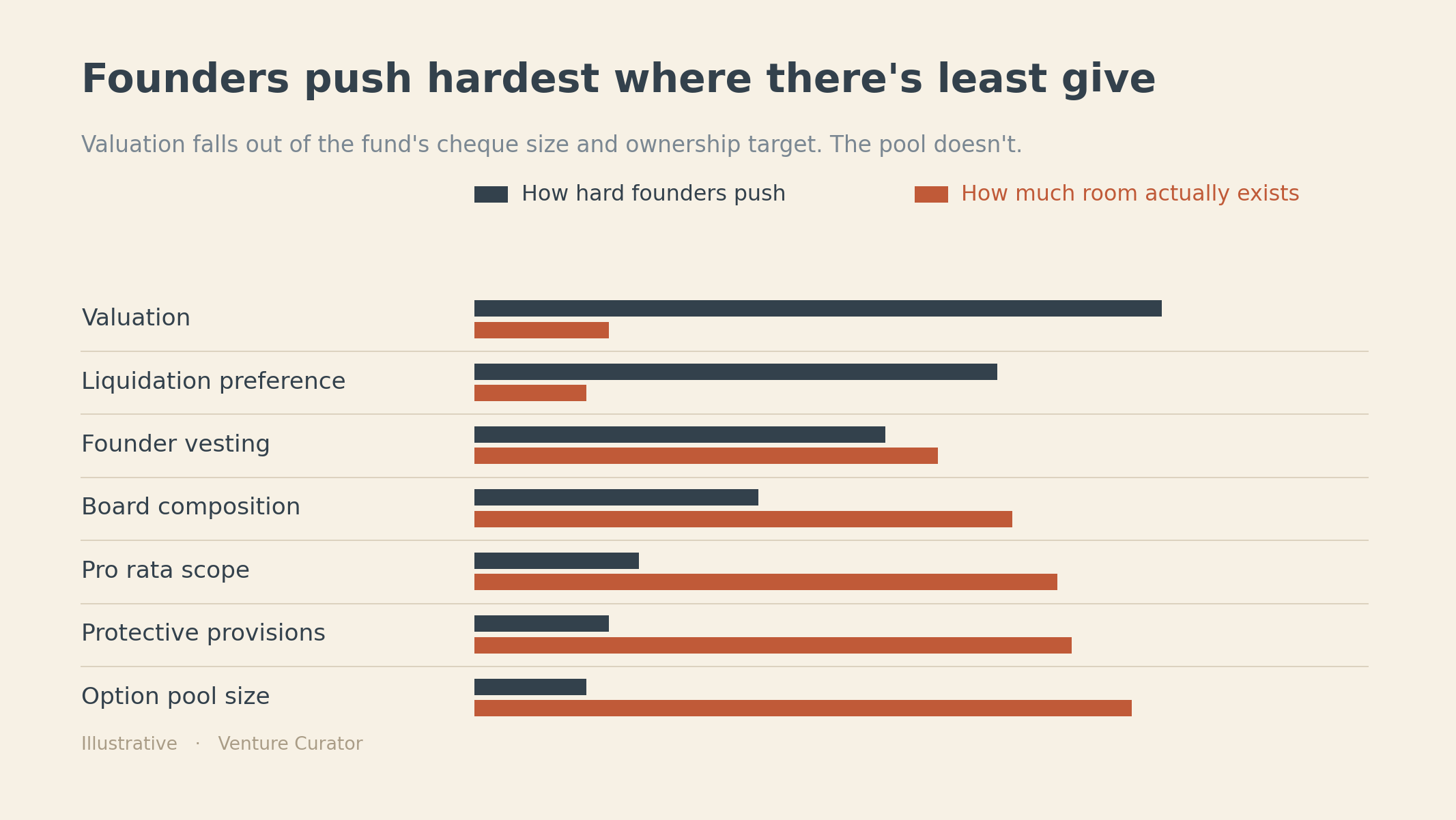
So the same pattern repeats. A founder pushes hardest on the term with the least give in it, spends two weeks and all their goodwill getting a small split, and signs the three that compound over the next four years.
You find out what that cost later. Usually the first time you need to make a decision and realise you need permission to make it.
What your investor is actually solving for
Ownership. Not price. And it binds harder than founders think - many funds carry an internal ownership target required to do a deal at all, anywhere from 5% to 20%+ depending on stage, because they’d rather own more of fewer companies.
Here’s the part that changes how you negotiate -
That number isn’t a preference your partner formed on the drive in. It’s a number they took into a room and got approved. They stood in front of their partnership and said: we’re doing this one, here’s the price, here’s our ownership, here’s the board. That approval is the only reason a term sheet exists.
So when you push on ownership, you’re not asking them to be flexible. You’re asking them to reopen a decision that was partly about them. Most won’t.
Which is exactly why everything else on the page has more give than it looks like.
So here’s the mistake, precisely
Your valuation falls out of the fund’s cheque size divided by their ownership target - arithmetic you don’t control and can’t argue with. (Full model in how seed valuations actually get set.)
The option pool, the protective provisions, the pro rata language are all genuinely open, all cost you real ownership or control, and all get signed as written because they read like paperwork.
You’re pushing on the one thing welded shut and waving through the three that aren’t.
What’s inside today’s deep dive
Which four terms are effectively fixed? And why pushing on them costs you more than it returns.
Which terms have real room? The tradeable middle, where the actual money is.
What’s in there just to be given back? The padding and how to spend it deliberately.
How do you trade instead of just asking? Six specific swaps that work, in the exact framing to use.
Which terms quietly cost more than valuation? Four of them, with the arithmetic.
What do you ask on the first call to find out which kind of investor you’re dealing with?
Plus the one-page negotiation map - every major term, which bucket it’s in, what to ask for, and what to trade it against.
Let’s get into it.