


👋 Hey, Sahil here - welcome back to Venture Curator, where we explore how top investors think, how real founders build, and the strategies shaping tomorrow’s companies.
Big idea + report of the week :
Are higher-valuation YC startups better bets? Here’s what the data shows.
Do VCs actually reward profitability?
Frameworks & insightful posts :
Why are so many SaaS companies struggling to grow, even after adding AI?
What really happens after you pitch a VC and leave the room?
Are you calculating ARR wrong if customers pay based on usage?
Get access to 150+ premium archive posts, 100+ startup & VC resources, investor databases, fundraising templates, and exclusive startup research - all in one place.
FROM OUR PARTNER - PAPERMARK
🔎 You have 77 seconds to convince an investor to keep reading
That’s one of the biggest findings from Papermark’s analysis of 24,541 pitch decks.

Half of investor deck views last less than 77 seconds, and the biggest audience drop happens between slides one and two.
Even more interesting: decks that put traction in the first three slides receive 20% more views, while 12-slide decks generate the most investor views and the highest share of return visits.
Papermark’s Fundraising Report breaks down what investors actually look at, where founders lose them, and how the decks that hold attention are structured.
Before you send your next pitch deck, see what the data says →
WORK WITH US
🤝 Partnership With Us
Get your product in front of an audience of 125,000+ - Our newsletter is read by thousands of tech professionals, founders, investors and managers worldwide. Get in touch today.
START WITH
🧠 Big idea + report of the week
Are higher-valuation YC startups better bets? Here’s what the data shows.
Seed investors are usually taught one simple rule: get into great companies as early and cheaply as possible.
But new data from Rebel Fund suggests that, at least inside Y Combinator, paying a higher price can sometimes be a signal that you are looking at a stronger company.
Jared Heyman and Rebel Fund analysed 642 YC startups from the 2021 to 2024 batches where they had Demo Day SAFE valuation-cap data. The relationship between price and near-term startup success was surprisingly strong.
Higher-priced YC startups were 3x more likely to reach Series A+: 25% of companies priced above their batch’s median valuation reached Series A or beyond, compared with just 8% of companies below the median.
They were also far less likely to fail: 16% of below-median companies had shut down, versus only 6% of companies priced above the median.
The relationship persists across valuation ranges: When Rebel plotted Demo Day SAFE caps against Series A+ graduation, the probability of reaching Series A increased consistently as valuation caps increased.
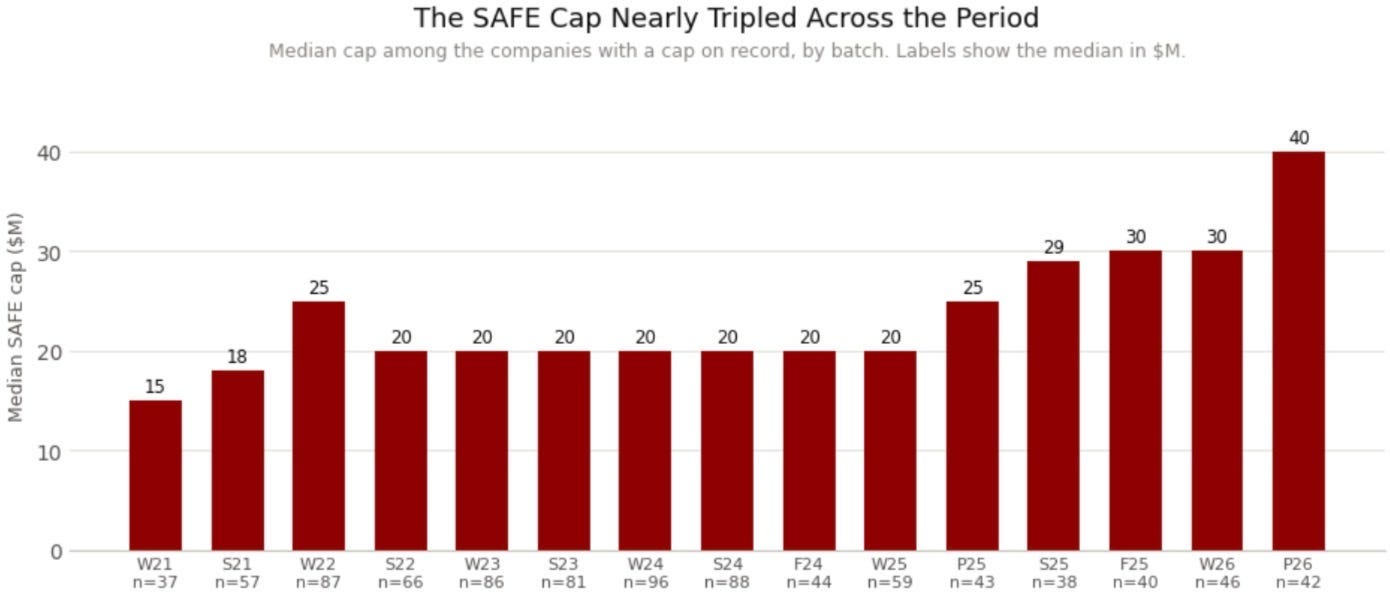
There is another important trend behind this. YC itself is getting much more expensive. Among companies Rebel interviewed, the median SAFE cap increased from roughly $15M in W21 to $40M by P26, nearly tripling in five years.
So why might expensive startups perform better?
The valuation itself probably isn’t causing better outcomes. Strong teams, traction, large markets and investor demand can push valuations higher. In other words, price may be capturing information that investors have already discovered about the company.
And this is where investors need to be careful.
Reaching Series A is not the same as generating a great venture return. A company bought at a $40M valuation that eventually exits for $200M could produce a worse return than a $10M company that reaches the same outcome. Rebel’s data shows that expensive YC startups have been safer, but it does not yet prove that they produce better long-term returns.
That creates an interesting tension for seed investors: a high valuation shouldn’t automatically be a reason to walk away, but neither should it be mistaken for quality.
The real opportunity is still finding the company where the fundamentals are significantly better than what its current price implies.
Do VCs actually reward profitability? Here’s what the data shows.
CFOs at VC-backed startups hear the same thing in almost every board meeting: get to profitability, tighten the burn, show discipline. It’s been the standard advice since the market reset of 2022.
But new data from Silicon Valley Bank’s H2 2026 State of the Markets report suggests that advice and what actually gets funded are two very different things.
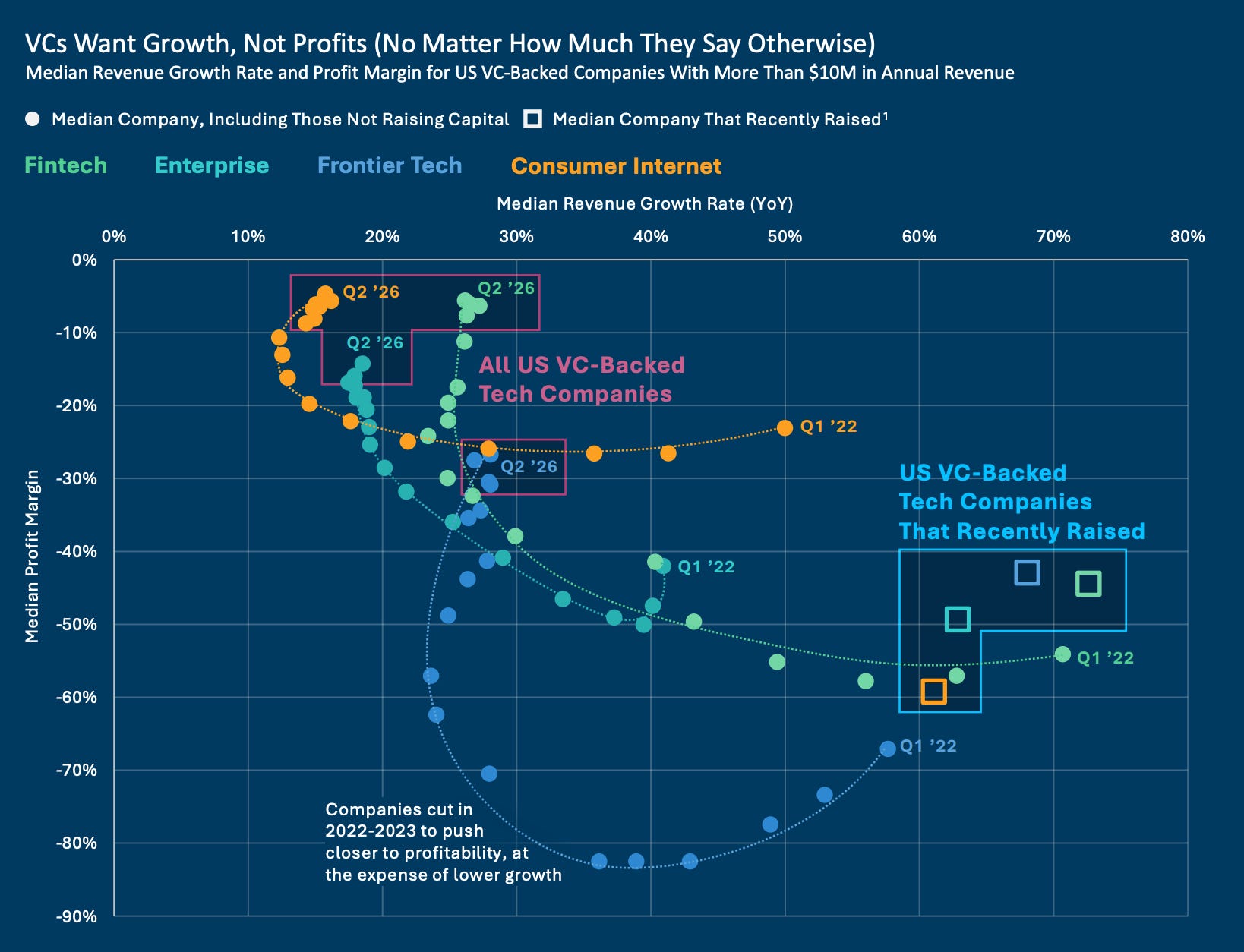
SVB tracked median revenue growth and profit margin for VC-backed tech companies doing more than $10M in annual revenue, split by sector, from Q1 2022 through Q2 2026- comparing the typical company in each sector against the subset that had just closed a new round.
Companies that recently raised capital look nothing like the median company in their own sector. They’re running meaningfully higher revenue growth and meaningfully deeper losses - the opposite of the “get efficient” advice most founders are hearing from their own boards.
Since Q1 2022, the broader population in every sector - fintech, enterprise, frontier tech, consumer internet - has moved steadily toward profitability, margins improving quarter after quarter as companies cut costs to extend runway.
But that same cost-cutting has pulled growth down with it. And growth, not margin, is what’s actually opening the door to a new check right now.
There’s a trap hiding in that gap.
The companies that followed the standard advice in 2022–2023 - cutting burn, tightening spend, pushing toward breakeven - are now the ones stuck.
They hit the target their board asked for, and it still isn’t enough to raise on.
Meanwhile, companies still burning hard but growing fast are the ones closing rounds.
So why are VCs funding exactly the opposite of what they say they want?
Profitability advice isn’t wrong for company health - it’s genuinely the safer path if capital dries up. But it isn’t what’s winning term sheets in 2026. Capital is chasing growth right now, especially anything that looks AI-native, and a clean set of margins doesn’t compensate for a soft growth line.
And this is where founders need to be careful.
Fixing your burn rate is still the right call if your goal is survival without a raise. It is not the same move as making yourself fundable. Those used to be the same advice. Right now, they aren’t.
The real risk isn’t running an inefficient business. It’s optimising for the metric your board keeps asking about while missing the one that actually decides whether you raise your next round.
Is your startup actually AI-Native? The valuation data says it matters.
SVB Bank analysed roughly 9,000 VC-backed companies that describe themselves using AI language and found something striking: 42% showed little evidence that AI was actually core to what they were building.
But the more interesting finding is what happened to their valuations.
Companies were grouped into Low, Medium and High AI relevance based on whether their descriptions contained signals of real technical AI development rather than generic phrases like “AI-powered.”
In 2026:
High AI relevance: 349% valuation premium versus the median US tech company
Medium relevance: 135% premium
Low relevance: 21% discount
That creates a 370-percentage-point gap between companies perceived as genuinely AI-native and those with weak AI relevance.
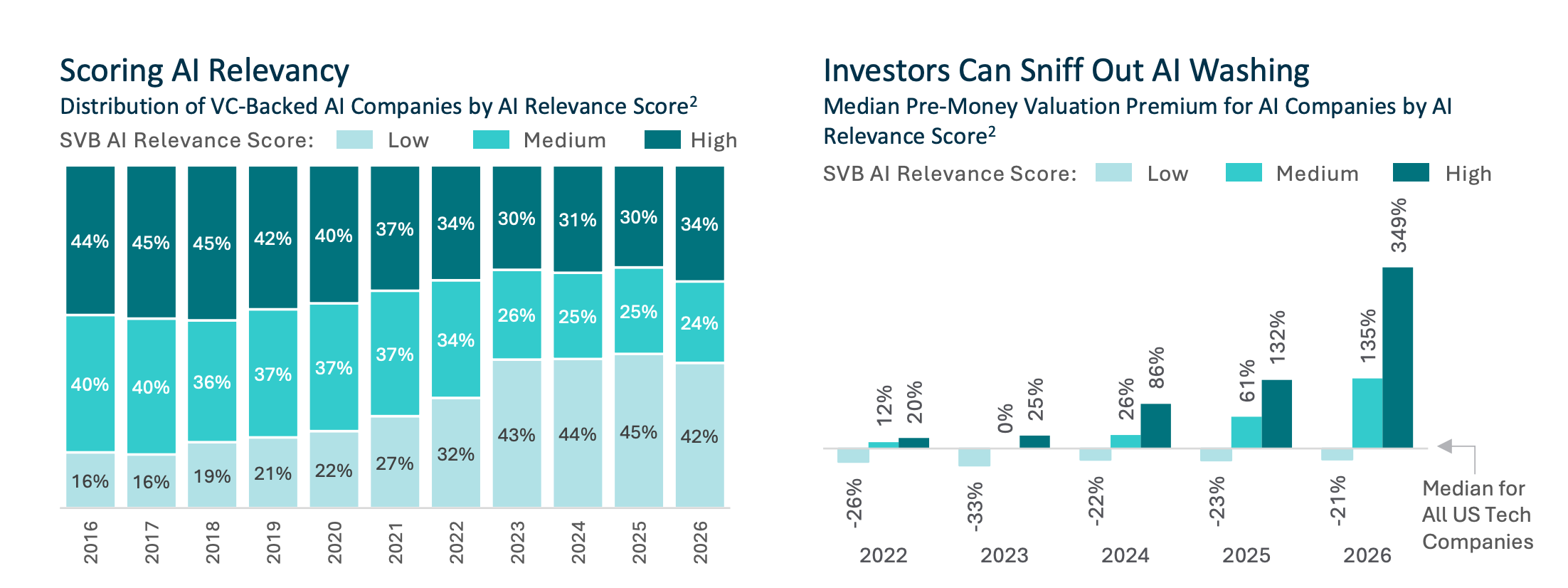
And that gap has exploded. In 2022, High-relevance companies traded at roughly a 20% premium while Low-relevance companies were at a 26% discount, a spread of only 46 percentage points.
Four years later, the spread is more than 8x larger.
There is another interesting shift happening underneath this.
In 2016, 44% of AI-labeled companies fell into the High-relevance category and only 16% were Low relevance. By 2026, High relevance had fallen to 34%, while Low relevance had grown to 42%.
In other words, more startups are calling themselves AI companies, while a smaller percentage appear to have AI at the core of what they actually build.
The important caveat is that this score isn’t measuring whether a startup is good or bad. An application company built on third-party models can still become an exceptional business.
What the data suggests is that investors are becoming much better at distinguishing between companies doing substantive AI work and companies simply adopting the language.
For founders, that makes positioning surprisingly important. Calling yourself “AI-native” or “AI-powered” isn’t necessarily helping if the rest of your company description can’t explain what makes the technology meaningfully different.
As the AI label becomes more common, specificity may be becoming more valuable than the label itself.
📄 Must Read Post


SOMETHING MORE
🧩 Frameworks & insightful posts
Why are so many SaaS companies struggling to grow, even after adding AI?
Almost every B2B software company now has AI features. Yet growth hasn’t suddenly come back.
That’s the uncomfortable part. You can ship copilots, agents, AI search, automation, and new pricing tiers, but if the rest of the company still operates like a 2022 SaaS business, AI alone probably won’t change the trajectory.
Recently, Jason Lemkin shared a useful breakdown of what this looks like across public B2B software companies, and the numbers are pretty revealing.
Out of 58 public B2B companies with available data:
18 are growing below 10%
23 are growing between 10% and 20%
11 are growing between 20% and 30%
Only 6 are growing above 30%
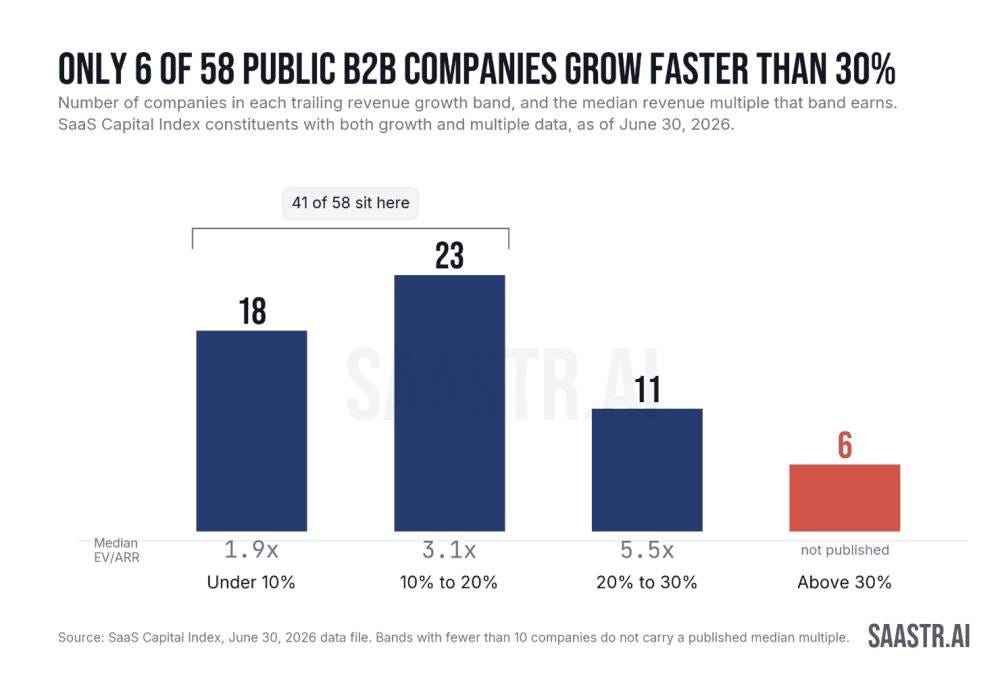
So 41 of 58 companies are growing below 20%.
And the valuation penalty is significant. Companies growing 20% to 30% trade around a median 5.5x revenue multiple. At 10% to 20%, that falls to 3.1x. Below 10%, it drops to roughly 1.9x.
The bigger thing is that adding AI features and rebuilding a company around AI are completely different things.
A real rebuild usually touches four areas:
Product: AI can’t just sit beside the old workflow. Eventually it needs to remove or fundamentally change parts of that workflow.
Pricing: If AI lets 25 employees do the work of 40 but you still charge per seat, your product may actually shrink its own billing base.
Data: Agents need clean context. Stale CRM records, duplicate data, missing fields, and undocumented processes become much bigger problems once AI starts acting on them.
GTM: Selling AI outcomes is different from selling software access. The buyer, pricing conversation, implementation process, and value proposition can all change.
Fin, formerly Intercom, is a useful example of how deep this can go.
The company started betting heavily on AI support around 2023. By 2026, it had built Fin into an agent approaching $100M ARR, with 30,000+ customers and roughly 76% of support volume reportedly resolved end to end. Eventually, the company even renamed itself around the AI product.
That wasn’t an AI feature launch.
It was roughly four years of rebuilding the product, pricing, positioning, and company around a different way of delivering value.
That’s probably why many established SaaS companies feel stuck somewhere in the middle right now. They’ve shipped AI, but they haven’t rebuilt everything around what AI changes.
The useful question for founders isn’t “Do we have AI?”
It’s: If we started this company today with AI available from day one, would we still build, price, sell, and operate it the same way?
If the answer is no, that gap is probably where the real work begins.
What really happens after you pitch a VC and leave the room?
A founder can walk out of a VC meeting feeling like everything went well. The partner liked the product, asked detailed questions, nodded at the traction numbers and ended with, “We’re excited to keep talking.”
Then nothing happens for a week.
What founders rarely see is that the fundraising process keeps moving without them. Within hours, someone at the fund may be writing an internal memo that compresses your company, team, traction, market and risks into a few pages.
That document can become more important than the pitch itself because many of the people ultimately voting on the investment were never in the original meeting.
We recently broke down what happens during those first 48 hours inside a venture firm, and the numbers explain why this stage matters so much.
A large study of 885 institutional VCs found that for every investment eventually made, a firm typically:
Looks at roughly 100 opportunities
Meets about 28 founding teams
Discusses around 10 at the partner level
Moves fewer than 5 into serious diligence
Negotiates roughly 1.7 term sheets
Invests in 1
So simply getting a meeting means very little. The bigger battle is getting someone inside the fund willing to take your company into the partner meeting and defend it.
And that is where the memo matters.
Most investment write-ups cover roughly the same things: the company and round, founding team, product and wedge, market, traction, risks, and deal terms. But the important part is that the memo is not a transcript of your pitch. It is someone else’s interpretation of it.
If you struggled to explain why your product is different, that can become “unclear wedge.”
If you dismissed a competitor too casually, that may become a risk.
If your ARR definition sounded questionable, the number may get discounted before the partnership ever sees it.
And if your founder-market fit was obvious to you but never clearly articulated, the person writing the memo now has to build that argument for you.
That leads to a useful fundraising principle:
Don’t just make your startup impressive. Make it easy for an investor to explain when you’re not in the room.
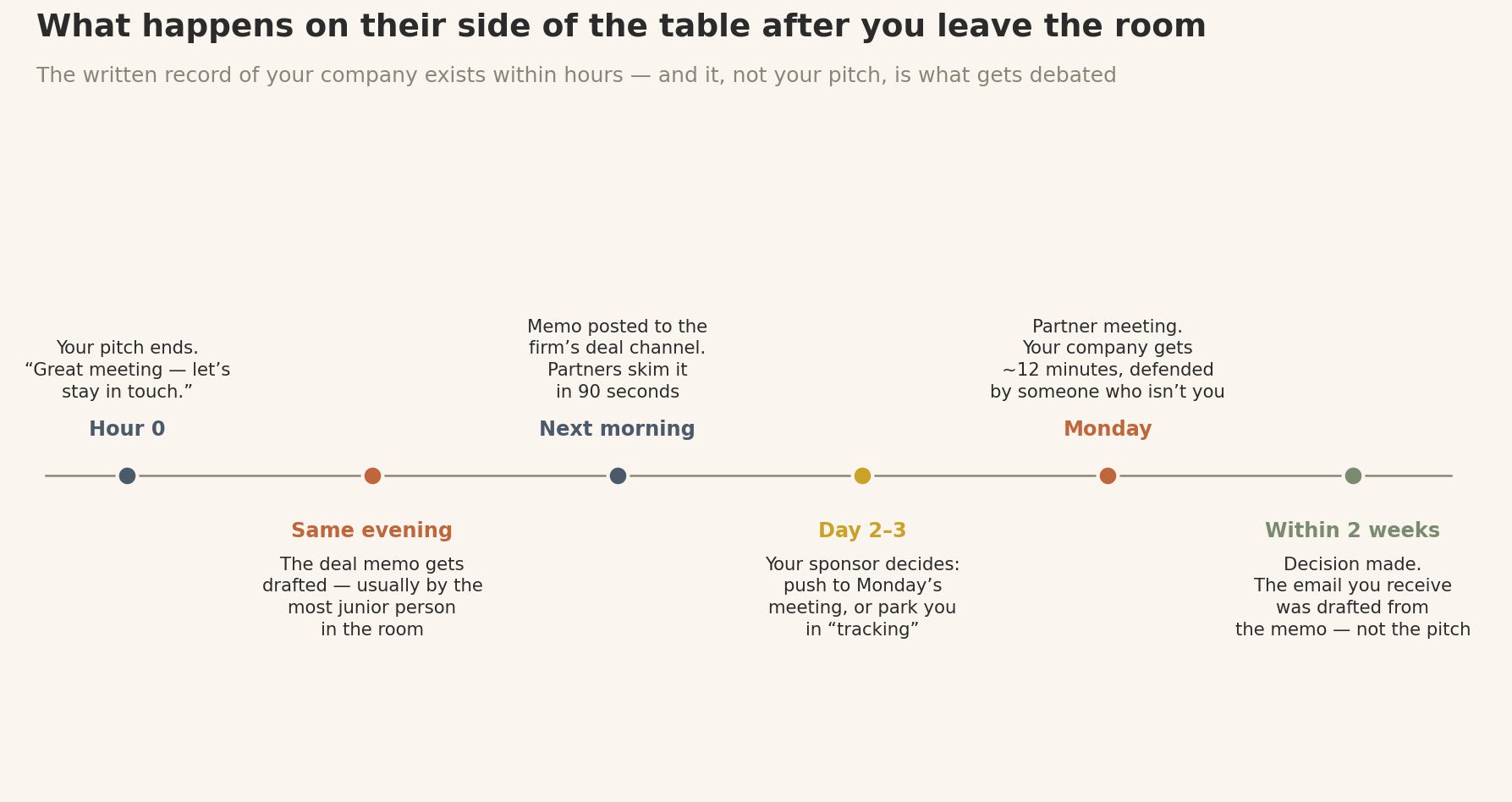
There are a few practical ways founders can do this.
Send a short post-meeting memo.
Within 24 hours, recap what the company does, why your team is unusually suited to build it, your wedge, precise traction, why now, and what you are raising. Not a generic thank-you email. Give them language they can actually reuse internally.
Give your champion answers to the obvious attacks.
Think about the three questions a skeptical partner is most likely to ask. “Why won’t OpenAI build this?” “Why is this market large enough?” “Why does this team win?” Send concise, evidence-backed answers before those questions get asked without you there.
Treat silence as information.
A progressing deal usually creates activity: more meetings, data requests, references, customer calls, diligence. Silence after a good meeting can simply mean nobody has decided to spend their internal credibility championing the deal.
One of the most useful reframes is that your pitch is raw material for the internal story investors tell about your company.
You may spend weeks preparing the deck, but the final investment decision can come down to a short discussion where someone else has ten minutes to explain why the company should exist, why you should win and why the risks are worth taking.
The better you make that story before leaving the room, the less gets lost when your pitch becomes someone else’s memo. (Read more here)
Are you calculating ARR wrong if customers pay based on usage?
A lot of AI startups still report ARR using the old SaaS formula: Current monthly revenue × 12 = ARR.
That worked reasonably well when customers paid the same subscription every month.
But AI software is increasingly usage-based. Customers pay for tokens, API calls, compute, overages, or actual consumption. And usage can move sharply from one month to another.
That makes the old formula surprisingly dangerous.
Recently, one breakdown showed why: if a customer has a large usage spike in November, multiplying that month by 12 can make the company look like it suddenly added hundreds of thousands of dollars in recurring revenue.
Then December arrives, usage returns to normal, and ARR appears to collapse. Nothing meaningful happened to the underlying business. The metric created both the growth and the slowdown.
A simple example:
40 customers each guarantee $2,000/month = $80K committed monthly revenue
Normal additional usage adds around $24K/month
One customer suddenly runs a large project and creates an extra $11.5K in one month
That month might produce roughly $113.5K in revenue. Annualise it directly, and you get about $1.36M ARR.
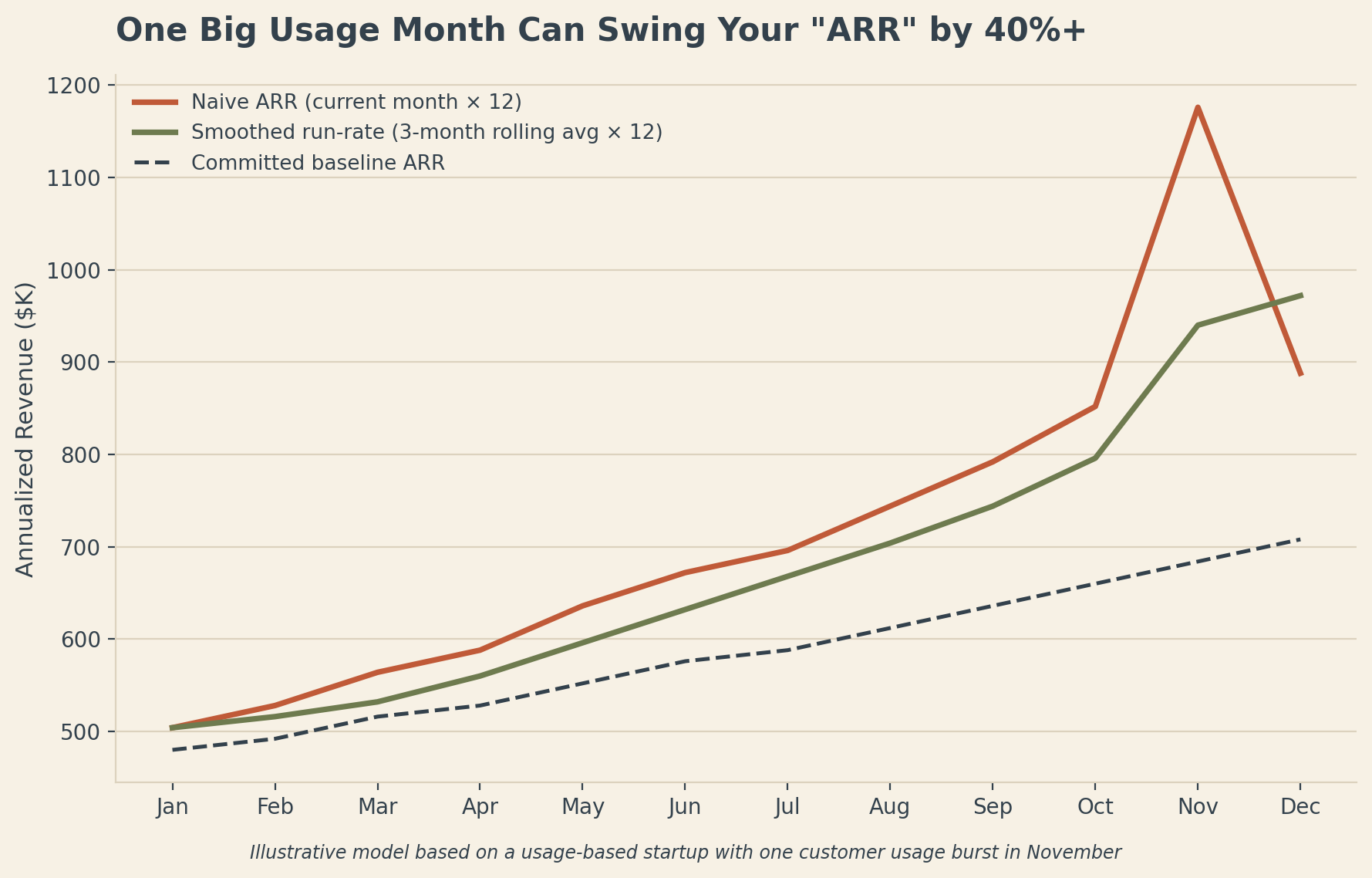
But the more useful view is:
$960K committed ARR
Around $288K annualised variable revenue based on a recent average
Roughly $1.25M sustainable run-rate
The difference comes from treating one unusual month as if it will repeat twelve times.
That matters beyond fundraising. Founders use ARR to make hiring decisions, calculate runway, judge burn efficiency, and set growth targets. An inflated number can quietly convince you that the company can afford spending it actually cannot.
The better approach is to separate revenue into two buckets:
Committed ARR
Revenue customers are contractually required to pay, regardless of usage.
Think subscription fees, minimum commitments, or contracted floors.
Variable usage run-rate
Everything driven by actual consumption.
Instead of annualising the latest month, use a rolling average, such as the previous three months, to smooth unusual spikes.
So rather than saying:
“We’re at $1.36M ARR.”
You can say:
“We have $960K in committed ARR plus roughly $288K in annualized usage revenue based on the trailing three-month average.”
That gives investors, boards, and founders a much clearer picture of what is actually recurring. There’s another useful insight here: usage revenue often becomes more predictable as the customer base grows.
One customer may spike in November while another slows down. Across enough customers, those movements can partially cancel each other out. So volatility is often most painful when the customer base is still small or concentrated.
A simple reporting rule for usage-based startups:
Start with contracted minimum revenue
Separate all usage above that minimum
Average variable usage across several months
Report committed and variable revenue separately
Don’t change hiring or spending plans because of one unusually strong usage month
And if you’re fundraising, go one step further: show whether usage from previous customer cohorts is still there months later.
For usage-based AI companies, investors increasingly care less about one impressive annualised number and more about whether the consumption behind it is durable.
So -
MRR × 12 tells you how big this month would be if it repeated perfectly. It does not automatically tell you how much recurring revenue your business actually has.
For traditional SaaS, those numbers can be close. For usage-heavy AI companies, they can be very different.
You can access the Excel sheet here.
📬 Upgrade to Venture Curator Premium
Get access to 150+ premium archive posts, 100+ startup & VC resources, investor databases, fundraising templates, and exclusive startup research - all in one place.
TODAY’S JOB OPPORTUNITIES
💼 Venture capital & startup jobs
Investment Operations Associate - Sand Capital | USA - Apply Here
Associate, Healthcare - B Capital Group | USA - Apply Here
Portfolio Reporting Team Lead - Cerity Partner | USA - Apply Here
Associate - Mount Judi Venture | USA - Apply Here
Technical Investment Operations Associate - Alpaca VC | USA - Apply Here
VC Research Lead - Murph Capital | Remote - Apply Here
Trade Operations Analyst - RA Capital | USA - Apply Here
Portfolio Management Associate - Cerity Partner | USA - Apply Here
Partner 36, Corporate Controller - a16z | USA - Apply Here
Investment Associate - Cerity Partner | USA - Apply Here
Head of Finance - Hivemind Capital Partner | USA - Apply Here
Senior Associate, Talent Sourcing - Redesign Health | India - Apply Here
Vice President, Investor Relations - Red Cell Partner | USA - Apply Here
Senior Associate - BVP | USA - Apply Here
Associate / Principal, Follow-on Investing - Village Global | USA - Apply Here
Senior Associate - Yamaha Motor Venture | USA - Apply Here
Associate / Principal - Village Global | USA - Apply Here
Tips to Break Into VC
What should your CV look like for a VC job?
Most VC applicants are not rejected because they lack experience. Their CV simply fails to show the three things funds actually look for: sourcing, judgment, and hustle.
This deep dive breaks down how to structure a VC CV, rewrite your experience for investing roles, build proof-of-work, and fix your LinkedIn profile. It also includes before-and-after examples, a 20-point screening checklist, and practical guidance for consultants, bankers, students, operators, and engineers.
Partnership With Us
Get your product in front of an audience of 125,000+ - Our newsletter is read by thousands of tech professionals, founders, investors and managers worldwide. Get in touch today.
Upgrade to Venture Curator Premium
Get access to 150+ premium archive posts, 100+ startup & VC resources, investor databases, fundraising templates, and exclusive startup research - all in one place.
(Subscribe to Venture Curator Premium and get 20% off forever.)