


👋 Hey, Sahil here - welcome back to Venture Curator, where we explore how top investors think, how real founders build, and the strategies shaping tomorrow’s companies.
Big idea + report of the week :
AI Hiring Paradox: What does Ramp’s study of 21,000 companies reveal about AI and hiring?
Why are even great startups struggling to raise Series A?
Why most Private Equity firms still aren’t seeing returns from AI?
Frameworks & insightful posts :
How to kill churn: A playbook from a founder who built a $50M SaaS business.
Could an AI crash actually create the next golden age?
Get access to 150+ premium archive posts, 100+ startup & VC resources, investor databases, fundraising templates, and exclusive startup research - all in one place.
FROM OUR PARTNER - ATTIO
What do Granola, Modal, and Wispr Flow all have in common? They all use Attio, the agentic CRM…

It meets you where you work, compounds every customer signal into context, then acts on it across your pipeline to let you move at unmatched speed and scale.
With agents and automations that build pipeline, chase signals, and move deals forward, Attio orchestrates your revenue work around the clock.
Loved by some of the world’s most successful startups, Attio amplifies what you can achieve and scales with your success.
WORK WITH US
🤝 Partnership With Us
Get your product in front of over 125,000+ audience - Our newsletter is read by thousands of tech professionals, founders, investors and managers worldwide. Get in touch today.
START WITH
🧠 Big idea + report of the week
AI Hiring Paradox: What does Ramp's study of 21,000 companies reveal about AI and hiring?
One of the biggest fears around AI is that companies will use it to replace workers.
A new study suggests the opposite may be happening -at least for companies that are adopting AI most aggressively.
Researchers from Ramp and Revelio Labs analysed AI spending and workforce data across 21,000+ U.S. businesses to understand what actually happens after companies roll out AI.
Their conclusion: companies that invest heavily in AI don’t shrink - they grow.
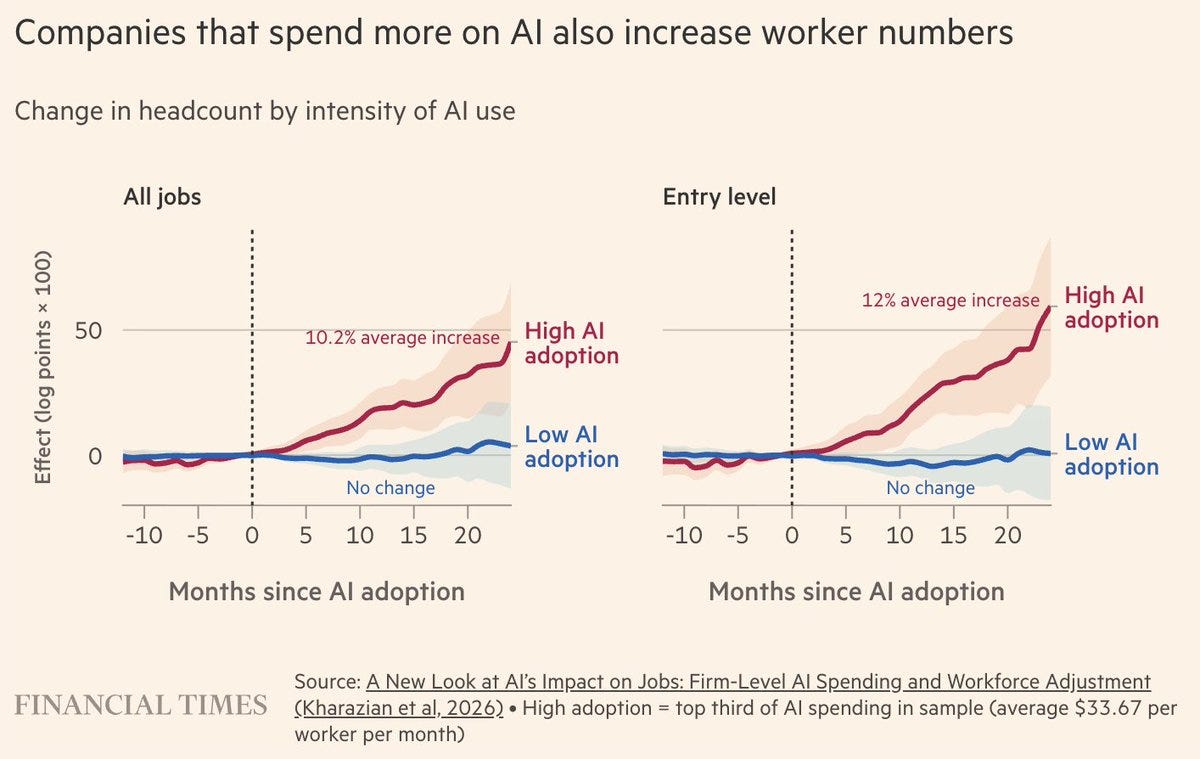
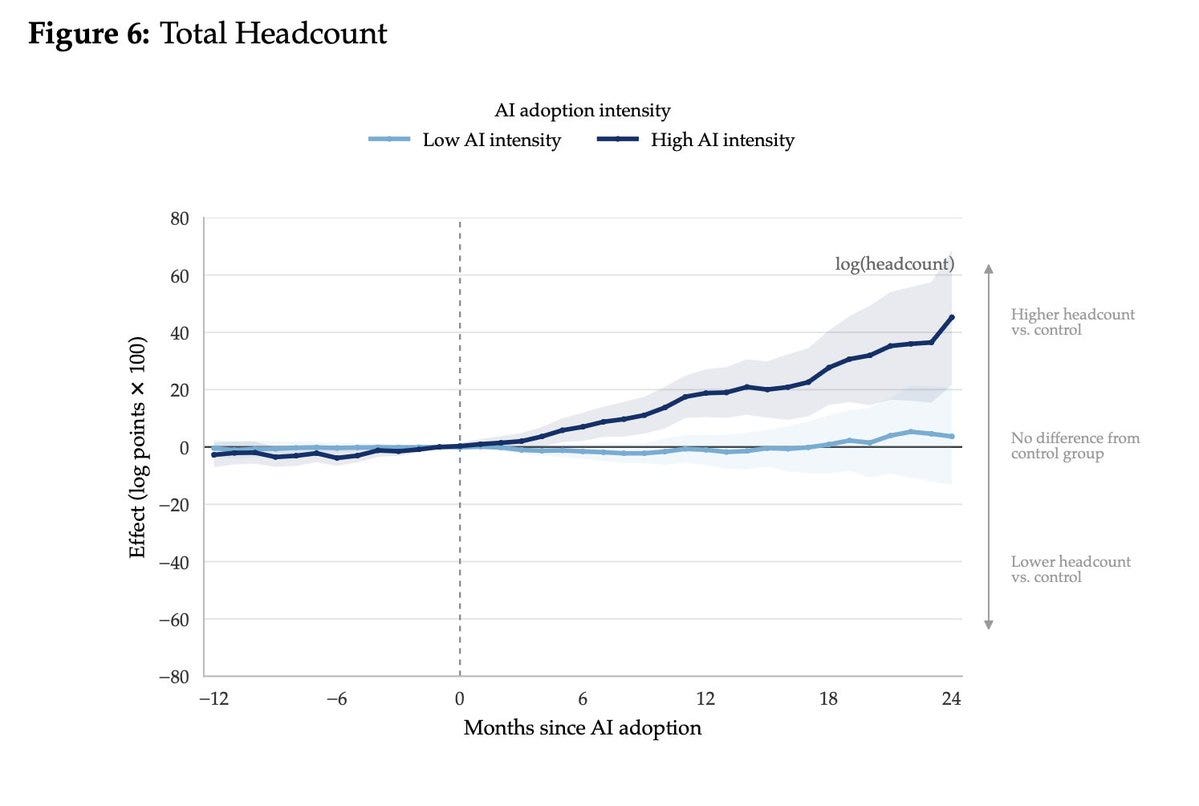
Companies with the highest AI adoption increased total headcount by 10.2% over two years, while low AI adopters saw no statistically significant change in hiring.
Entry-level hiring grew even faster. High AI adopters expanded entry-level headcount by 12% over two years, suggesting firms are recruiting new graduates who already know how to work with AI rather than eliminating junior roles.
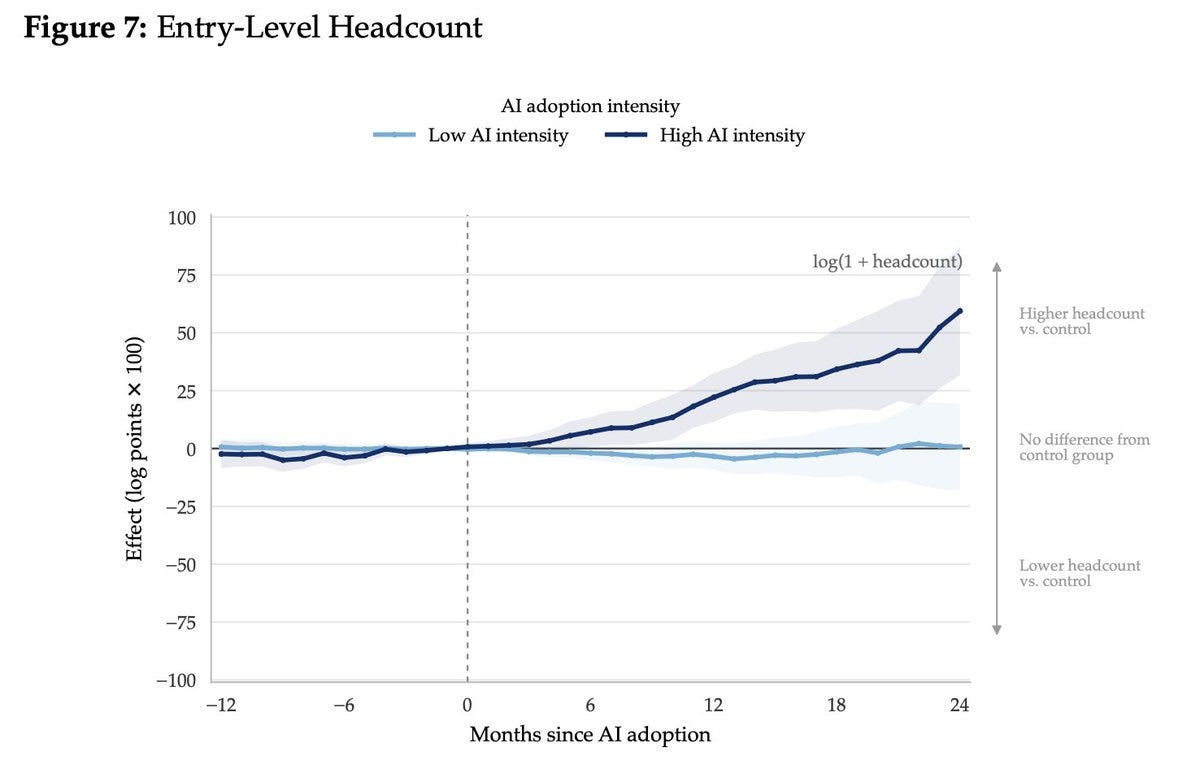
The hiring effect wasn’t immediate. Most companies saw little change during the first 6-12 months, with workforce growth accelerating only after employees had time to integrate AI into daily workflows.
The researchers were careful to account for an important criticism: fast-growing companies naturally adopt new technology earlier.
Instead of comparing AI companies with everyone else, they matched early adopters against businesses following nearly identical growth paths that simply hadn’t adopted AI yet. Even after controlling for those differences, the hiring advantage remained.
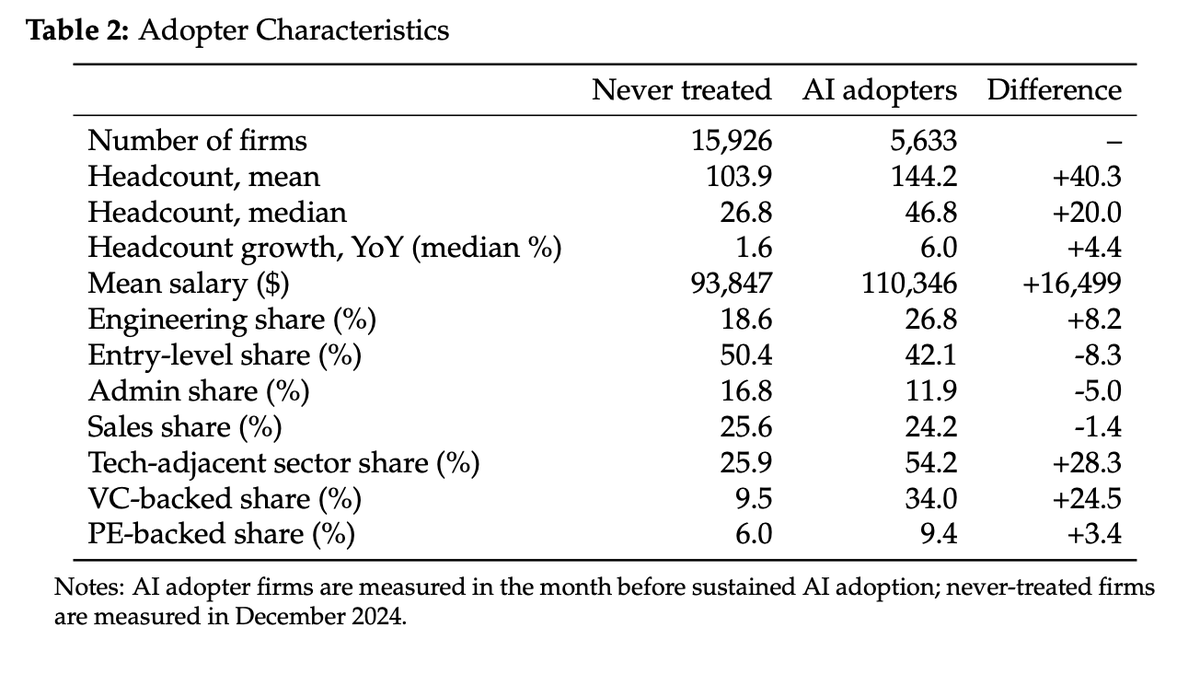
The study also found AI adoption spreads through networks.
VC-backed companies and firms connected to strong technology ecosystems were far more likely to adopt AI than peers in similar industries. Interestingly, small businesses adopted AI less frequently, but when they did, they spent more per employee than larger companies - suggesting AI can unlock capabilities that smaller teams previously couldn’t afford.
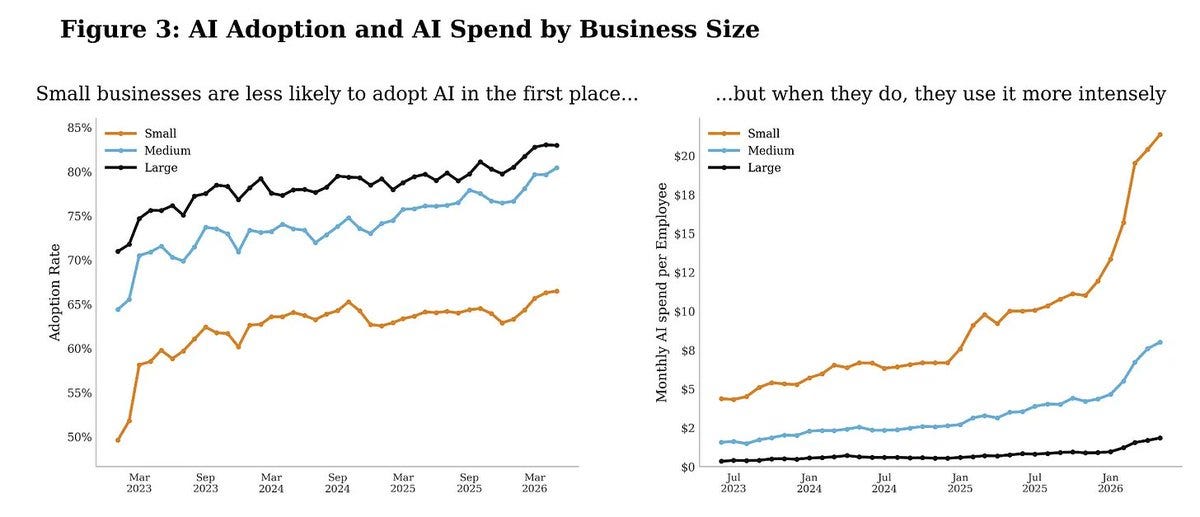
Rather than replacing workers outright, the evidence points toward a different pattern: companies using AI effectively become more productive, expand faster, and then hire more people to pursue opportunities that weren’t previously possible.
Why are even great startups struggling to raise Series A?
Raising a seed round used to feel like the hardest part of building a startup. Today, many founders are discovering that Series A has become the real filter.
Even companies with millions in revenue and healthy growth are struggling to raise, while investor attention remains concentrated on AI, defence, robotics and a handful of other hot sectors.
Recent data from Carta, combined with observations from FPV Ventures partner Nikunj Kothari, shows just how much the market has changed.
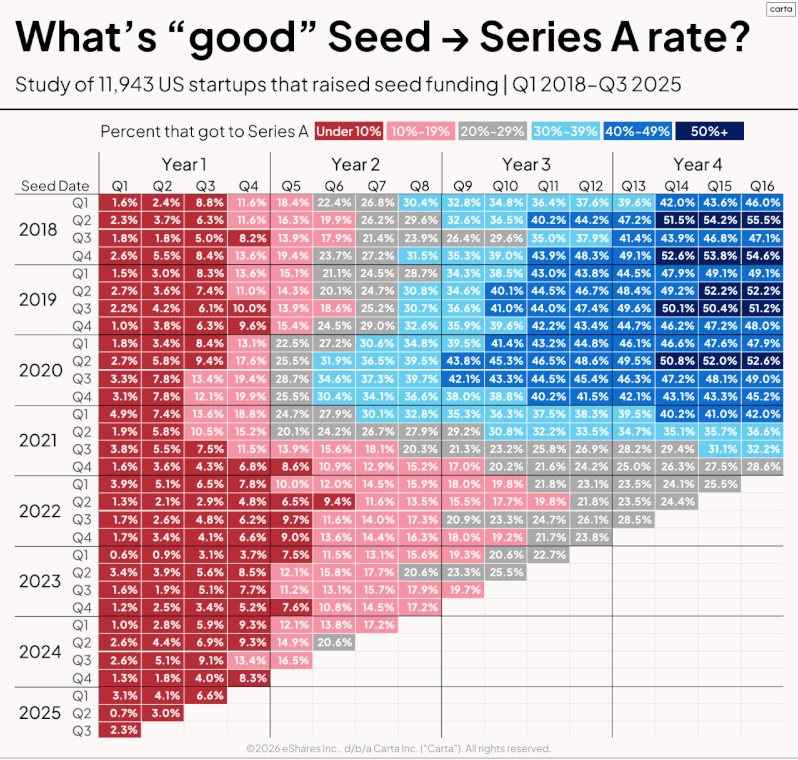
The odds of reaching Series A have fallen sharply. Among the strongest seed cohorts, roughly 30-35% of startups reached Series A within three years. Newer cohorts are tracking below 20%, making graduation from seed increasingly difficult.
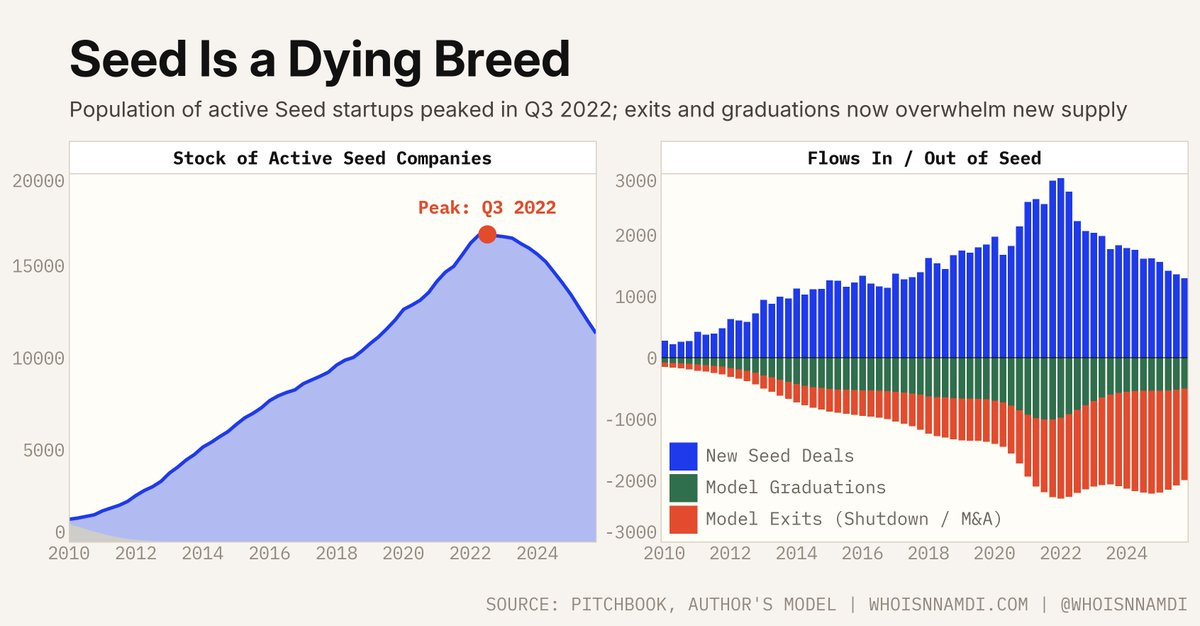
The seed ecosystem itself is shrinking. The number of active seed-stage startups peaked in Q3 2022 and has steadily declined as acquisitions, shutdowns and Series A graduations now outpace the creation of new seed companies.
Strong businesses are still getting funded - but on tougher terms. Founders building outside today’s hottest categories are often raising flat rounds or modest step-ups, even with a few million dollars in ARR. In today’s market, securing a quality Series A investor may matter far more than maximising valuation.
Many founders compare themselves to AI startups raising at massive valuations with little revenue. But those deals represent a small part of the market. Most venture-backed companies are operating in a much tougher fundraising environment where investors are becoming increasingly selective.
The reality is that Series A is no longer just a milestone - it’s becoming the biggest bottleneck in venture. Founders who survive this stage are doing so by building durable businesses, demonstrating clear traction and optimising for long-term company building rather than headline valuations.
Why most Private Equity firms still aren't seeing returns from AI?
AI has quickly become one of private equity’s biggest priorities, with firms encouraging portfolio companies to adopt it in the hope of improving efficiency, accelerating growth and ultimately increasing exit valuations.
But according to a new PitchBook report, most PE firms are still in the experimentation phase. While AI adoption is widespread, very few firms can point to meaningful financial results.
The biggest obstacle isn’t the technology - it’s implementation.
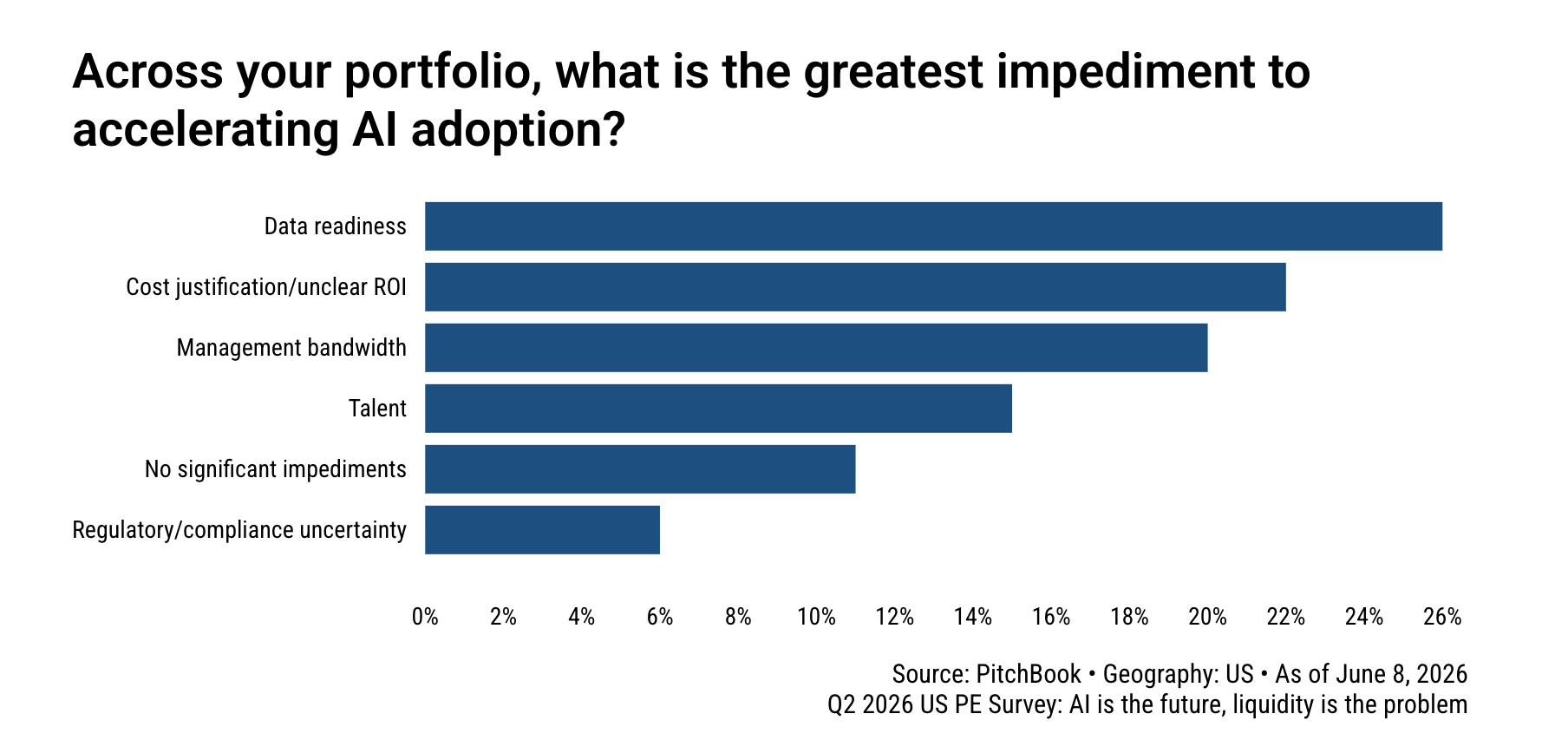
Data readiness was cited as the largest barrier to AI adoption across portfolio companies, followed by unclear ROI, limited management bandwidth and talent shortages. Regulatory concerns ranked much lower, suggesting execution is a much bigger challenge than compliance.
Most AI projects are saving time, not creating revenue.
Today’s most common use cases include financial planning, reporting, contract management and other back-office workflows. These improve productivity, but only 8% of firms say AI is already making a material impact on EBITDA or strengthening their exit story.
The biggest opportunity lies in revenue generation.
Bain Capital shared examples of using AI inside industrial and aerospace businesses to automate order processing, improve pricing decisions and respond to customers faster. Rather than simply reducing costs, these applications are designed to win more customers, grow revenue and expand margins over time.
The next phase of AI adoption won’t be defined by who uses the most AI tools, but by who integrates AI into core business operations in ways that directly improve financial performance. For most private equity firms, that transformation is still underway.
FEATURED POSTS
📄 Must Read Post
How to automate your startup fundraising with Claude (And avoid this autopilot trap).

👋 Hey, Sahil here - welcome to this edition of Venture Curator, where we break down how great startups grow, how top investors think, and what’s shaping the future of tech.
Why are even great startups still struggling to raise capital despite record venture funding?

👋 Hey, Sahil here - welcome to this edition of Venture Curator, where we break down how great startups grow, how top investors think, and what’s shaping the future of tech.
SOMETHING MORE
🧩 Frameworks & insightful posts
How to kill churn: A playbook from a founder who built a $50M SaaS business.
Every founder obsesses over growth. More traffic. More signups. More revenue.
But after scaling VEED to $50M in annual revenue, founder Sabba Keynejad says the metric that matters most isn’t acquisition - it’s churn. If customers leave as fast as they arrive, growth becomes a treadmill that’s almost impossible to sustain.
After spending nearly a decade studying churn across consumer apps, SMB software, enterprise products, and APIs, he shared the framework that changed how he thinks about building software businesses.
Your market matters more than your product
One of the biggest misconceptions is that churn is mainly a product problem.
In reality, it’s often a market problem.
A product people use every working day naturally becomes sticky. A product someone opens once to create a birthday invitation probably won’t.
That’s why different categories have completely different expectations:
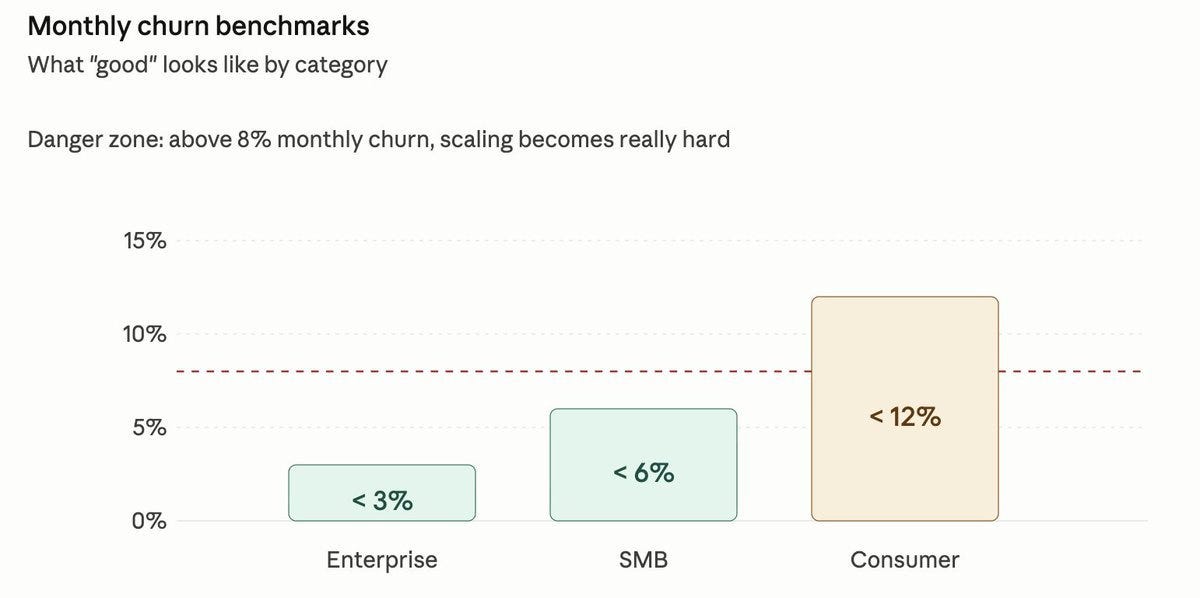
Enterprise SaaS: under 3% monthly churn is considered healthy.
SMB SaaS: under 6% monthly churn is a strong benchmark.
Consumer products: under 12% monthly churn is often acceptable.
He also shared one number every founder should remember:
Once monthly churn moves above roughly 8%, scaling becomes dramatically harder.
The math compounds quickly. A business losing 10% of customers every month replaces roughly 70% of its customer base every year, meaning growth increasingly becomes about replacing lost users instead of creating new value.
Your average churn rate hides your biggest problem
A single churn number rarely tells the full story. Imagine your company reports 10% monthly churn.
That sounds useful - but what if one customer segment churns at 5%, while another churns at 20%?
The average hides where the real problem lives.
Instead of trying to reduce churn across the board, he recommends identifying the customers who naturally stick around the longest.
Ask questions during onboarding:
What role do they have?
What company size are they from?
What are they trying to accomplish?
Then compare those answers against long-term retention.
The goal becomes surprisingly simple:
Find your stickiest users. Build for them.
Acquire more people like them.
He shared that he personally onboarded customers until VEED reached $6M ARR, speaking with 10-15 users every day instead of relying entirely on dashboards. Those conversations revealed which customers became long-term users and which were never likely to stay.
Activation is usually a bigger churn lever than retention
Many founders spend months trying to reduce churn when the real issue happened much earlier.
Users never experienced the product’s value.
Every product has an “aha moment” - the point where someone understands why they’ll keep using it.
Anything that delays that moment increases churn:
Asking for credit card details too early.
Complicated onboarding.
Long surveys.
Confusing interfaces.
The faster users reach value, the more likely they are to stay.
Cursor is a great example. Instead of aggressively selling upfront, it lets users build real value first. By the time usage limits appear, many users already depend on the product enough to upgrade naturally.
The 3 hidden levers you aren’t using.
While your market largely determines your long-term churn ceiling, there are several practical ways to improve it.
Some of the highest-leverage tactics include:
Annual plans, which reduce churn mechanically while improving cash flow.
Exit flows that offer pauses or temporary discounts instead of immediate cancellations.
Recovering failed payments through smart retries and dunning emails, since expired cards alone account for around 2% of churn in many SaaS businesses.
Individually, these changes may seem small, but together they can reduce churn by 10–30%.
The best SaaS companies eventually achieve negative churn
The ultimate goal isn’t simply retaining customers. It’s negative churn.
That’s when existing customers expand faster than the business loses customers through cancellations.
Companies like Figma achieve this because teams naturally invite colleagues, purchase additional seats, and adopt adjacent products over time.
If new revenue from existing customers consistently exceeds lost revenue, the business continues growing even before acquiring a single new customer.
That’s why he ranks SaaS businesses in three broad categories:
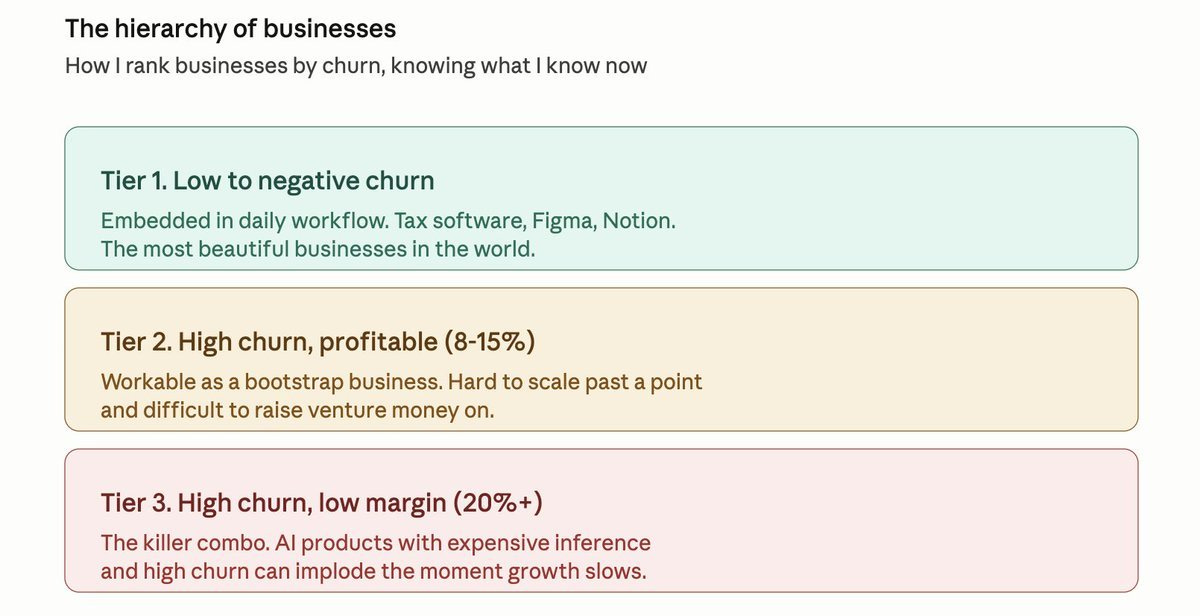
Tier 1: Low or negative churn businesses embedded into customers’ daily workflows. These are the strongest companies to build.
Tier 2: High-churn but profitable businesses that can still become excellent bootstrapped companies, though scaling becomes harder.
Tier 3: High churn combined with low margins - the most dangerous combination, especially for AI businesses with expensive inference costs.
The takeaway isn’t that churn should be eliminated. It can’t.
It’s that the strongest software companies don’t win by constantly fixing churn 0 they win by building products people naturally return to every single day. That’s a much stronger competitive advantage than any pricing experiment or cancellation flow.
Could an AI crash actually create the next golden age?
Everyone is talking about the AI bubble.
Model valuations are soaring. Data centre spending is exploding. Capital is flowing into AI faster than almost any technology in history. Most people assume the goal is to avoid a crash at all costs.
But venture capitalist Vijay Pande argues the opposite:
a crash may be exactly what AI needs.
His argument isn’t that recessions are good. It’s that every major technological revolution - from railways to the internet - followed the same pattern: innovation, speculation, a financial bubble, a crash, and then decades of real economic value.
According to economic historian Carlota Perez, the bubble isn’t a detour. It’s often what finances the infrastructure that later powers an entire generation of businesses.
Why bubbles matter more than most people realise
History shows that while investors often lose money during bubbles, society usually keeps the infrastructure they paid for.
Railway speculation left Britain with an enormous rail network.
The dot-com crash wiped out billions in market value but left behind the fibre-optic infrastructure that powered the internet economy.
AI is following the same path today through massive investments in chips, data centres, energy infrastructure, and AI talent.
The companies funding this buildout may not all survive, but the infrastructure almost certainly will.
A crash isn’t the real danger
One of the strongest ideas is that a market crash and a depression are distinct.
A crash simply resets unrealistic valuations.
A depression happens only when governments, businesses, and institutions fail to rebuild afterward.
He explains it through a simple framework with four possible outcomes:
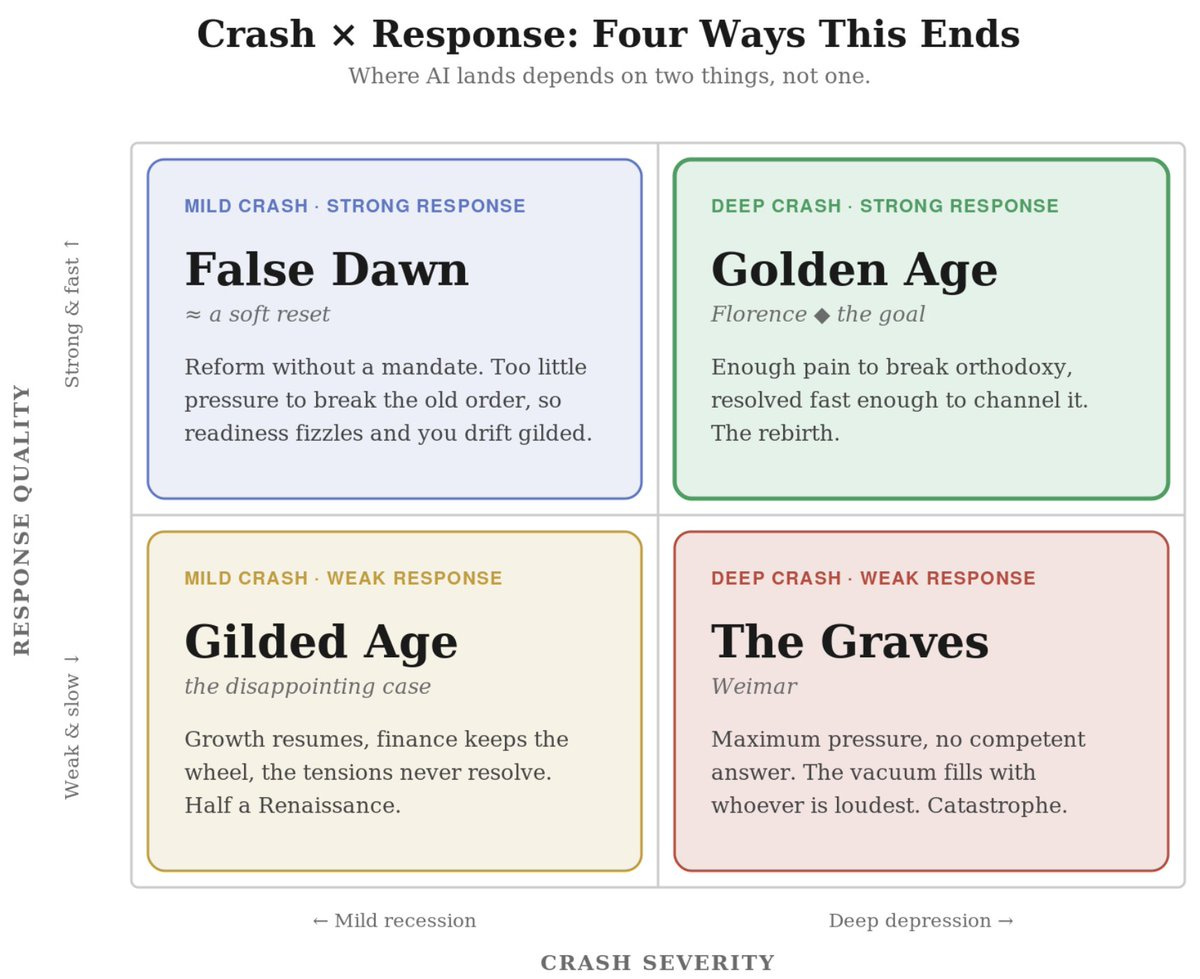
Mild crash + weak response → “Gilded Age.” Growth resumes, but the underlying problems remain unresolved.
Mild crash + strong response → “False Dawn.” Some reforms happen, but not enough pressure exists to create lasting change.
Deep crash + weak response → “The Graves.” Economic pain turns into political instability, extremism, and long-term damage.
Deep crash + strong response → “Golden Age.” Society uses the crisis to rebuild institutions, adopt new technologies, and unlock decades of growth.
The crash doesn’t determine the future. The response does.
Why AI could follow the same historical cycle
During a boom, easy money discourages difficult conversations. Questions like:
Who should own AI?
How open should models be?
How should governments regulate them?
Who benefits from productivity gains?
Often get ignored because markets are focused on growth.
A crash forces those conversations.
History shows many of the institutions that shaped decades of prosperity - financial regulations, deposit insurance, competition rules - were created only after major crises exposed the weaknesses of the previous system.
Don’t redistribute the profits. Spread the tools.
Perhaps the most original argument in the article is about AI ownership.
Instead of simply taxing successful AI companies after the fact, he believes society should focus on giving more people direct access to the productive tools themselves.
That means:
Open AI models.
Affordable compute.
Broad ownership.
Easy access for builders rather than concentrating power among a handful of companies.
So, owning the tools creates far more long-term prosperity than redistributing the profits they generate.
Why founders should pay attention
Most founders think about AI as a product opportunity.
Every major technology cycle eventually shifts from financial speculation to real productivity. The companies that survive aren’t necessarily the ones that raised the most money during the boom - they’re the ones that build enduring value once the hype disappears.
If AI follows the same historical pattern as railways, electricity, automobiles, and the internet, the biggest winners may emerge after the bubble bursts, not before.
The real question isn’t whether an AI correction happens.
It’s whether the infrastructure, institutions, and access we build today are strong enough to turn that correction into the foundation for the next economic renaissance rather than another lost decade.
📬 Upgrade to Venture Curator Premium
Get access to 150+ premium archive posts, 100+ startup & VC resources, investor databases, fundraising templates, and exclusive startup research - all in one place.
NEWS RECAP
🗞️ This week in startups & VC
New In VC
Harpoon Ventures, a San Diego, CA-based early-stage venture capital firm, closed Fund IV at $155m. (Link)
Tapestry VC, a London, UK-based venture capital firm, has launched an $80m Fund III. The $80M Fund III is co-anchored by a $40m commitment from new sovereign investor. (Link)
Ashton Kutcher, an actor and investor, is leaving Sound Ventures to launch a new early-stage venture firm with former NFX general partner Morgan Beller. (Link)
Vicus Ventures, a New York and San Francisco-based early-stage venture firm founded by brothers Raj Singh Sandhu and Sunny Singh Sandhu, closed its debut $55 million fund. (Link)
New Startup Deals
Dawnguard, an Amsterdam, Netherlands-based developer of an AI-native cloud security architecture platform, raised an additional $3.3M in Pre-Seed funding. (Link)
Appnigma AI, a San Francisco, CA-based developer of an AI-powered enterprise software integration platform, closed its Pre-Seed funding round. (Link)
Taxwire, a New York City-based AI-powered sales tax automation platform, raised $25M in combined Seed and Series A funding. (Link)
Arcturus, a Los Angeles, CA-based developer of carbon-infused advanced conductor materials, raised $8M in Seed funding. (Link)
Axon, a Dubai, UAE-based institutional financial orchestration platform, raised approximately $1M in funding. (Link)
8090 Labs, a Menlo Park, CA-based AI-enabled software manufacturing company, raised $135M in Series A funding. (Link)
TODAY’S JOB OPPORTUNITIES
💼 Venture capital & startup jobs
All-In-One VC Interview Preparation Guide: In partnership with a leading investor group, we have created an all-in-one guide for aspiring VCs. Don’t miss this. (Access Here)
Associate or Senior Associate - Bessemer Partner | USA - Apply Here
Associate - Primary VC | USA - Apply Here
VP — Finance & Compliance - Transition VC | India - Apply Here
Senior Associate - ICONIQUE CAPITAL | USA - Apply Here
Ventures Associate - Plug and Play Tech Centre | USA - Apply Here
Fund Operations Analyst - Indogen Capital | Indonesia - Apply Here
Investment Associate / Analyst - Flashpoint | UK - Apply Here
Venture Capital Analyst - MicroVentures | USA - Apply Here
Hard Tech Investment Associate - Upfront Venture | USA - Apply Here
Associate - Engine Venture | USA - Apply Here
Senior Venture Studio Analyst - Atlantic Health System | USA - Apply Here
Talent Investor - Associate - Entrepreneur First | India - Apply Here
Associate, Life Sciences - General Atlantics | USA - Apply Here
Venture Investment Manager - AMD | USA - Apply Here
Partner 16, Partner 18 - a16z | USA - Apply Here
Principal - 2150 VC | UK - Apply Here
Partnership With Us
Get your product in front of over 125,000+ audience - Our newsletter is read by thousands of tech professionals, founders, investors and managers worldwide. Get in touch today.
Upgrade to Venture Curator Premium
Get access to 150+ premium archive posts, 100+ startup & VC resources, investor databases, fundraising templates, and exclusive startup research - all in one place.
(Subscribe to Venture Curator Premium and get 20% off forever.)