

👋 Hey, Sahil here - welcome back to Venture Curator, where we explore how top investors think, how real founders build, and the strategies shaping tomorrow’s companies.
Big idea + report of the week :
Claude is already leading 26% of Anthropic’s AI R&D. What happens next?
The hidden test AI startups may face during acquisition diligence.
Is being a first-time founder becoming a structural disadvantage?
Frameworks & insightful posts :
Is the SaaS crash narrative wrong? Here’s what 72,000 companies show.
How do you build a seed deck that actually raises money?
What does a VC really look for in your financial model? (Template you can use).
Get access to 150+ premium archive posts, 100+ startup & VC resources, investor databases, fundraising templates, and exclusive startup research - all in one place.
FROM OUR PARTNER - MECO
The best new app for newsletter reading - Meco

Reading newsletters in your inbox is frustrating; it is noisy and easy to lose control of subscriptions.
Now with Meco, you can enjoy your newsletters in an app built for reading, while giving your inbox space to breathe.
Meco connects to Gmail & Outlook, allowing you to instantly move your newsletters to the app (and clear your inbox)
The experience is packed with features to supercharge your reading, including the ability to group newsletters, set smart filters, bookmark your favourites, and read in a scrollable feed
You can try the experience for free, and it's available on iOS, Android and web (desktop)
Over 30k readers are enjoying their newsletters (and decluttering their inbox) with Meco.
WORK WITH US
🤝 Partnership With Us
Get your product in front of an audience of 125,000+ - Our newsletter is read by thousands of tech professionals, founders, investors and managers worldwide. Get in touch today.
START WITH
🧠 Big idea + report of the week
Claude is already leading 26% of Anthropic’s AI R&D. What happens next?
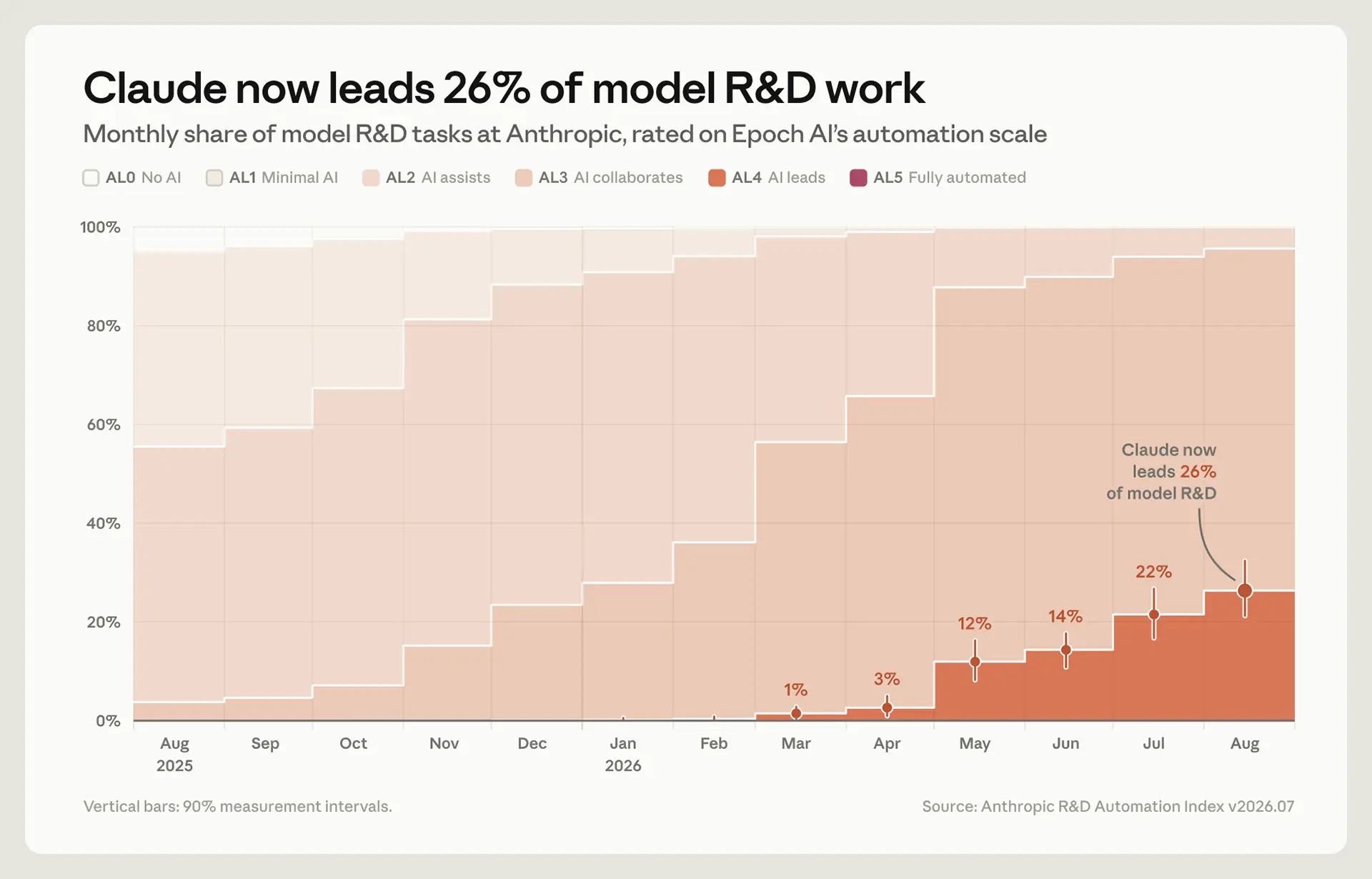
Anthropic published new internal measurements showing how deeply AI is now involved in its own model research and development. The most striking number is how quickly Claude has moved from assisting researchers to leading parts of the work.
Claude now “leads” 26% of Anthropic’s AI R&D: At this level, Claude can take a high-level instruction and complete most of a task end-to-end while a human supervises. Anthropic says this was below 1% in February 2026.
More than 90% of AI R&D involves Claude at a collaborative level or higher: This means AI can already perform substantial chunks of the work across most of Anthropic’s model-development process. However, Anthropic says Claude is not yet fully autonomous on any measured subset of R&D.
30,000 AI agents are working internally at any given time: On Anthropic’s most-used internal research and engineering platform, roughly 30,000 agents were operating simultaneously as of August 2026. Their actions are monitored, with 100% passing through an online monitor before execution.
Actual interventions are extremely rare: Anthropic analysed more than 1 billion agent decisions during August. Only 0.002%, roughly 1 in 47,000, were blocked by its real-time monitoring system. Its offline system escalates roughly 50 high-priority cases per week to humans.
Anthropic is also measuring how much compute goes toward safety: During one week in July, about 6% of compute used for AI R&D went specifically toward safety work. Among compute used for AI-driven AI R&D, the safety share was roughly 12%.
The important shift here is that AI development is no longer simply humans using AI as a coding assistant.
Anthropic is trying to measure something much more consequential: how much of the process of creating the next generation of AI is itself being handed over to AI.
Today, humans are still supervising. Anthropic defines the final stage, AL5, as the point where AI can identify work, execute it, test it and deploy it without needing a human involved.
They say they haven’t reached that point.
But going from under 1% of R&D being AI-led in February to 26% by August makes the direction of travel worth watching closely.
The hidden test AI startups may face during acquisition diligence.
Founders heading into acquisition talks are usually taught that diligence is a fairly mechanical process. Financials, contracts, code review, reference calls. The tense part is supposed to be the negotiation, not the diligence itself.
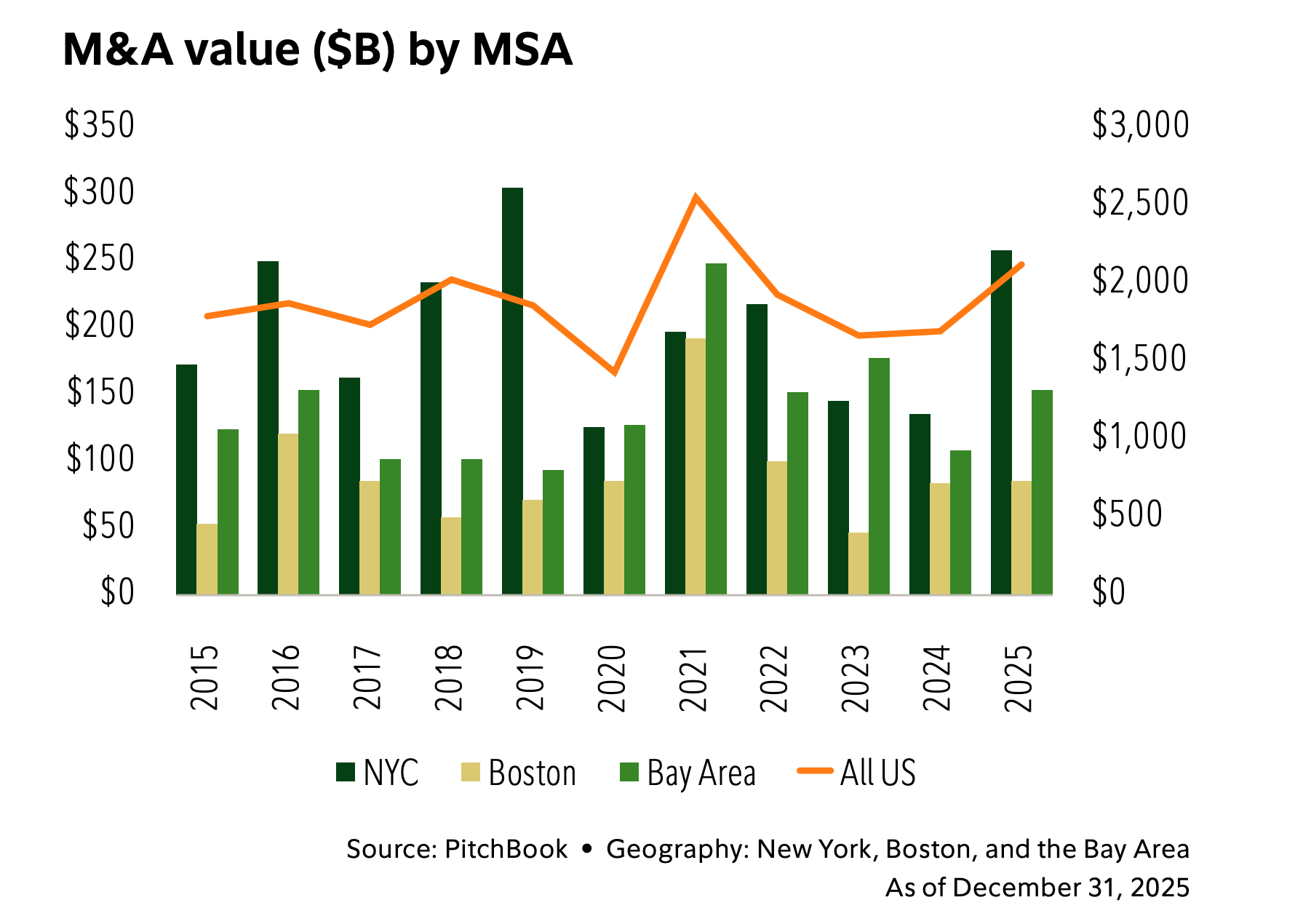
But a single line buried in Fidelity and PitchBook’s 2026 VC trends report points to a far more adversarial process running in parallel for some AI-native companies, one most founders have no idea is happening to them.
The finding shows up almost as an aside in the report’s outlook section, not as a headline stat: acquirers evaluating AI companies are increasingly paying outside consulting firms to attempt to rebuild the product they’re considering buying, in parallel with the deal itself.
The stated purpose is to pressure-test defensibility: checking whether what makes the startup valuable is a genuine, hard-to-replicate advantage, or something a well-resourced team could recreate in a matter of weeks.
This isn’t a hypothetical threat model. AI consulting work has become, in the report’s own words, “a meaningful revenue driver” for consulting firms specifically because enterprises are paying for exactly this kind of evaluation.
The company running this test is very often the same one sitting across the table in diligence meetings, asking friendly questions about your roadmap and architecture, while a separate internal or contracted team quietly tries to reproduce what you’ve built.
There’s a reason acquirers have started doing this now rather than a few years ago. AI bubble concerns are already reshaping how capital gets deployed across the market - the same report flags “spray and pray” AI investing as a real worry heading into 2026. Acquirers who’ve watched valuations detach from defensibility have gotten wary of paying a premium for a moat that turns out to be thin, so testing it directly has become a genuine diligence tool instead of a one-off paranoid move by a single buyer.
So why would a company go this far instead of just trusting what’s in the data room?
Because in AI specifically, the usual proof points of defensibility, retention, revenue growth, even patents, don’t reliably prove a product can’t be rebuilt. A team with resources, model access, and a few weeks can often approximate a young AI company’s core functionality. So acquirers have started testing that claim directly rather than taking the pitch deck’s moat story at face value.
And this is where founders need to be careful.
Being cloneable doesn’t automatically kill a deal. But it changes the terms of the conversation, and you can’t negotiate around a test you don’t know is happening. You may walk into a valuation discussion believing your technical moat is your strongest card, while the acquirer’s internal team has already run their own private experiment and reached a very different conclusion, one you never get the chance to counter because you never knew to ask.
The real risk isn’t that your product might be cloneable. It’s negotiating as if the acquirer only knows what’s in the data room, when they may already have their own answer to the exact question your valuation depends on.
Is being a first-time founder becoming a structural disadvantage?
The venture pitch has always come with a version of the same reassurance: great ideas win regardless of whether you’ve built a company before. Investors back the idea and the team in front of them, not just the résumé.
But new data from PitchBook’s Q3 2026 analyst note suggests the market’s actual behaviour tells a different story, and the gap between first-time and serial founders is getting wider, not smaller.
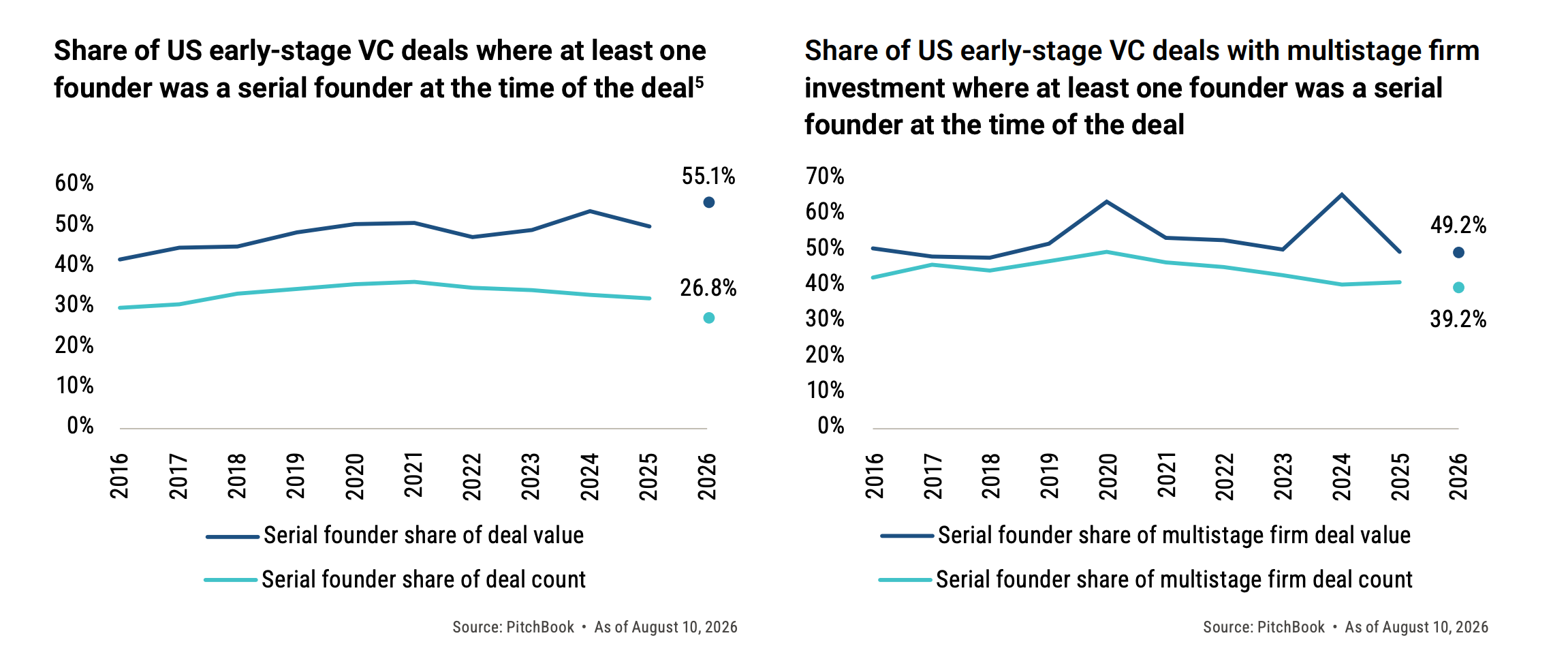
PitchBook tracked early-stage US VC deal value and deal count through August 2026, isolating how often at least one founder on a deal had already started a company before.
Serial founders make up a shrinking 26.8% of early-stage deal count this year, down five points year over year. But they’re capturing a growing 55.1% of total deal value - up more than five points over the same period.
The tilt is sharper inside the rounds led by the biggest checks. Among deals backed by multistage funds specifically, 39.2% involve at least one serial founder, well above the broader market’s 26.8%.
That gap between multistage-backed deals and the broader market has widened from 8.9 percentage points in 2025 to 12.4 points in 2026 — the largest gap in six years.
There’s a real explanation behind this, not just bias. PitchBook’s own read is that serial founders, particularly those with a prior exit, tend to show exactly the traits large funds lean on when there isn’t much operating history to judge a company by: proven execution, an existing network, and credibility that offsets some of the uncertainty baked into early-stage investing.
There’s also a selection effect running the other way - the strongest serial founders often run competitive processes and choose investors capable of leading their future rounds too, meaning some of this pattern reflects founders picking multistage capital as much as multistage funds picking them.
So is this the market getting smarter about risk, or a shortcut that’s becoming more entrenched?
Probably both, and the two are hard to fully separate. Serial founders genuinely carry lower-variance signal at a stage where there’s little else to evaluate. But when the mechanism reinforcing that signal is check size and fund economics as much as it is founder quality, the gap compounds independent of whether the specific first-time founder in the room is actually the stronger bet.
And this is where first-time founders need to be careful.
None of this means you can’t raise. The traditional path - smaller funds, iterative fundraising, building traction round by round - remains genuinely viable, and PitchBook’s own data confirms it. What’s changed is that the ceiling looks different depending on which side of this line you’re on. If you’re a first-time founder raising into a competitive, multistage-adjacent round, your traction and specificity are doing double duty right now: proving the company and standing in for the track record your résumé doesn’t yet carry on its own.
The real risk isn’t being a first-time founder. It’s assuming the fundraising environment treats your first company the way it treats someone’s third — on this data, it doesn’t, and the gap is still growing.
📄 Must-Read Post


Your VC called your competitor before passing on you. How to spot it, stop it and protect your deck.

SOMETHING MORE
🧩 Frameworks & insightful posts
Is the SaaS crash narrative wrong? Here’s what 72,000 companies show.
Earlier this year, fears that AI would disrupt traditional software triggered what became known as the “SaaSpocalypse,” wiping nearly $1 trillion from software valuations in early February, with some estimates putting the broader decline as high as $2 trillion.
But new data from Stripe suggests the underlying SaaS businesses have been far more resilient than their stock prices implied.
Stripe created the Stripe SaaS Index using weekly payment volume from an average of roughly 72,000 non-AI SaaS businesses. Because it tracks the same businesses over time, it gives a useful view into how SaaS demand itself is changing.
The surprising finding: SaaS revenue growth accelerated through the sell-off rather than collapsing.
Year-over-year growth in the index has climbed above 30%, around the strongest levels seen since 2023.
From May through December 2025, the index grew about 14%. Over a comparable period beginning in January 2026, it grew another 21%.
The overall index is now roughly 4% above the trajectory it was following before the SaaS sell-off.
The strength isn’t evenly distributed. Larger SaaS companies helped drive the aggregate numbers, while the typical SaaS company initially experienced slower growth. But even that group subsequently reaccelerated and has returned roughly to its pre-sell-off trend.
The most interesting signal may be young SaaS companies.
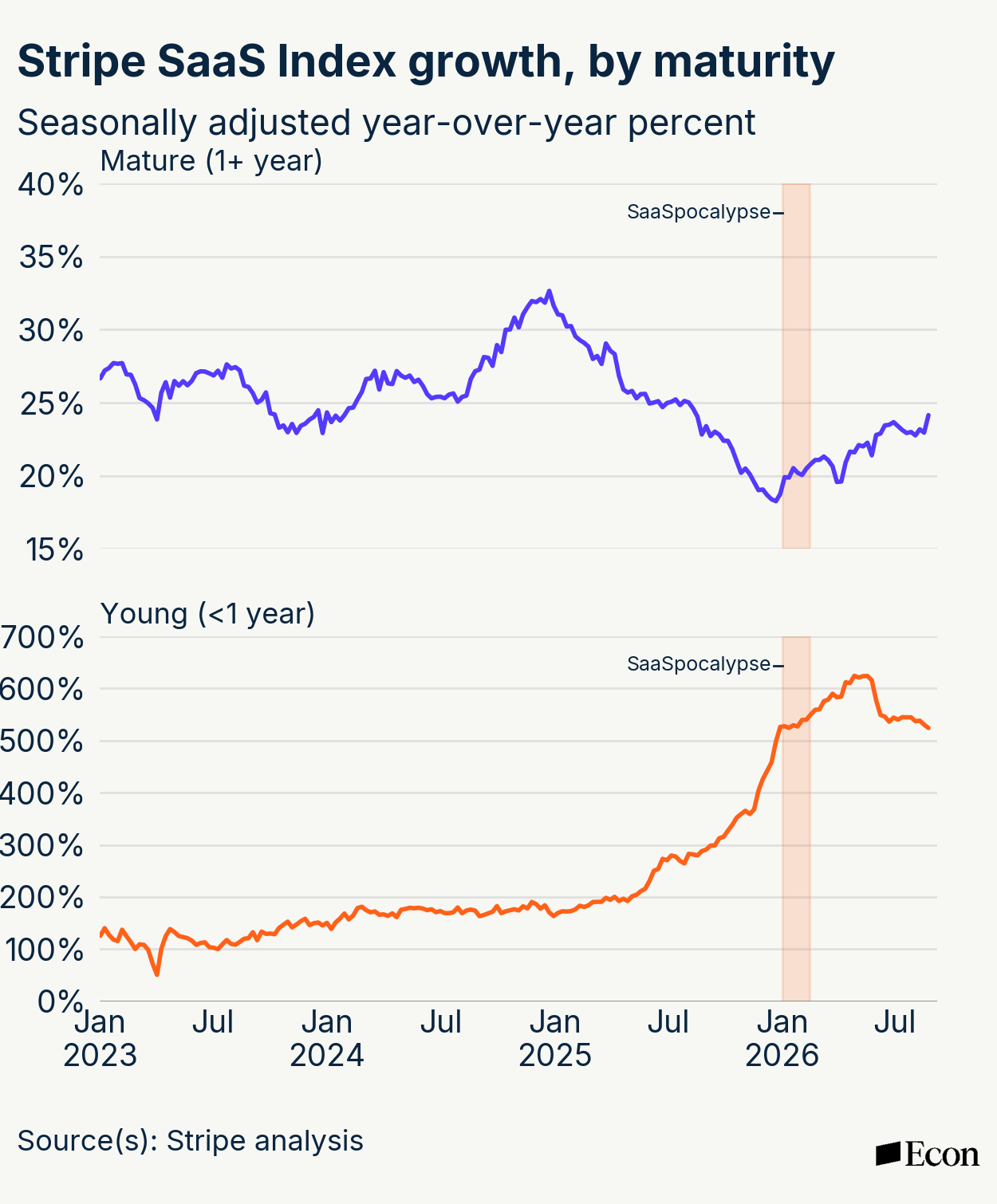
Businesses less than a year from their first Stripe transaction experienced particularly strong acceleration. Their growth began rising in mid-2025 and continued through the SaaSpocalypse. Stripe also found that younger SaaS companies have rapidly increased their use of AI tools.
At the beginning of 2026, mature SaaS companies were about five percentage points more likely to show Stripe’s proxy signals for AI adoption. By April that relationship had flipped, and young SaaS companies are now about four points more likely to show those signals.
There are also differences underneath the headline numbers. US SaaS growth has remained particularly strong, Europe is still above its pre-sell-off trajectory despite some slowing, and healthcare SaaS showed especially strong acceleration. Retail and professional-services SaaS have also performed above their earlier trends.
The important distinction is between what markets expect AI to do to SaaS and what is happening to SaaS demand today.
The sell-off reflected a forward-looking fear: if AI agents can perform work traditionally handled by software, existing SaaS products could eventually lose pricing power, users, or entire workflows.
Stripe’s payment data doesn’t prove that concern is wrong. It also doesn’t measure profitability or payments processed outside Stripe.
But so far, the feared disruption hasn’t appeared as a broad collapse in SaaS revenue.
So, AI may ultimately reshape SaaS, but the transition currently looks less like SaaS disappearing and more like SaaS companies adapting, with some of the youngest companies potentially benefiting from AI adoption themselves.
How do you build a seed deck that actually raises money?
Most founders know the standard pitch deck advice: explain the problem, show the solution, prove there’s a market, and keep the slides simple.
But after analysing 50+ Y Combinator startup decks from companies that collectively raised more than $450M, a much clearer pattern emerges. Strong seed decks tend to follow a surprisingly consistent structure.
Here’s the 9-slide framework:
Title: Company name + one sentence explaining exactly what you do.
Problem: Make the pain obvious. Use a real example, statistic, or customer story instead of a wall of text.
Solution: Show how your product solves that problem and why your approach is different.
Traction: Put your strongest evidence here, whether that’s revenue, users, retention, growth, pilots, or another meaningful signal.
Unique advantage: Explain what you understand, own, or can do that competitors cannot easily replicate.
Business model: Make it immediately clear who pays you, how much they pay, and how the company makes money.
Market opportunity: Show how large the opportunity can become without relying only on a giant top-down TAM number.
Team: Focus on why the founders are particularly suited to build this company.
The ask: State how much you’re raising, what the capital will fund, and what milestones it should help you reach.
But structure is only half the job.
YC’s pitch deck guidance comes back to three principles: legibility, simplicity, and obviousness.
A slide should be readable immediately. It should communicate one important idea rather than five competing ones. And someone unfamiliar with your startup should understand what you’re trying to say within seconds.
That means cutting dense paragraphs, tiny screenshots, unnecessary diagrams, excessive branding, and anything that forces the investor to decode the slide.
The bigger lesson: a seed deck doesn’t need to explain everything about your company. It needs to make the most important things impossible to misunderstand.
We also collected 50+ YC startup pitch decks that collectively raised $450M+, so you can study how real founders structured their fundraising stories rather than starting from a blank template.

So, your pitch deck is not a company encyclopedia. It is a sequence of evidence. Each slide should answer the next obvious question an investor has, then move them naturally to the next one.
What does a VC really look for in your financial model? (Template you can use).
Most founders think investors open a financial model to decide whether the five-year projections are believable.
That’s not really the test.
At pre-seed and seed, nobody expects you to predict exactly where revenue will be five years from now. Instead, the model is being used to answer a simpler question:
Does this founder actually understand how their business works?
An investor can often form that view surprisingly quickly.
Three things matter immediately:
Burn multiple: How much cash are you burning for every dollar of new ARR? If growth requires increasingly more capital, investors notice.
CAC payback: How long does it take to recover the cost of acquiring a customer? This helps separate efficient growth from growth that is simply being bought.
The hockey-stick test: If historical growth is modest but your forecast suddenly accelerates, what specifically causes it? More salespeople? A new channel? Higher conversion? Pricing changes?
The problem isn’t projecting aggressive growth.
The problem is projecting aggressive growth without showing what creates it.
There’s also an important stage difference.
At pre-seed and seed, investors generally don’t need a giant 30-tab financial model. A bottom-up revenue model, basic P&L, cash runway, and clearly stated assumptions can tell them far more.
By Series A, expectations change. Historical numbers need to reconcile, retention and cohorts matter more, and unit economics need to withstand deeper diligence.
So before sending your model, ask yourself:
Can I explain exactly where growth comes from, what it costs, and how long my cash lasts without opening the spreadsheet?
If not, the problem probably isn’t the spreadsheet.
It’s that the assumptions underneath it still need work.
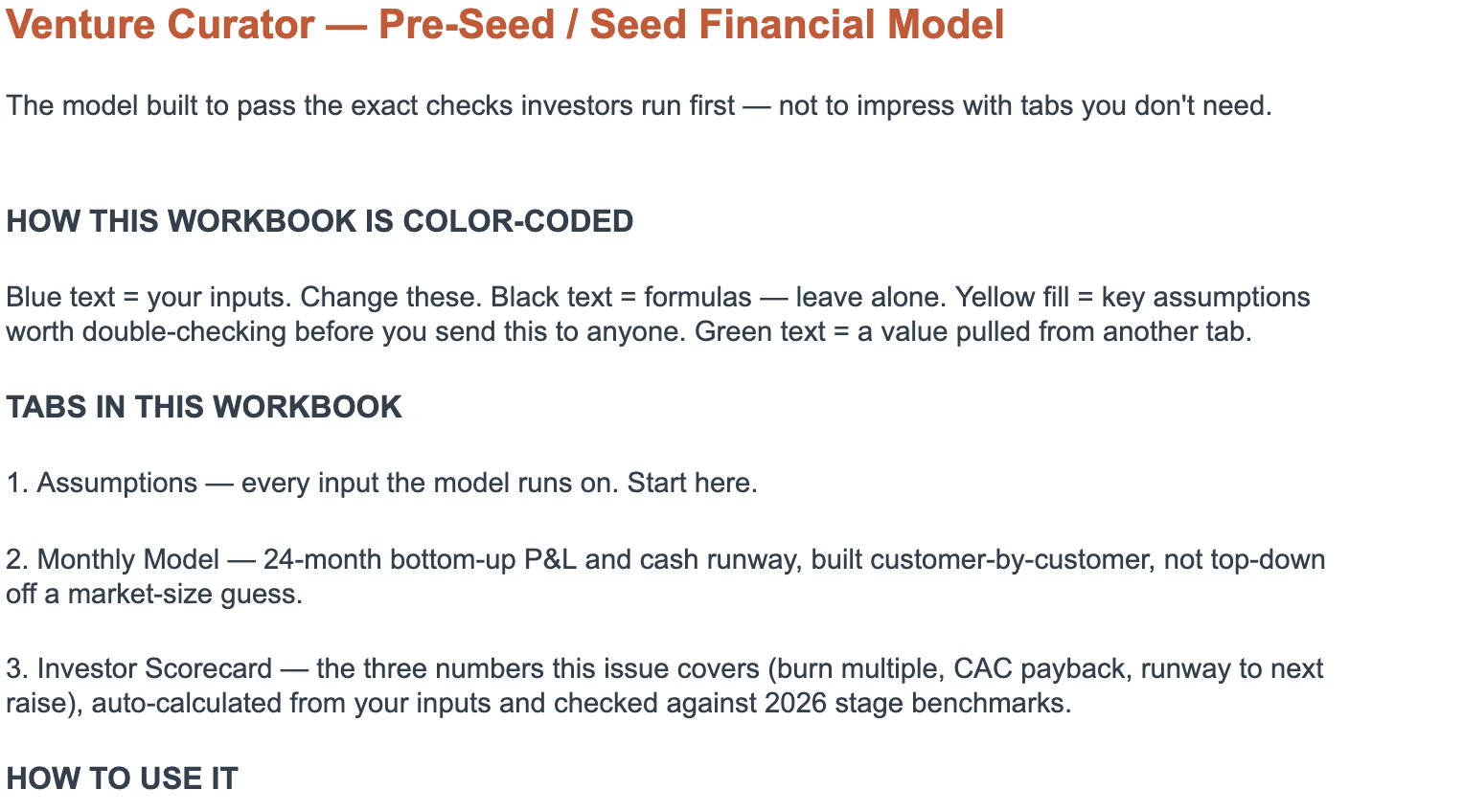
We also built a simple pre-seed/seed financial model that calculates burn multiple, CAC payback, runway, and the core metrics investors are likely to examine.
📬 Upgrade to Venture Curator Premium
Get access to 150+ premium archive posts, 100+ startup & VC resources, investor databases, fundraising templates, and exclusive startup research - all in one place.
TODAY’S JOB OPPORTUNITIES
💼 Venture capital & startup jobs
Associate / Principal - Village Global | USA - Apply Here
VC Fellow - Kalaari Capital | India - Apply Here
Artificial Intelligence Specialist - Blum Venture | USA - Apply Here
VC Research Lead - Murph Capital | Remote - Apply Here
Venture Capital Fellow (AI) - 1752 VC | Remote - Apply Here
Trade Operations Analyst - RA Capital | USA - Apply Here
Portfolio Management Associate - Cerity Partner | USA - Apply Here
Partner 36, Corporate Controller - a16z | USA - Apply Here
Investment Associate - Cerity Partner | USA - Apply Here
Senior Associate - NY Life Venture | USA - Apply Here
Senior Principal - Entegris Venture | USA - Apply Here
Global Capital Partner (India) - Antler - Apply Here
Tips to Break Into VC
10 VC math questions you’ll get asked in interviews, solved line by line
Most candidates can talk through markets and startups. The math is where many freeze.
This deep dive walks through 10 real VC interview math questions, including dilution, pro-rata, option pools, SAFE conversion, ownership targets, liquidation preferences, fund returns, carry, reserves, and bottom-up market sizing.
Every question is solved step by step, with the logic behind the answer and how to explain it out loud in an interview. It also includes a one-page formula cheat sheet and a practice spreadsheet.
Partnership With Us
Get your product in front of an audience of 125,000+ - Our newsletter is read by thousands of tech professionals, founders, investors and managers worldwide. Get in touch today.
Upgrade to Venture Curator Premium
Get access to 150+ premium archive posts, 100+ startup & VC resources, investor databases, fundraising templates, and exclusive startup research - all in one place.
(Subscribe to Venture Curator Premium and get 20% off forever.)