


👋 Hey, Sahil here - welcome back to Venture Curator, where we explore how top investors think, how real founders build, and the strategies shaping tomorrow’s companies.
Big idea + report of the week :
Is the Seed → Series A → Series B funding playbook becoming outdated?
Why are so many 2021 venture funds underperforming?
Which companies are producing the next generation of unicorn founders?
Frameworks & insightful posts :
The AI application race is shifting: from owning the interface to owning the intelligence.
Reddit citations are suddenly disappearing from ChatGPT search. Why?
Are AI startups redefining what intellectual property is worth? - $50M–$100M per person.
Get access to 150+ premium archive posts, 100+ startup & VC resources, investor databases, fundraising templates, and exclusive startup research - all in one place.
FROM OUR PARTNER - FRAMER
🤝 Launch your site faster than ever with Framer - now with Agents that make every part of your workflow effortless…

Framer is the pro website builder for creators, teams, and businesses that care enough to get every detail right.
Now with Agents that work alongside you across the full website workflow: designing new pages, managing your CMS, editing content, and adding SEO all without leaving the tool where the real site lives. Trusted by teams at companies like Miro and Perplexity
Agents bring speed and scale; you bring taste, judgment, and control. Together you can:
Build and iterate faster: generate sections, refine layout and styling, and ship updates in minutes.
Scale content with confidence: update CMS collections, localise copy, and keep metadata consistent across pages.
Stay production‑ready: reviewable changes, collaboration, and safeguards that help teams ship without handoffs.
Launch your site with Framer today →
WORK WITH US
🤝 Partnership With Us
Get your product in front of over 125,000+ audience - Our newsletter is read by thousands of tech professionals, founders, investors and managers worldwide. Get in touch today.
START WITH
🧠 Big idea + report of the week
Is the Seed → Series A → Series B funding playbook becoming outdated?
Startup financing is no longer just a VC game.
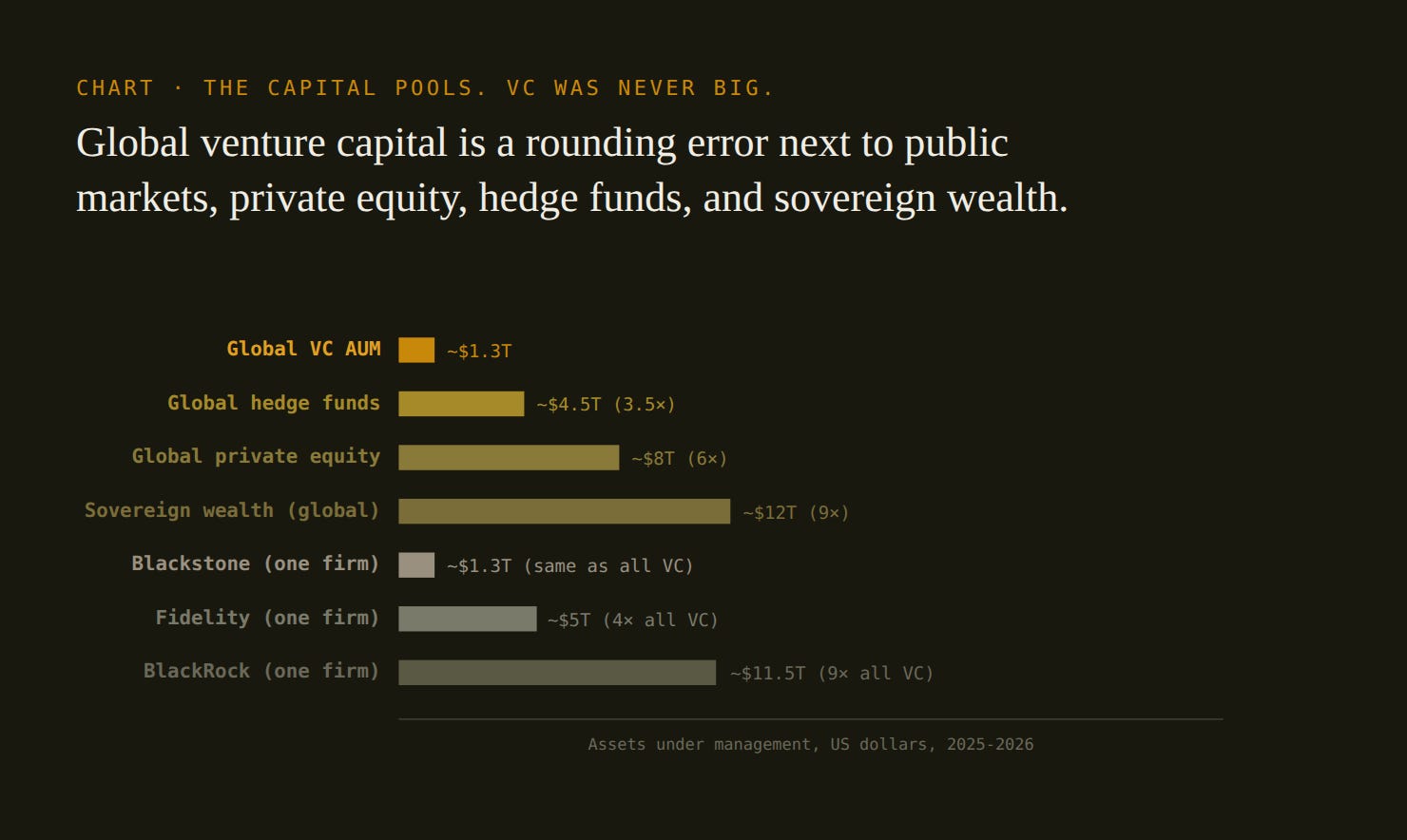
The entire global venture capital industry manages roughly $1.3 trillion. That sounds enormous until you compare it with the pools of capital sitting around it.
Global hedge funds manage roughly $4.5 trillion. Private equity manages around $8 trillion. Sovereign wealth funds control roughly $12 trillion. BlackRock alone manages nearly 9x as much capital as the entire global VC industry.
Stephen Messer highlighted this gap in his piece on how technology is becoming embedded across much larger pools of capital.
And as some of this money moves deeper into private technology companies, founders are gaining access to something potentially more important than simply more capital: more ways to finance a startup.
For decades, the startup financing playbook was fairly predictable. Raise seed, then Series A, B, C, and continue selling equity as the company grows.
That model becomes harder to justify when companies need billions of dollars to build AI infrastructure, data centres, robotics, energy systems or manufacturing capacity.
CoreWeave is a useful example.
In March 2026, the company closed an $8.5 billion delayed-draw term loan facility. Instead of financing all of its infrastructure expansion by repeatedly selling equity, CoreWeave can tap debt alongside equity to fund growth.
The lender group itself shows how startup financing is changing. It included major institutional capital providers such as Blackstone, Magnetar, Coatue, Carlyle, PIMCO, BlackRock and DigitalBridge Credit.
Base Power offers another version of the same idea.
The residential battery company has raised $2.5 billion at a $13 billion valuation, but its business can also generate capital through customer subscriptions and grid economics. Customers pay monthly memberships, while Base can use its distributed battery network as a virtual power plant.
This leads to a much more interesting question for founders:
Instead of asking, “How much equity should we raise?”, ask, “What type of capital should finance each part of the business?”
Equity can finance risky product development and expansion. Debt can potentially finance predictable infrastructure and assets.
Customer contracts can support financing against future revenue. Strategic investors can bring capital together with distribution, infrastructure or customers.
That distinction matters because equity is expensive. Every equity round permanently gives away part of the company.
As startups become more capital intensive, particularly across AI infrastructure, robotics, energy and defence, the best founders may need to become good at something previous generations of software founders could largely ignore: capital structure.
Building the company is one skill. Figuring out the cheapest and smartest way to finance that company is increasingly another.
Why are so many 2021 venture funds underperforming?
For years, venture capital operated on a simple promise.
Invest in the next generation of startups, wait patiently, and eventually the winners will return the entire fund multiple times over.
But what happens when almost everyone invested at the same time, at the same peak valuations?
Peter Walker from Carta recently analysed performance data across 2,689 US venture funds, and one chart stands out.
The 2021 vintage is struggling.
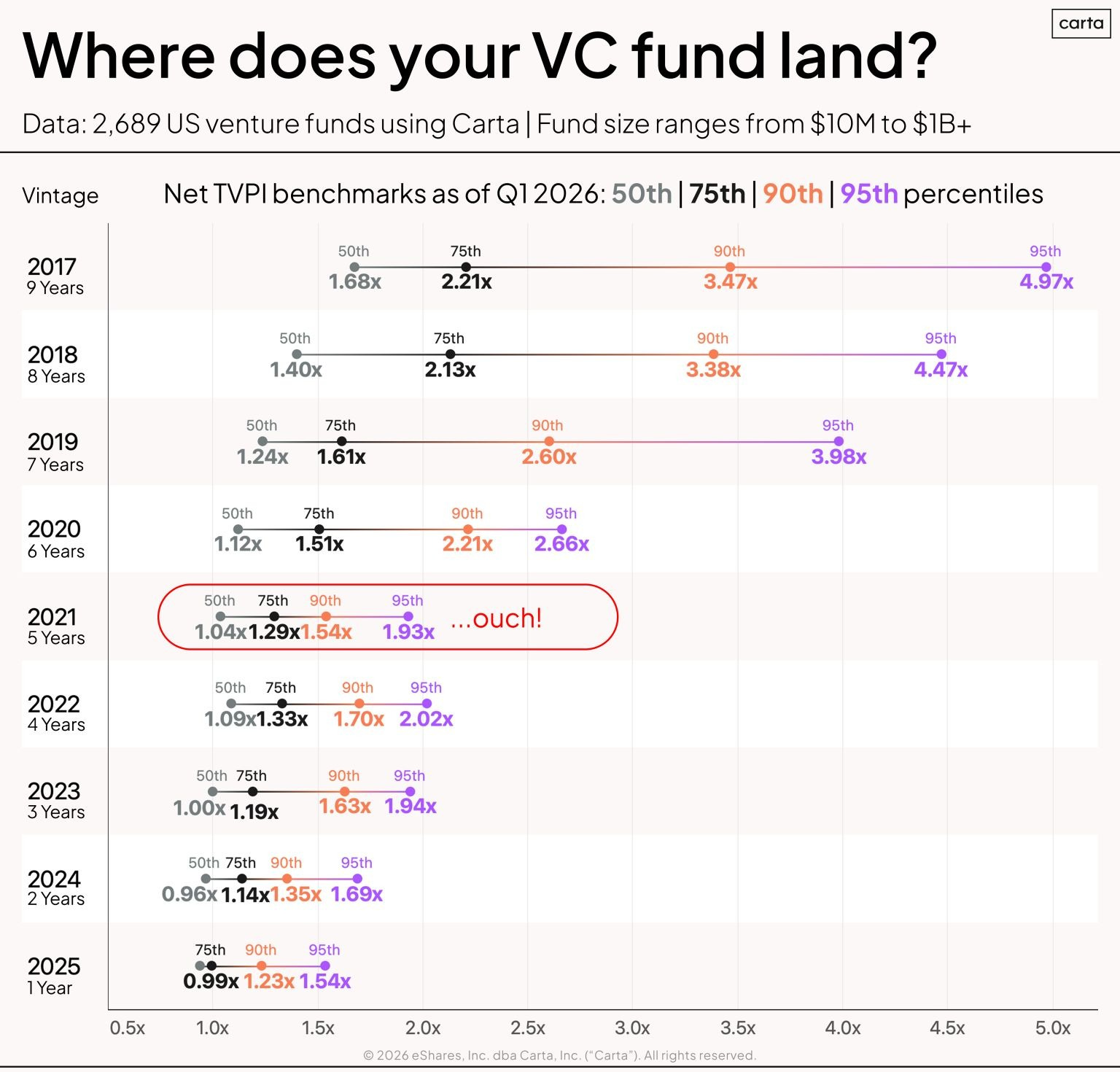
Five years into its life cycle, the median 2021 venture fund sits at just 1.04x Net TVPI.
In simple terms, the average fund has barely created value beyond the capital it invested.
Some of the numbers are striking:
The median 2021 fund sits at 1.04x.
Even the top 25% of funds have only reached 1.29x.
The top 10% of funds are at 1.54x.
The top 5% of funds have reached 1.93x.
That might sound reasonable until you compare it with older vintages.
The 2017 cohort tells a very different story.
At roughly the same stage of maturity, the median 2017 fund reached 1.68x, while the 90th percentile reached 3.47x.
Perhaps the most surprising comparison:
The 95th percentile fund from 2021 (1.93x) is still below the 75th percentile fund from 2017 (2.21x).
In other words, some of today’s best-performing funds would have looked merely above average a few years ago.
So what happened? Walker points to four forces colliding at the same time.
Record numbers of investors entered venture during the boom.
Startup valuations reached historic highs.
Interest rates reversed sharply in 2022.
AI emerged as a major platform shift shortly after many 2021 funds had already deployed capital elsewhere.
The result was a perfect storm.
Many investors bought into companies at peak prices just before capital became more expensive and public market multiples compressed.
The venture industry is still working through that adjustment.
Interestingly, newer vintages appear to be recovering.
The 2022 vintage, despite launching during a difficult fundraising environment, is already showing stronger numbers. Its 90th percentile sits at 1.70x, while the top 5% have crossed 2.0x.
That suggests the problem may not be venture capital itself. It may simply be that 2021 was one of the most expensive moments in startup history to put money to work.
The broader lesson is an uncomfortable one.
Venture returns are often determined long before a company exits.
They’re heavily influenced by the price investors pay on the day they enter.
And for many funds raised during the 2021 boom, that entry price may prove to be the defining story of the entire vintage.
Which companies are producing the next generation of unicorn founders?
Where someone works before becoming a founder may matter more than it first appears.
Certain companies become unusually strong training grounds for future founders. Employees learn how fast-growing companies operate, build networks with ambitious people, understand emerging technologies and eventually leave to build companies of their own.
New research from Stanford GSB professor Ilya Strebulaev shows that these founder factories have changed significantly over time.
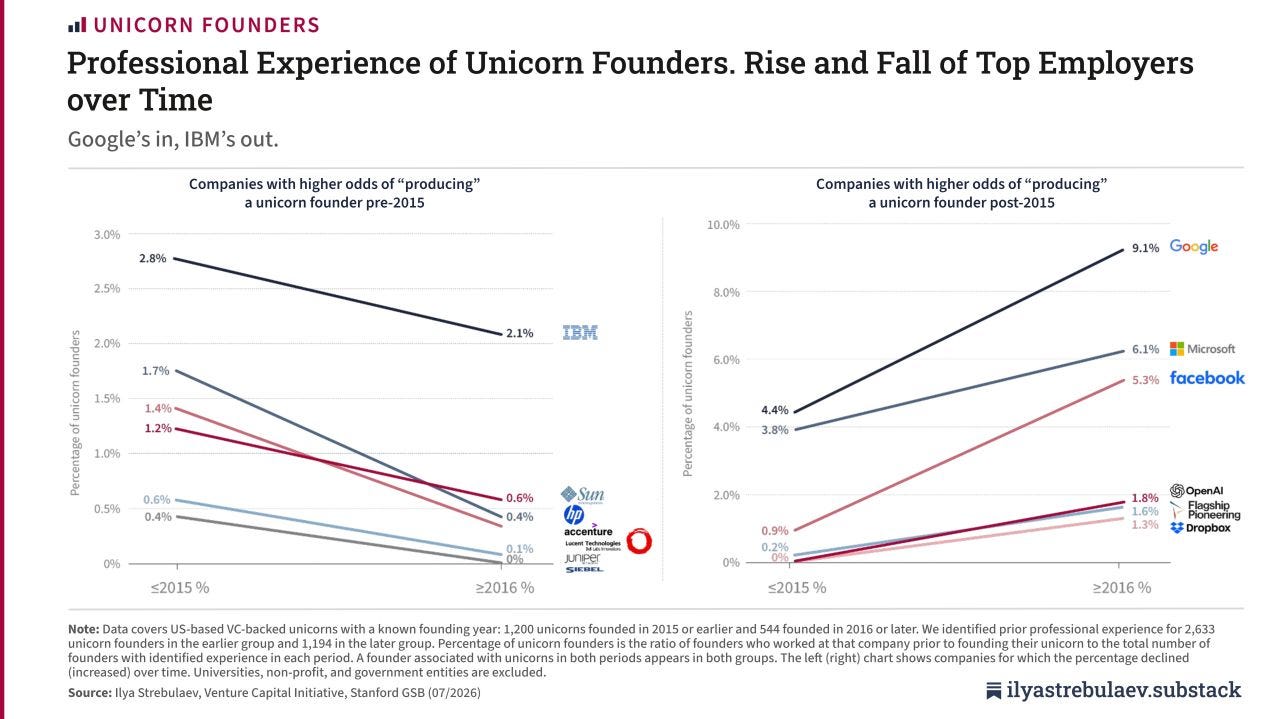
The analysis examined the professional backgrounds of 2,633 founders of US-based VC-backed unicorns founded in 2015 or earlier and 1,194 founders whose unicorns were founded from 2016 onward.
The shift is striking.
Google has become the strongest founder factory in the dataset. Among the earlier generation of unicorn founders, 4.4% had previously worked at Google. For the newer cohort, that rises to 9.1%.
That means almost 1 in 11 founders of newer unicorns previously worked at Google.
Microsoft shows a similar pattern, rising from 3.8% to 6.1%.
Facebook’s increase is even more dramatic, jumping from just 0.9% among the earlier cohort to 5.3% among newer unicorn founders.
But perhaps the more interesting signal is which younger organisations are emerging.
OpenAI went from effectively 0% to 1.8%. Flagship Pioneering increased from 0.2% to 1.6%, while Dropbox moved from 0.04% to 1.3%.
At the same time, several companies that trained an earlier generation of technology founders are fading.
IBM declined from 2.8% to 2.1%.
Sun Microsystems fell from 1.7% to 0.4%.
Hewlett-Packard dropped from 1.4% to 0.3%.
Accenture declined from 1.2% to 0.6%, while Lucent fell from 0.6% to 0.1%. Juniper Networks and Siebel Systems produced no founders in the newer unicorn cohort captured by the analysis.
There is a useful way to think about this beyond simply ranking employers.
The best founder factories tend to sit close to the technological shift happening at that moment.
An earlier generation came out of IBM, Sun and HP. The next generation increasingly came through Google, Facebook and Microsoft.
Now OpenAI is already appearing on the list despite being dramatically younger.
For aspiring founders, this suggests that choosing where to work can be more than a career decision. Spending a few years inside a company operating at the frontier can provide exposure to new technology, exceptional talent, ambitious networks and problems that may eventually become startup opportunities.
For investors, the same data can become a sourcing signal.
Instead of only asking which sectors are producing the next generation of startups, it may also be worth asking:
Which companies today are quietly training the founders who will build the next generation of unicorns?
📄 Must Read Post


SOMETHING MORE
🧩 Frameworks & insightful posts
The AI application race is shifting: from owning the interface to owning the intelligence.
For the first wave of AI startups, the playbook was straightforward: take the best frontier model, wrap it in a great product, add proprietary workflows and distribution, and let the labs worry about intelligence.
That model is starting to change.
Sequoia’s Sonya Huang and team argue that the next competitive battle for AI application companies won’t just happen at the application layer. Increasingly, companies will have to decide how much of the underlying intelligence they want to control themselves.
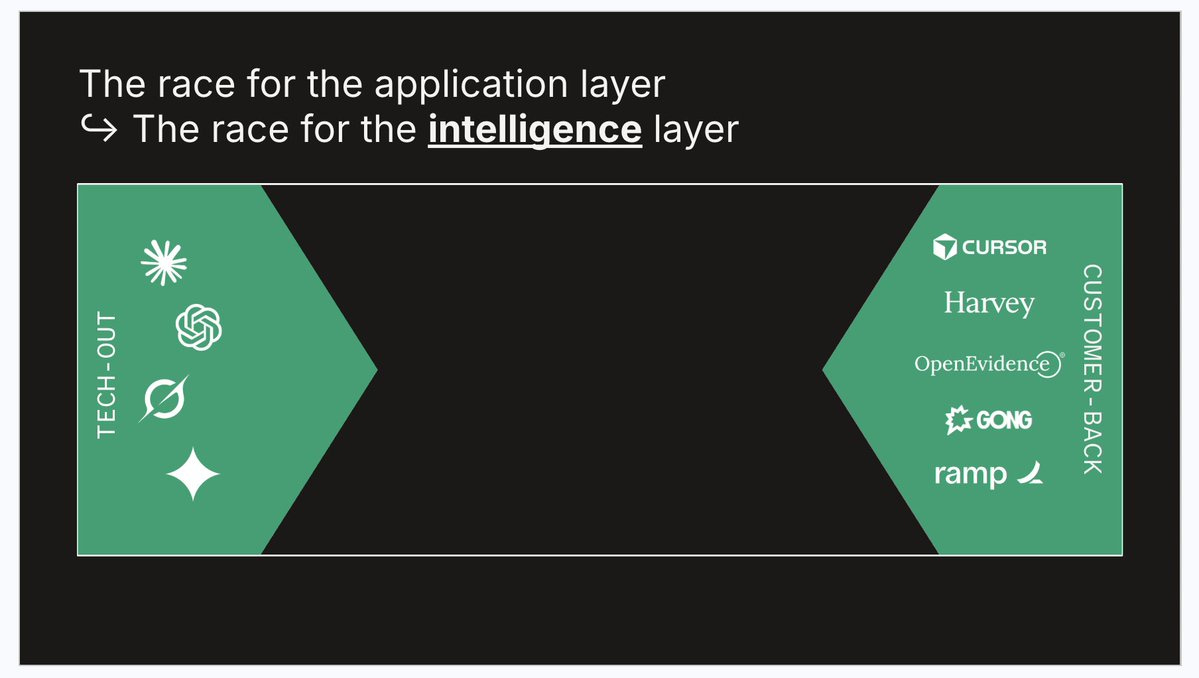
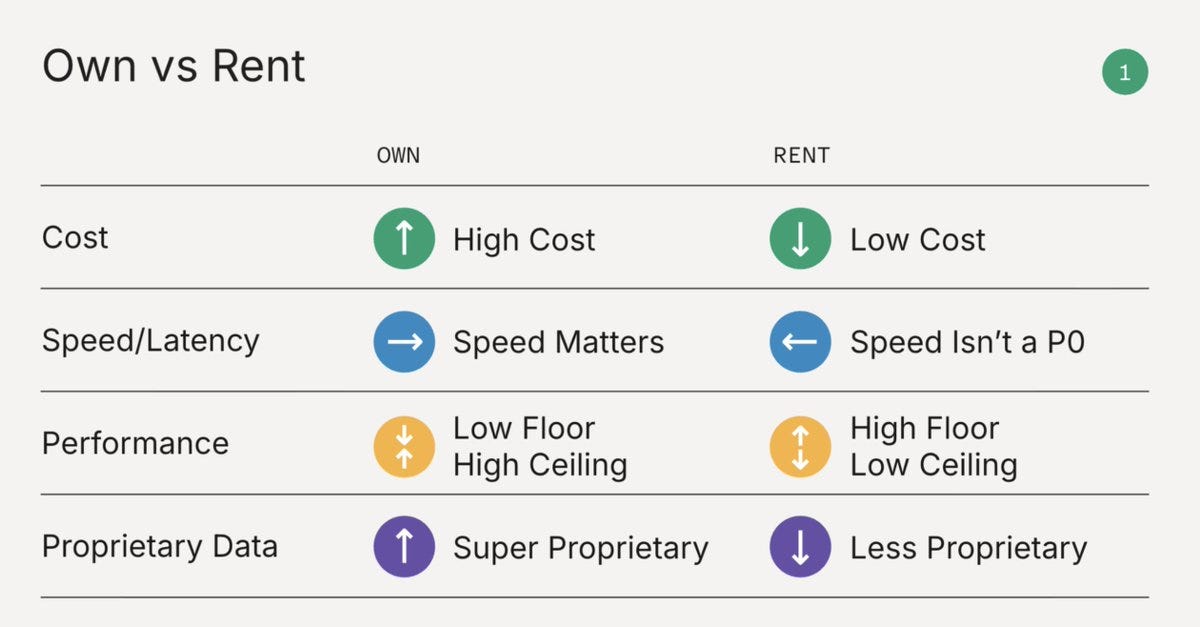
This doesn’t mean abandoning OpenAI, Anthropic, Google, or other frontier models. For many workloads, renting intelligence through an API remains cheaper, simpler, and better.
But the economics are creating reasons for successful AI companies to move deeper into the stack.
The decision largely comes down to four things:
Cost: AI COGS rise with usage. At sufficient scale, running customized or open-weight models can improve margins.
Speed: A smaller specialized model can sometimes outperform a much larger general model when latency matters.
Proprietary data: Customer interactions, feedback, evals and workflow data can become increasingly valuable as the system learns.
Control: Frontier labs are moving upward into applications while application companies are moving downward into models and training.
That last point may be the most important.
The boundary between “AI model company” and “AI application company” is becoming less clear.
Companies like Harvey aren’t necessarily trying to build the next general-purpose frontier model. Instead, the opportunity is to build intelligence specifically optimized for legal work. The same logic can eventually apply to coding, finance, healthcare, cybersecurity and other verticals.
Sequoia describes the technical path as a progression:
Evals → Harness/context engineering → Post-training → Online learning
Evals: Test whether the AI is actually good at the job.
Harness/context: Give the AI the right information, tools, and instructions to do the job.
Post-training: Train the AI to become better at that specific job.
Online learning: Learn from real usage and mistakes to keep improving.
It starts with evals. Before improving a model, a company needs a reliable way to measure whether its AI actually performs the work customers care about. Harvey, for example, created a Legal Agent Benchmark containing more than 1,200 tasks across 24 legal practice areas and more than 75,000 expert-written rubric criteria.
Once measurement exists, companies can improve the system around the model.
The harness controls routing, retrieval, tools, memory, context, fallbacks and traces. Instead of asking, “Which model is smartest?”, teams can ask a much more useful question: “Which combination of model + context + tools performs this particular task best?”
Then comes post-training.
Different problems require different approaches. Missing knowledge may simply require better context or RAG. Incorrect behavior may call for supervised fine-tuning. Product preferences can use preference tuning. Specialized reasoning may benefit from reinforcement learning. Expensive or slow models can potentially be distilled into smaller ones.
Finally comes perhaps the most interesting layer: online learning.
Every interaction produces a trajectory - what context the model received, which tools it used, what answer it generated, what failed, what the customer changed and whether the task ultimately succeeded.
Those trajectories can become the company’s learning loop:
Failed task → new eval
Missing information → better context
Tool failure → harness improvement
Repeated behavior → training data
User correction → feedback signal
This is where the intelligence layer can become proprietary.
Two companies might start with exactly the same open-weight model. But after millions of domain-specific interactions, proprietary evals, customer feedback, specialized context and post-training, they can end up with very different systems.
That creates a different kind of AI moat.
The model itself doesn’t necessarily have to be proprietary. The learning loop does.
There is still a major trade-off. Renting intelligence provides a high performance floor with very little infrastructure. Owning more of the stack is expensive, technically difficult and can initially produce worse results.
But it potentially offers a much higher ceiling.
That suggests the future may not be “open models vs. closed models” at all. The strongest AI companies could use both: frontier models wherever general intelligence matters, and increasingly specialized models wherever proprietary data, latency, economics or domain performance justify owning more of the stack.
The labs will continue building increasingly powerful general-purpose intelligence.
The application companies may build something different: smaller, highly specialized intelligence that understands one industry’s work better than anyone else.
And if that happens, the most defensible AI application companies won’t simply own the customer relationship.
They’ll own the system that continuously learns from it.
Reddit citations are suddenly disappearing from ChatGPT search. Why?
Something interesting happened to Reddit’s visibility inside AI search this month.
According to Promptwatch data, Reddit accounted for roughly 3.8% of all citations in ChatGPT Search from July 18 through August 7. Then things changed quickly.
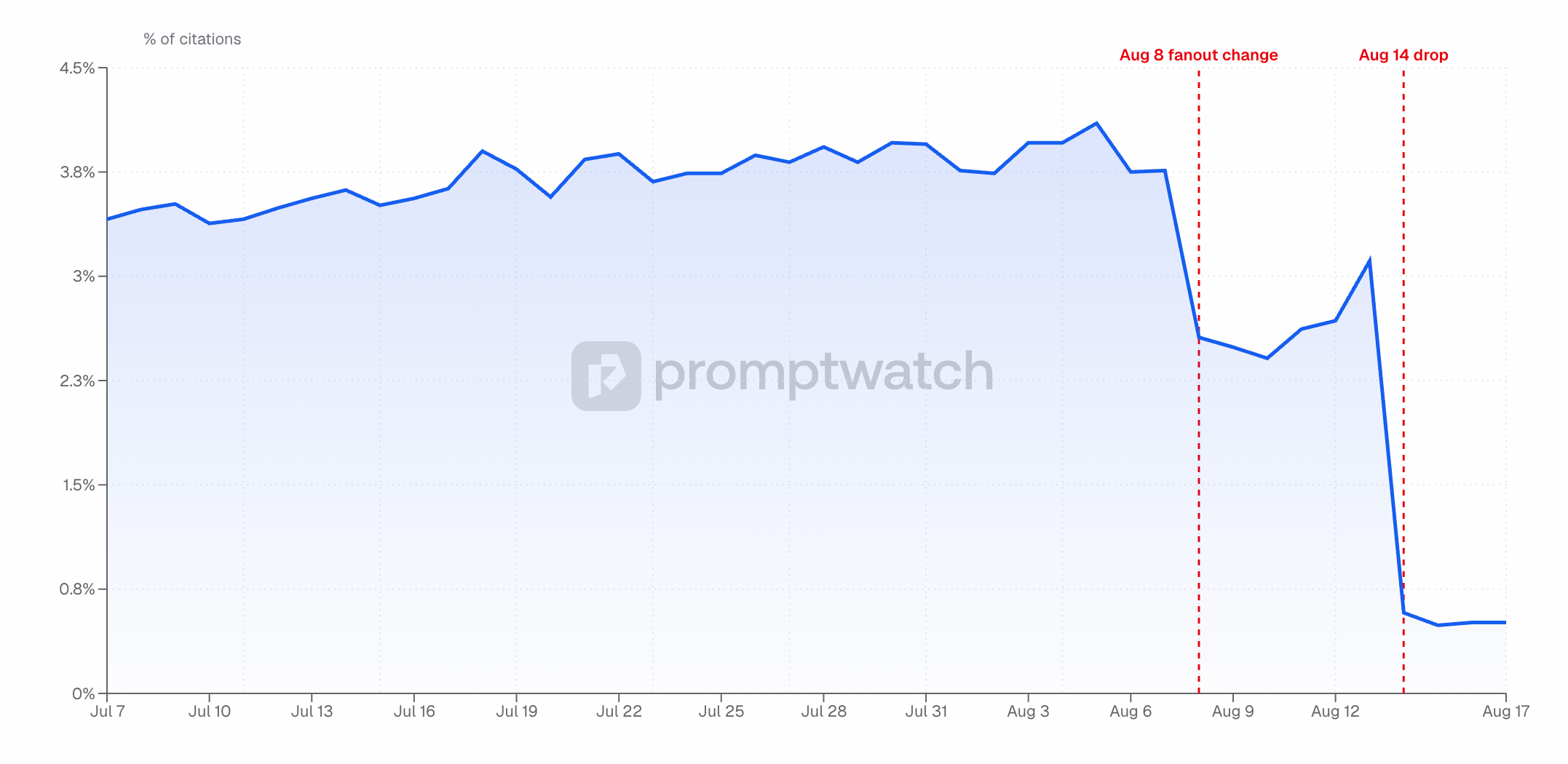
On August 8, after a change in ChatGPT Search’s query fanout behavior, Reddit’s citation share dropped into the mid-2% range.
On August 14, it fell sharply again to below 1%.
From August 14–17, Reddit averaged just 0.52% of ChatGPT citations — an 86.4% decline from its previous ~3.83% average.
What makes this especially interesting is that the same pattern isn’t showing up as dramatically in Google.
Reddit’s share of Google AI Overview citations declined gradually from about 2.37% to 2.10%, while Google AI Mode saw a larger but still gradual decline from 2.22% to 1.54%.
So this doesn’t look like a broad disappearance of Reddit from AI search. The sharpest change appears specific to ChatGPT Search.
There’s also an important caveat: the chart shows when the change happened, not why. It could reflect a change in how ChatGPT selects or retrieves sources, but Promptwatch notes that a data-collection issue can’t yet be ruled out.
Still, if the trend holds, there’s a useful takeaway for marketers and founders:
Getting mentioned on Reddit may no longer translate into ChatGPT visibility the way it did just a few weeks ago.
And more broadly, AI-search distribution can change almost overnight. A source that gets heavily cited today can lose most of that visibility after a retrieval or ranking change tomorrow.
That makes AI SEO less about optimising for one platform or source and more about building authority across multiple places the models can discover and trust.
Are AI startups redefining what intellectual property is worth? - $50M–$100M per person.
For years, startup acquisitions were mostly about buying a product, customers, distribution, or technology. In frontier AI, that logic is flipping.
The asset being priced most aggressively is increasingly the team itself.
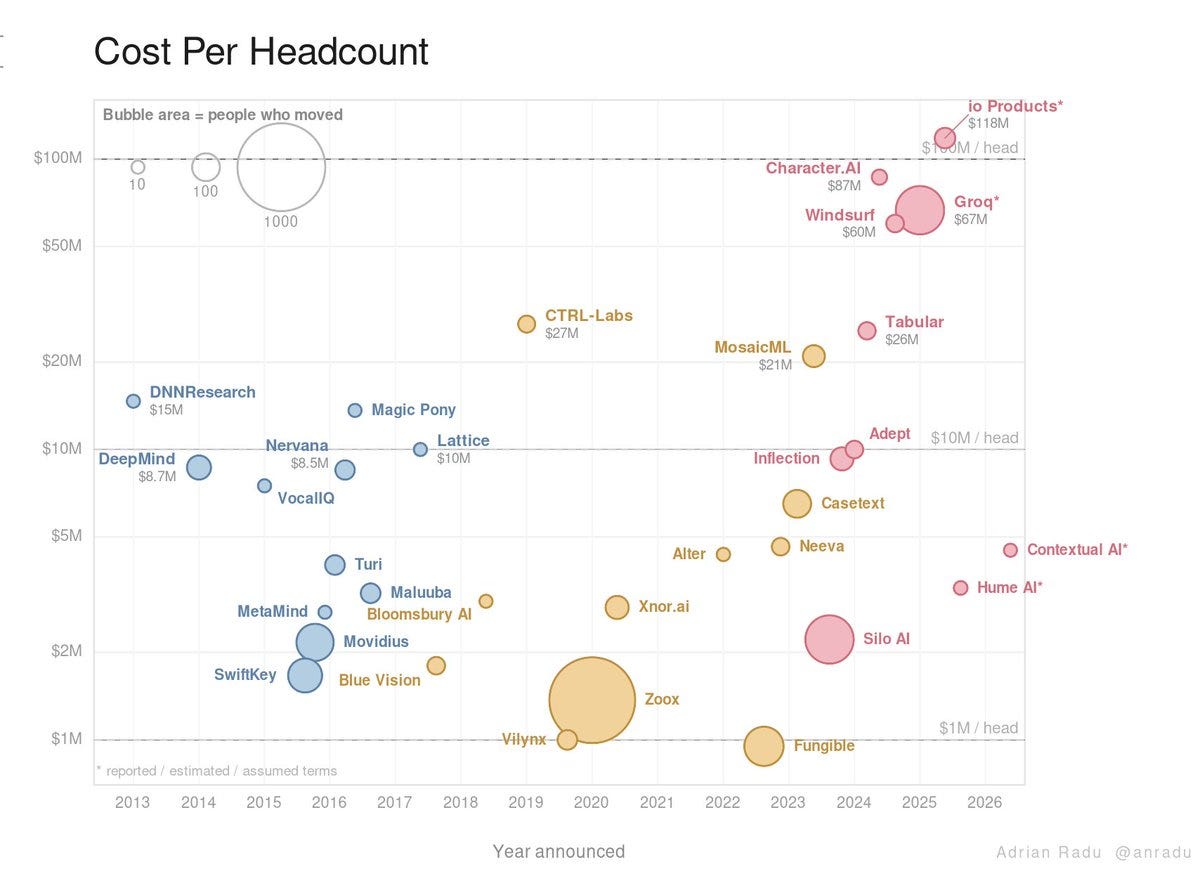
A recent analysis of AI acquisitions and talent deals by Adrian Radu shows just how quickly the market has changed. In the early 2010s, paying $10M–$15M per researcher already looked extreme. Today, some transactions imply $50M–$100M per person, with a handful pushing beyond $100M.
The reason is simple:
Only a very small number of researchers and engineers have actually trained, scaled, and shipped frontier AI systems. That experience is difficult to reproduce, and much of it lives as tacit knowledge inside the people rather than in a codebase that can simply be acquired.
The market seems to have moved through three distinct eras:
The classic era: talent was expensive, but still priced like an acquisition.
Google’s 2013 acquisition of DNNResearch, founded by Geoffrey Hinton, Alex Krizhevsky, and Ilya Sutskever, reportedly came in around $40M–$44M. DeepMind later sold to Google for roughly $500M–$600M. Across deals such as Magic Pony, Nervana, and Lattice, the upper end generally stayed around $10M–$15M per person.
The middle era: strategic capability became more valuable.
From roughly 2018–2023, acquisitions increasingly combined talent, technology, and codebases. Databricks’ $1.3B acquisition of MosaicML, which had around 60 employees, implied more than $20M per employee. Deals involving CTRL-Labs, Xnor.ai, Casetext, and others pushed the upper end closer to $20M–$30M per head.
The frontier era: the people themselves are becoming the scarce asset.
Since 2024, deal structures have changed. Instead of buying the entire company, large AI labs increasingly hire key researchers and license the technology — the so-called reverse acquihire structure seen around companies such as Character.AI, Inflexion, Adept, and Windsurf.
That shift creates some extraordinary implied numbers. The chart puts several recent deals around $50M–$100M per person, with some higher still.
And compensation inside the labs is moving in the same direction. Elite researchers have reportedly been offered multi-year packages worth hundreds of millions of dollars, while competing labs have responded with accelerated vesting schedules and large retention grants.
We can say - AI has changed what intellectual property looks like.
In traditional software, a large part of the value could remain inside the codebase after the founders or engineers left. Frontier AI is different. The most valuable knowledge can be knowing how to train the model, what failed in previous experiments, how to scale infrastructure, which data decisions matter, and how to turn research into a working product.
Much of that walks out the door with the team.
That helps explain why the market is willing to pay prices that would have looked absurd a decade ago. A handful of exceptional people can now influence billions of dollars in model performance, infrastructure spend, product revenue, and competitive positioning.
The interesting question may no longer be whether $100M per researcher sounds expensive.
It is whether, in a market where one small team can create tens of billions in enterprise value, $100M eventually starts to look cheap.
📬 Upgrade to Venture Curator Premium
Get access to 150+ premium archive posts, 100+ startup & VC resources, investor databases, fundraising templates, and exclusive startup research - all in one place.
TODAY’S JOB OPPORTUNITIES
💼 Venture capital & startup jobs
Why your CV keeps getting ignored for VC jobs (and how to fix it): How to reframe your experience into clear venture signals, add an investing exposure section, and create proof of work that shows you are already doing the job before anyone hires you.
Associate / Principal, Follow-on Investing - Village Global | USA - Apply Here
Senior Associate - Yamaha Motor Venture | USA - Apply Here
Financial Management Analyst - Duke Capital Partner | USA - Apply Here
Investment Principal - Contrarian Thinking Capital | USA - Apply Here
Financial Management Analyst - Duke Capital Partner | USA - Apply Here
Senior Associate - Yamaha Motor Venture | USA - Apply Here
Incubation Associate, Compute - Primary | USA - Apply Here
Investment Analyst - Mela Venture | India - Apply Here
Associate or Senior Associate - Bessemer Partner | USA - Apply Here
Partner 18, Events Associate, Crypto - a16z | USA - Apply Here
AI Analyst - Array Venture | USA - Apply Here
SMB Program Associate - Plug and Play Tech Centre | USA - Apply Here
VC Fellow - V11 | Remote - Apply Here
Associate, Healthcare - B Capital Group | USA - Apply Here
Portfolio Reporting Team Lead - Cerity Partner | USA - Apply Here
Associate - Mount Judi Venture | USA - Apply Here
Partnership With Us
Get your product in front of over 125,000+ audience - Our newsletter is read by thousands of tech professionals, founders, investors and managers worldwide. Get in touch today.
Upgrade to Venture Curator Premium
Get access to 150+ premium archive posts, 100+ startup & VC resources, investor databases, fundraising templates, and exclusive startup research - all in one place.
(Subscribe to Venture Curator Premium and get 20% off forever.)