

👋 Hey, Sahil here - welcome to this edition of Venture Curator, where we break down how great startups grow, how top investors think, and what’s shaping the future of tech.
P.S. Get access to 100+ startup & VC resources, investor databases, fundraising templates, 150+ premium archive posts and exclusive startup research - all in one place.
FROM OUR PARTNER - MICRO1.
🤖 Get paid for the operational processes you’ve already documented…

Your company’s workflows capture the context AI needs to understand how real businesses operate.
micro1 is currently paying partners between $100K and $2M for approved operational documentation, including SOPs, playbooks, training materials, process documentation, QA guidelines, and other workflow artefacts.
We work with your team to identify operational data you already have, keep everything anonymised and private, and pay you for what’s approved.
We’re looking for companies with 30+ employees and substantial, well-documented operations. If that’s you, we’d love to start a conversation.
Visit micro1.ai to get started →
📜 DEEP DIVE
What should founders never automate with AI? The Signal vs. Repetition framework.
Over the last couple of weeks, we’ve published two of the issues -
and my inbox has looked the same ever since. Founders sending me screenshots of their setups. Founders asking which agent to build next. Founders proudly listing everything they’ve taken off their own plate.
Reading through those emails, a pattern started bothering me. Almost every founder was asking how to automate something. Almost nobody was asking whether they should. And the functions they were proudest of automating - support, outreach, onboarding - were consistently the ones that made me wince.
One email made the problem impossible to ignore.
A seed-stage founder wrote that his biggest ops win of last year was taking himself out of customer support entirely. He’d wired up an AI agent - deflection rate north of 70%, response time under a minute. Then, six months later, a churn number he couldn’t explain.
He ended up digging through old resolved tickets at midnight and found, buried in the transcripts, the same feature complaint phrased forty different ways. His agent had answered every single one politely. Nobody on the team had read any of them.
He didn’t lose those customers because the AI gave bad answers. He lost them because the answers were good enough that the signal never reached a human.
Here’s the thing: he didn’t pick the wrong tool. He automated the wrong function, and there was no way for him to know that, because nobody has given founders a way to tell the difference.
Which function is safe to hand to an agent, and which one quietly holds your product-market fit? That’s not a gut call.
There’s a framework for it, and it’s what this issue is about.
But first, the numbers - because this isn’t one founder’s mistake. It’s most of the market’s.
The money is going in. Almost nothing is coming back.
MIT’s NANDA initiative studied 300 enterprise AI deployments and put a number on what most operators already suspected: 95% of generative AI pilots deliver no measurable P&L impact. Not underwhelming returns. No measurable returns - against an estimated $30-40 billion in enterprise spend.
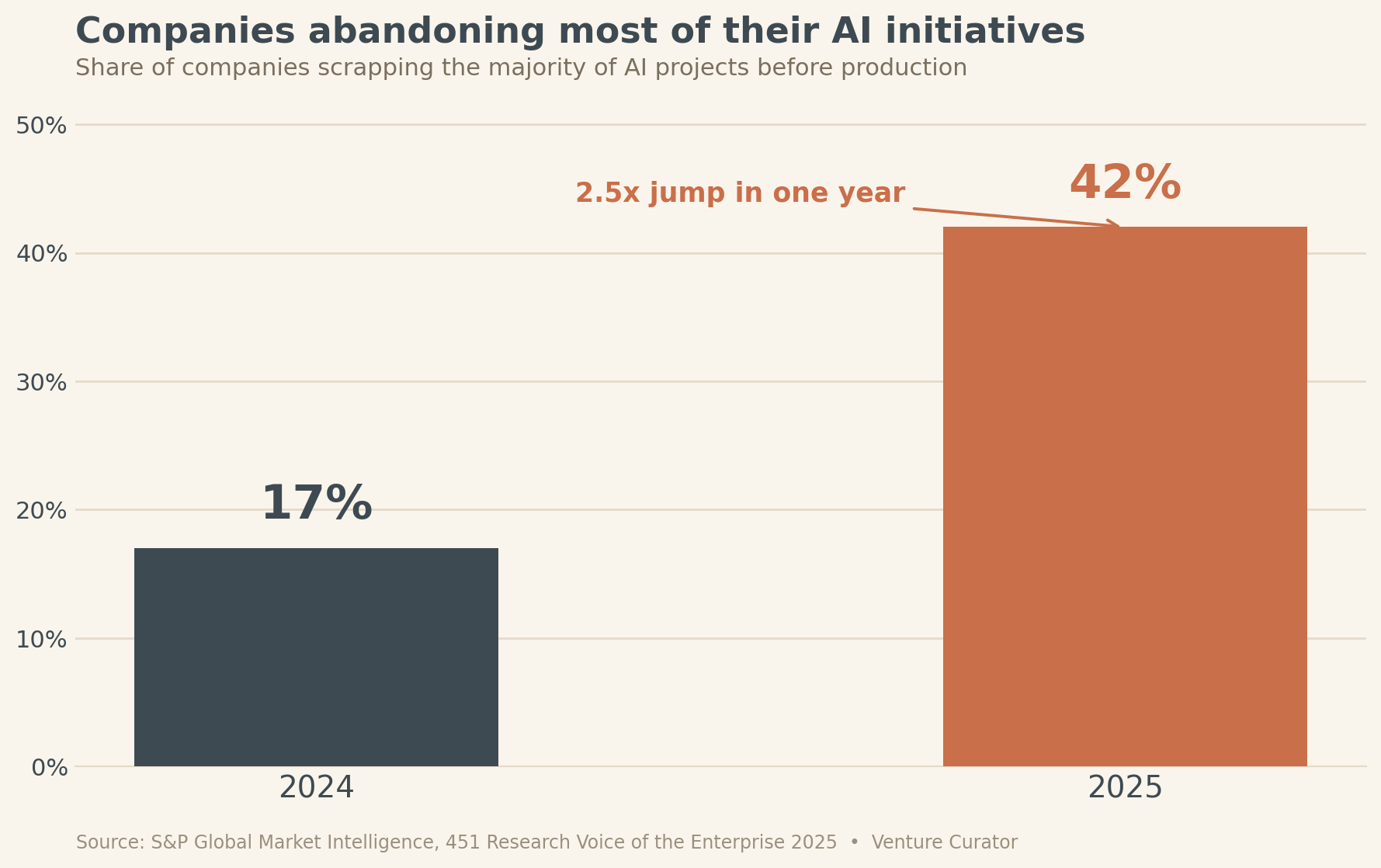
Companies are responding the way you’d expect. The share of companies abandoning most of their AI initiatives jumped from 17% to 42% in a single year, per S&P Global’s survey of 1,000+ organisations, and the average company now scraps 46% of its AI proofs of concept before they ever reach production.
The easy read is “AI is overhyped.” That’s not what the data says. MIT’s researchers were explicit that the failure rate has almost nothing to do with model quality. The tools work.
The 95% failed because of where companies pointed them.
And buried in the same report is the finding that matters most for founders: more than half of generative AI budgets went to sales and marketing tools, while the biggest measured ROI came from back-office automation. Operations. Process work. The unglamorous internal stuff.
The money went to the visible half of the company. The returns lived in the invisible half. At enterprise scale, that mismatch burns budget. At your stage, it does something much worse, and almost nobody is talking about it.
You don’t get to sit this out, either
Here’s the uncomfortable part: “just automate less” is not an available move anymore, because investors have started pricing automation into your round.
Carta’s data shows Series A teams have shrunk from an average of 25.9 employees in 2021 to 16.8 today - same milestones, a third fewer people. The median time to a startup’s first hire has stretched from 214 days to 284.
And VCs are now explicit that revenue per employee has become a core efficiency signal at Series A - CRV goes as far as saying that if you’re building with AI tools and not showing superior capital efficiency, “that now reads as a weakness.”
So this is the squeeze every early-stage founder is sitting in right now:
Automate aggressively, and you risk joining the 95% or worse, automating away the exact conversations that would have gotten you to product-market fit. Automate timidly, and you walk into your Series A with a 2021-shaped headcount and get benchmarked against companies running twice your revenue per head.
The founders getting this right aren’t the ones with better tools. They’re using the same models as everyone else. What they have is a different map - a simple way of sorting every function in the company before deciding whether AI touches it. Once you see it, the MIT budget mismatch, the churn story above, and the rev-per-head data all snap into the same picture.
Here’s what the rest of this deep dive covers:
What actually separates the functions you should automate this week from the ones that will quietly cost you product-market fit if you touch them?
Why does the same function flip from “never automate” to “automate immediately” as you grow, and what’s the specific trigger to watch for?
Where does the first $500-$2,000/month of automation spend reliably pay for itself at seed stage?
Which three automations can you build in Claude, with copy-paste prompts, and which popular one should you refuse to build?