

👋 Hey, Sahil here - welcome back to Venture Curator, where we explore how top investors think, how real founders build, and the strategies shaping tomorrow’s companies.
Big idea + report of the week :
What makes one AI startup worth 30x ARR and another 100x+?
What separates an average VC fund from the top 1%? (Carta analysed 400+ funds).
195 new unicorns in six months. What’s driving the surge?
Frameworks & insightful posts :
Is your seed valuation actually about your startup or the fund’s math?
Can AI agents finally use computers well enough to replace back-office work? - a16z’s data shows something unexpected.
Do the biggest startups actually come from the hottest trends? Sequoia analysed 20 years of tech trends.
Get access to 150+ premium archive posts, 100+ startup & VC resources, investor databases, fundraising templates, and exclusive startup research - all in one place.
FROM OUR PARTNER - KAPITALWISE
💹 Your financial goals are personal. Your advisor should be too.

Not every financial advisor is right for every investor. The right fit depends on what you’re building toward, the kind of guidance you need, and where you are financially.
Kapitalwise AdvisorConnect uses AI-powered matching to connect you with vetted financial advisors and planners based on your needs - making it easier to find relevant expertise without spending hours searching and comparing.
Think of it as a smarter starting point for an important financial decision: fewer random options, more relevant matches.
See which financial advisors match your needs →
WORK WITH US
🤝 Partnership With Us
Get your product in front of over 125,000+ audience - Our newsletter is read by thousands of tech professionals, founders, investors and managers worldwide. Get in touch today.
START WITH
🧠 Big idea + report of the week
What makes one AI startup worth 30x ARR and another 100x+?
AI companies are reaching $100M ARR at extraordinary speed, but investors aren’t valuing every fast-growing company the same way.
Tom Tunguz analysed valuation and ARR data across Harvey, Legora, Sierra, Ramp, and Decagon. The interesting part isn’t simply how high the multiples are - it’s how differently the market prices companies with similarly exceptional growth.
Sierra reached roughly a 79x ARR multiple, while Legora sits around 56x and Harvey around 37x. Decagon’s estimated multiple is even higher at 129x, though its revenue figure is based on third-party estimates.
Multiples have also started expanding again. Legora moved from roughly 36x to 56x, Sierra from 67x to 79x, and Ramp from 23x to 31x as the fundraising environment improved.
Harvey is the interesting exception: despite strong revenue growth, its multiple compressed from roughly 50x to 37x. That suggests growth rate alone isn’t determining valuation.
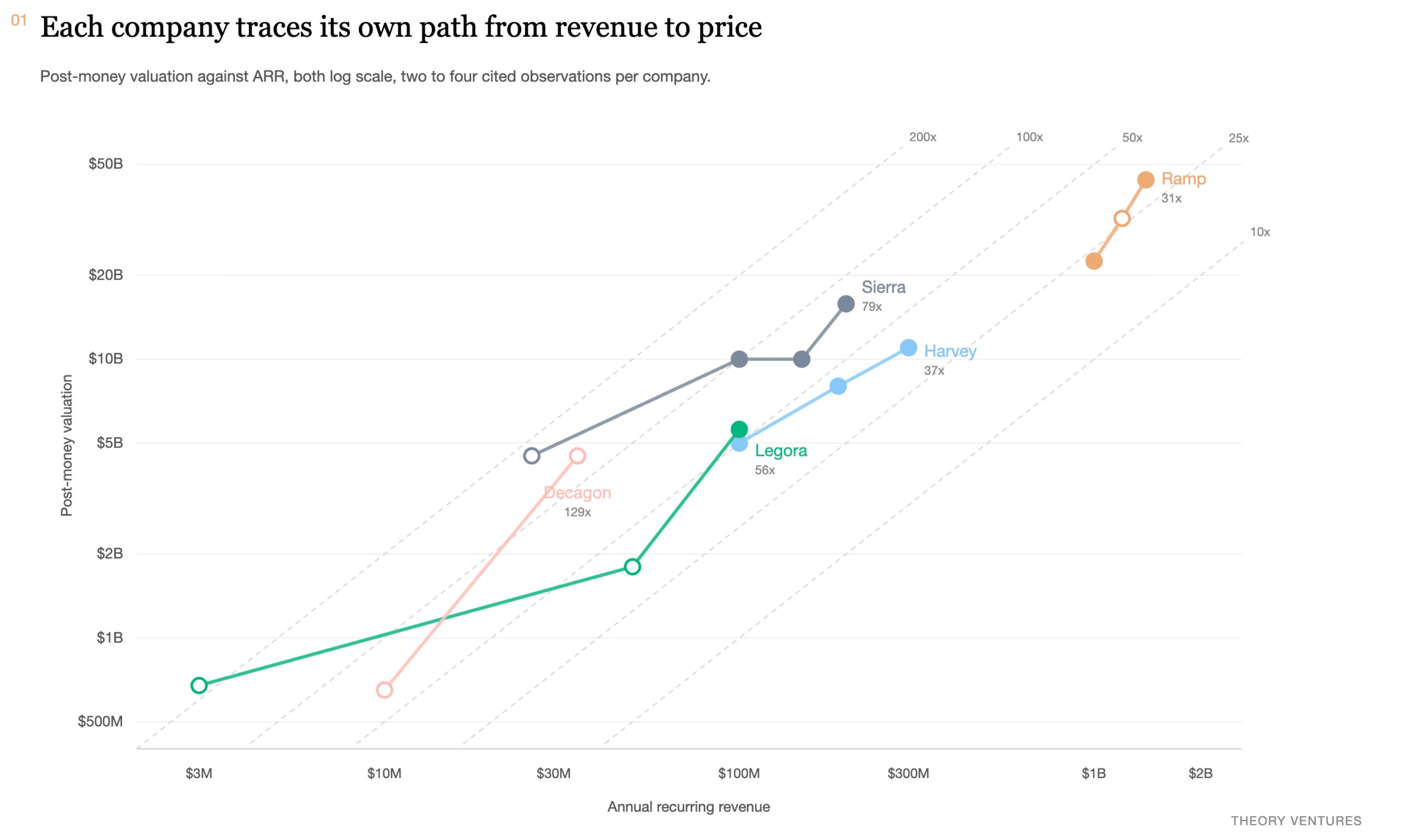
So - category position may increasingly determine the premium investors are willing to pay.
Two AI companies can both grow incredibly fast and still receive dramatically different revenue multiples depending on how investors view their market position, defensibility, and potential to own the category.
We’re effectively seeing 50x–100x ARR multiples return for some elite private AI companies - but this time, they’re being supported by businesses growing much faster than the SaaS companies that commanded similar multiples in 2021.
One caveat: several ARR figures are estimates rather than audited disclosures, so the direction of the valuation trends matters more than the exact multiples.
What separates an average VC fund from the top 1%? (Carta analysed 400+ funds).
Venture capital is built around a simple but brutal reality: a small number of investments generate most of the returns. Carta’s latest fund data shows that the same power law applies to VC funds themselves.
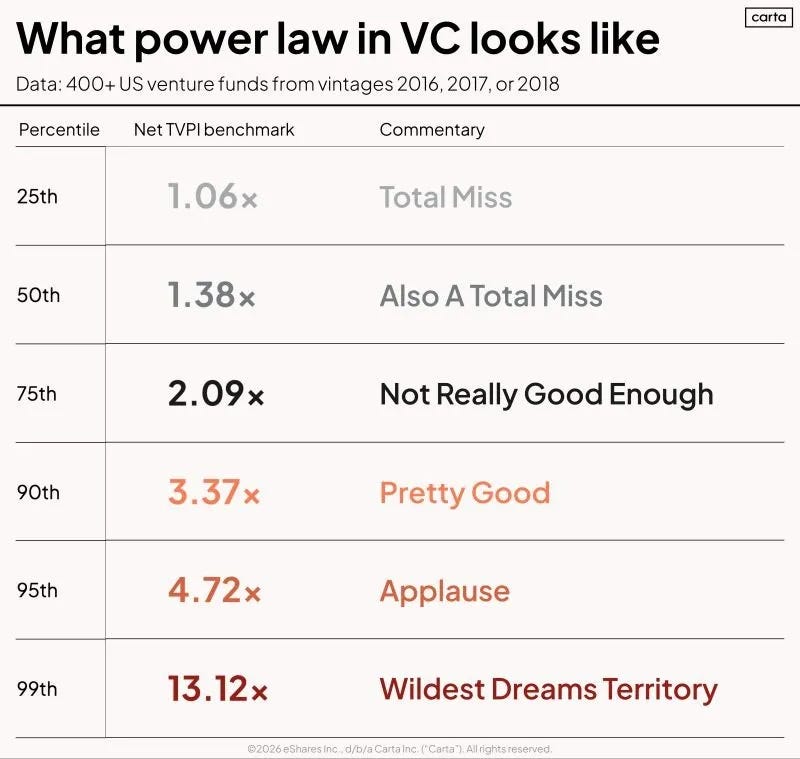
Carta looked at more than 400 U.S. venture funds from the 2016, 2017 and 2018 vintages and compared their net TVPI.
TVPI (Total Value to Paid-In Capital) simply measures how much a fund’s investments are currently worth compared with the money investors put into it.
A 2x TVPI means every $1 invested is now worth about $2, including both realized and unrealised value.
The difference between an average fund and an exceptional fund is enormous.
At the 25th percentile, net TVPI is just 1.06x. Put simply, $1 invested is worth roughly $1.06 today. After years of taking startup risk and locking up capital, that’s essentially no meaningful return.
The median fund sits at 1.38x. That means $1 invested has become roughly $1.38. It sounds positive, but venture funds typically hold capital for many years, so the time involved makes that return far less impressive than the multiple initially suggests.
Even reaching the 75th percentile only gets a fund to 2.09x. In other words, being better than roughly three quarters of the funds in the dataset still doesn’t necessarily produce exceptional venture returns
Then the curve changes dramatically.
The top 10% of VC funds reach at least 3.37x TVPI, the top 5% reach 4.72x, and the top 1% jump to 13.12x.
Put differently, a hypothetical $1 million investment would correspond to roughly $1.38M at the median, $3.37M at the 90th percentile, $4.72M at the 95th, and more than $13M at the 99th.
This is why simply saying a VC fund “made money” doesn’t mean much. Investors are taking illiquidity, startup failure risk, and long holding periods, so returns need to justify that risk.
For LPs, access to exceptional managers can dramatically change portfolio outcomes. For VCs, consistently picking good startups isn’t enough. A few extraordinary companies often drive most of the fund’s returns.
The power law is clear: median performance looks ordinary, top-decile performance becomes attractive, and the top 1% operates in a completely different universe.
Being a VC is relatively easy. Generating exceptional venture returns is incredibly hard.
195 new unicorns in six months. What’s driving the surge?
After two years of slower funding and valuation resets, the global unicorn market is accelerating again. But this time, the rebound is being driven heavily by AI, robotics, chips and other capital-intensive technology companies.
Crunchbase counted 195 new unicorns globally in the first half of 2026, already surpassing the 193 companies that became unicorns during all of 2025. It is the strongest six-month period since the first half of 2022, although still below the extraordinary 2021 peak.
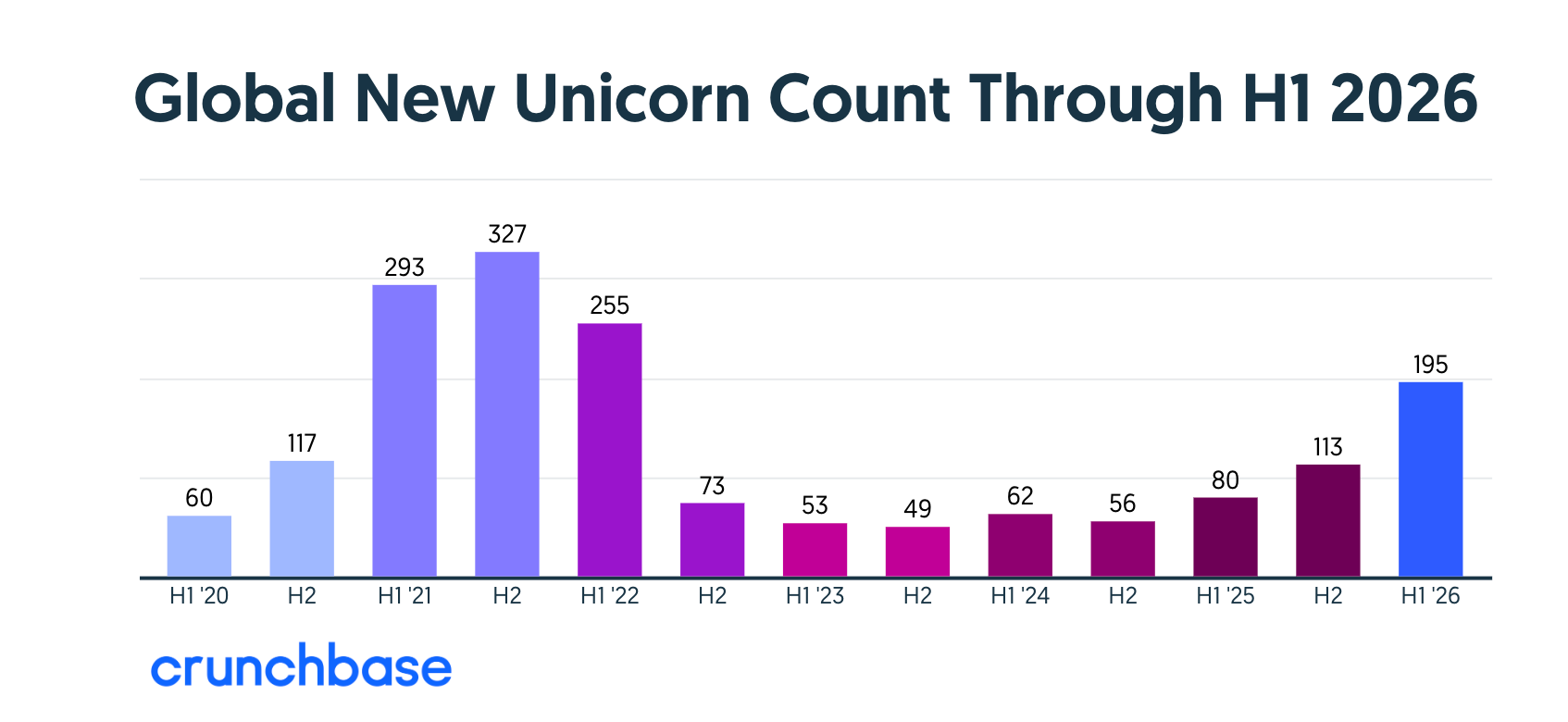
The acceleration is clear. New unicorn creation rose from 49 in H2 2023 to 62 in H1 2024, 80 in H1 2025, and 195 in H1 2026.
The 2026 cohort added roughly $440 billion in value to the Crunchbase Unicorn Board and has raised around $80 billion in funding. DeepSeek leads at a $50 billion valuation, followed by OKX at $25 billion and OpenAI Deployment Company at $14 billion.
Valuations are also moving faster. Crunchbase found that 19 new unicorns raised follow-on rounds within roughly six months, often at sharply higher valuations.
The market remains concentrated geographically. The U.S. produced 110 of the 195 new unicorns, followed by China with 38 and the U.K. with 13.
But the bigger story is where investors are placing their bets.
AI labs, robotics, AI infrastructure, semiconductors, defence, aerospace, and developer tools led the new unicorn cohort.
The recovery is real, but selective. Capital is flowing toward companies investors believe can dominate strategically important markets, often through successive rounds at rapidly rising valuations.
For founders, the 195-unicorn headline doesn’t mean fundraising is easy again. It shows that the gap between companies with strong investor momentum and everyone else is widening. Category, growth, strategic importance, and a credible path to market leadership matter more than ever.
📄 Must Read Post


SOMETHING MORE
🧩 Frameworks & insightful posts
Is your seed valuation actually about your startup or the fund’s math?
Founders often hear some version of: “We like the company, but we’re not there on valuation.”
It sounds like feedback on the business. Maybe traction is too early. Maybe the market story isn’t strong enough. Maybe another few months of growth gets the number up.
But often, the disagreement started before the meeting.
A fund has a fixed amount of capital, a typical initial cheque, and an ownership target it needs to make its portfolio economics work. Once those three numbers are known, there is already a rough ceiling on what it can pay.
For example, if a fund typically invests $600K and wants roughly 7% ownership, the math implies an ~$8.6M post-money valuation. If you’re raising at $18M, a better pitch probably isn’t solving the problem.
The problem is that the fund may simply not be built to lead that round.
This idea was broken down recently in a useful framework for understanding seed pricing: instead of starting with “what is my startup worth?”, start with what price can this specific fund structurally afford?
The chain is surprisingly simple:
Fund size influences how much capital is available for initial investments.
That determines the fund’s typical cheque size.
The cheque is divided by the ownership the fund wants.
That gives you the approximate post-money valuation where its model works.
So a $1M cheque targeting 10% ownership implies roughly a $10M post. A $2M cheque targeting 10% gets you closer to $20M.

That framing explains why two investors can look at the same company and come back with completely different valuations. They may not disagree much about the startup at all. They may simply be running different fund models.
And today, this matters more because seed prices have moved faster than many smaller funds’ portfolio construction.
At higher seed valuations, a smaller fund can find itself unable to hit its target ownership even when writing one of its largest normal cheques. When that happens, it generally has three choices:
Stay below market. Keep the ownership requirement and only lead companies at lower valuations.
Become a follower. Write smaller checks into rounds priced by somebody else and accept lower ownership.
Concentrate the portfolio. Make fewer investments so the fund can write larger checks into each company.
For founders, knowing which version you’re talking to changes the entire fundraising process.
There’s also a useful way to reverse the math from your side.
Round size ÷ dilution = implied post-money valuation.
If you need to raise $3M and are willing to sell 20%, you’re implicitly targeting a $15M post-money valuation. Once you know that, you can work backwards again and ask: what size fund normally writes the cheque required to lead this round?
That may be a much better way to build a target list than starting with brand names.
A few implications:
Research a fund’s typical cheque and ownership target before spending weeks in diligence.
Look at its recent deals, especially whether it actually leads or mostly follows.
Set your round size from the capital required to reach the next milestone, then calculate the valuation implied by acceptable dilution.
Don’t spend six weeks trying to convince an investor to violate the economics of their own fund.
And there’s one simple question founders can ask surprisingly early:
“What’s the typical initial check from this fund, and what ownership do you usually target?”
Those two numbers can tell you more about whether a deal is possible than another hour discussing TAM.
Remember - seed valuation isn’t purely a judgment of what your company is worth. It’s the intersection of your financing needs and the portfolio math of the investor sitting across from you.
Sometimes “we’re not there on valuation” really means exactly that. They aren’t. (Read More)
Can AI agents finally use computers well enough to replace back-office work? - (a16z’s data shows something unexpected)
For a long time, computer-use agents looked impressive in demos but broke down the moment they had to do real work. Clicking through portals, filling forms, updating CRMs, moving data between legacy systems - the kinds of tasks millions of people still do manually - required too much supervision to make the economics work.
That is starting to change.
Fabrizio Serafini, an investment partner at a16z focused on early-stage AI, recently shared a detailed look at how far computer-use agents have progressed and what teams are actually seeing in production.
The most striking number is the performance jump.
A year ago, the best computer-use model scored roughly 42% on OSWorld-Verified, a benchmark that tests agents on real desktop tasks across Windows, Ubuntu, and macOS. Today, the leading score is around 85%, above the roughly 72% human baseline on the same benchmark.
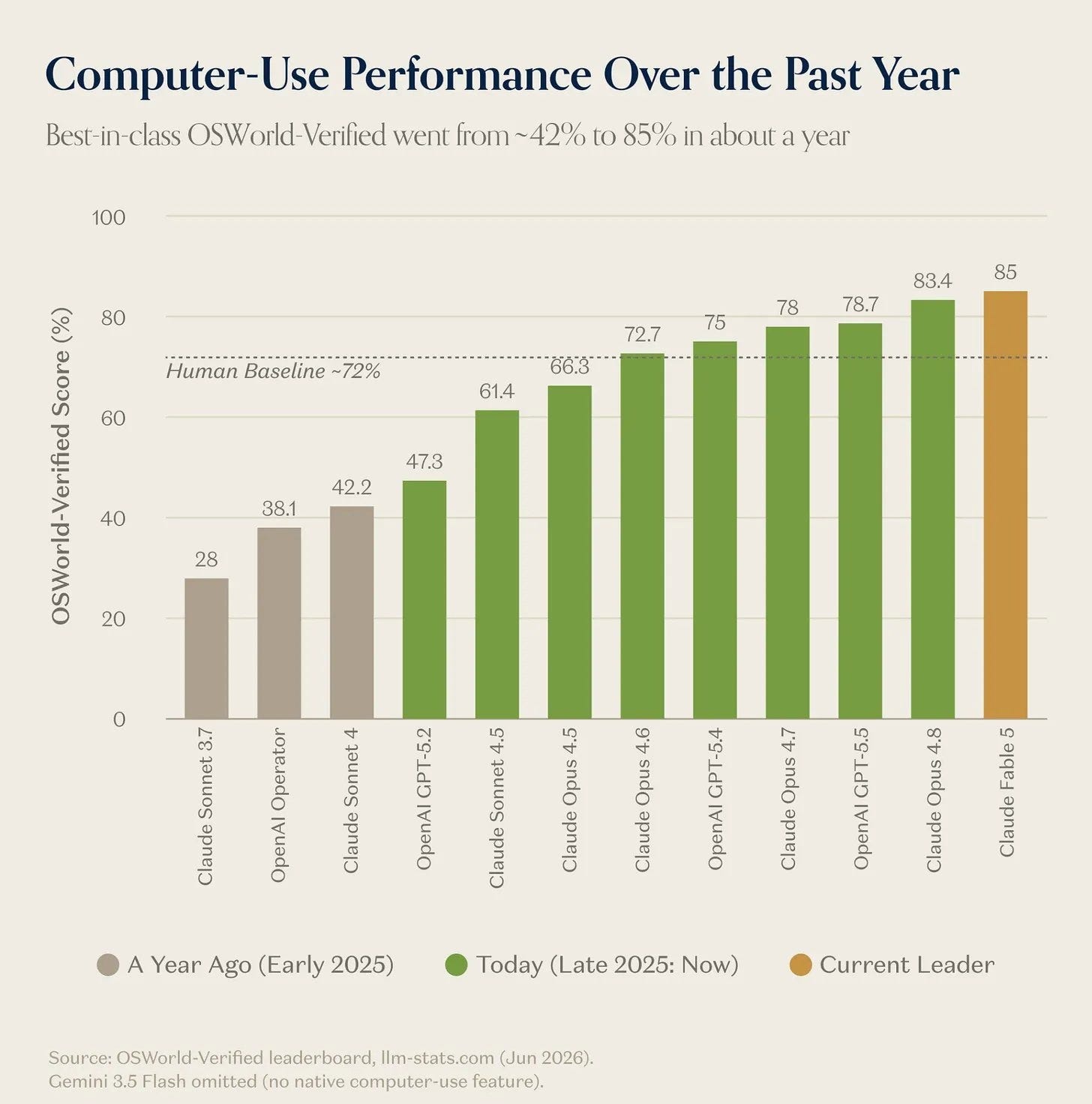
That doesn’t mean agents are suddenly perfect. An 85% score still means 15 failures out of every 100 tasks, and real business workflows rarely tolerate that kind of error rate.
But the capability has improved enough that companies are now deploying agents on narrow, repetitive workflows where the steps are predictable, and success can be verified.
Some of the best current use cases look surprisingly boring:
Updating systems of record and CRMs
Processing IT tickets
Pulling data from government, insurance, or retailer portals
QA and record checking
One example is a data platform running roughly 15–20 million automated portal interactions per month. Agents act as a fallback when traditional scrapers break after a retailer changes its interface, diagnosing the issue and repairing the automation before engineers need to step in.
Another company is running 27 computer-use workflows handling roughly 1,500-2,100 IT tickets a day.
So - the model itself is quickly becoming less important than everything around it.
If every frontier model can eventually click, type, and navigate software, then “computer use” itself isn’t much of a moat.
The durable value moves into the surrounding system:
What context does the agent have?
What permissions can it use?
How does it know what success looks like?
What happens when the workflow changes?
How does it verify its own work?
When should it escalate to a human?
Can repetitive portions be cached and turned into deterministic code?
That last point matters economically.
The article estimates a computer-use agent at roughly $6-8 per hour of inference, with a broader range of around $3–15 depending on the workflow and architecture.
Compare that with roughly:
Offshore BPO labour: ~$10/hour fully loaded
U.S. back-office labour: ~$30–45/hour fully loaded
Even in relatively expensive fully-agentic mode, the cost is already approaching offshore outsourcing economics and can be dramatically cheaper than U.S. labor.
And good systems don’t keep calling an expensive model for every click. One emerging pattern is to let the agent perform the workflow, convert repeatable portions into deterministic automation, then bring the model back only when something breaks.
That can push the blended cost much lower over time.
There is still a major limitation, though: verification.
Computer-use agents work best when success is immediately observable. If an agent updates a CRM field, the system can check the new value. If it files something into a portal and receives a confirmation, that’s measurable.
They struggle when the real outcome happens later or outside the system.
Imagine an agent submits an insurance claim successfully, but two days later an adjuster calls asking for a missing policy number. A human worker naturally resolves that call. The agent may never even know the process failed.
That’s why the current sweet spot is not “replace every office worker.”
It is much narrower:
High-volume workflows with repetitive steps, stable rules, legacy interfaces, clear verification, and obvious escalation paths.
The bigger opportunity for startups may therefore sit above the raw model layer.
As computer navigation becomes commoditised, the winners are likely to be the companies that understand a specific workflow deeply enough to package the context, credentials, guardrails, validation, and exception handling required to make the agent trustworthy in production.
The question is quickly moving from:
“Can an AI agent use a computer?” to:
“Can it reliably do this particular job without someone watching every step?”
That second question is where a very large new software market could be built.
Do the biggest startups actually come from the hottest trends? Sequoia analysed 20 years of tech trends.
Konstantine Buhler at Sequoia analysed nearly 20 years of Hacker News data, comparing the internet’s most-hyped technology topics each year with the most valuable company founded during that same year.
The biggest company created in a given year was rarely built around that year’s hottest trend.
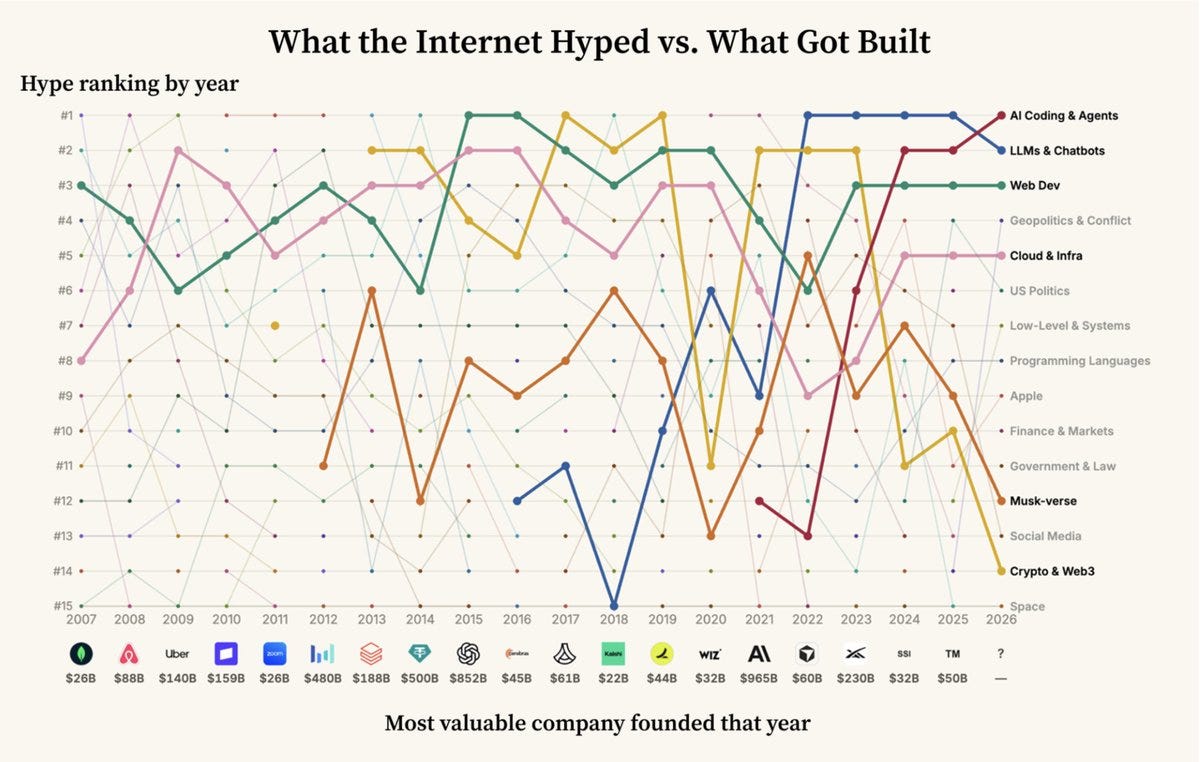
Airbnb was founded in 2008 while Google dominated online discussion.
Uber launched in 2009 when low-level programming was among the hottest topics.
Anthropic started in 2021 while crypto dominated attention.
But hype isn’t useless. Major trends often appear 5-6 years before they become mainstream.
LLMs entered the top 15 in 2016 before reaching #1 in 2022;
AI coding appeared in 2021 and now tops the ranking in 2026.
The stronger signal may be persistent attention rather than sudden hype. Topics that remain relevant for years can indicate a deeper technological shift, while short-lived spikes are easier to mistake for opportunity.
So as founders or investors: don’t automatically build where everyone is looking today. Watch what small technical communities keep talking about long before the rest of the market cares.
The best opportunities may not sit at peak hype - they may be hiding in the trends quietly compounding underneath it.
📬 Upgrade to Venture Curator Premium
Get access to 150+ premium archive posts, 100+ startup & VC resources, investor databases, fundraising templates, and exclusive startup research - all in one place.
TODAY’S JOB OPPORTUNITIES
💼 Venture capital & startup jobs
Why your CV keeps getting ignored for VC jobs (and how to fix it): How to reframe your experience into clear venture signals, add an investing exposure section, and create proof of work that shows you are already doing the job before anyone hires you.
Analyst - Yournest Capital | India - Apply Here
Financial Management Analyst - Duke Capital Partner | USA - Apply Here
VC Associate - Artha Group | India - Apply Here
Investment Principal - Contrarian Thinking Capital | USA - Apply Here
Senior Associate - Yamaha Motor Venture | USA - Apply Here
Principal - Neuraleap Group | India - Apply Here
Incubation Associate, Compute - Primary | USA - Apply Here
Associate or Senior Associate - Bessemer Partner | USA - Apply Here
Partner 18, Events Associate, Crypto - a16z | USA - Apply Here
AI Analyst - Array Venture | USA - Apply Here
SMB Program Associate - Plug and Play Tech Centre | USA - Apply Here
VC Fellow - V11 | Remote - Apply Here
Associate, Healthcare - B Capital Group | USA - Apply Here
Portfolio Reporting Team Lead - Cerity Partner | USA - Apply Here
Associate - Mount Judi Venture | USA - Apply Here
Technical Investment Operations Associate - Alpaca VC | USA - Apply Here
Partnership With Us
Get your product in front of over 125,000+ audience - Our newsletter is read by thousands of tech professionals, founders, investors and managers worldwide. Get in touch today.
Upgrade to Venture Curator Premium
Get access to 150+ premium archive posts, 100+ startup & VC resources, investor databases, fundraising templates, and exclusive startup research - all in one place.
(Subscribe to Venture Curator Premium and get 20% off forever.)
This framework resonates deeply in India, where startup valuations often anchor to Silicon Valley norms without accounting for local fund sizes.
Indian seed funds typically write smaller cheques, so the implied post-money is far lower than global benchmarks suggest. Founders here should reverse-engineer valuations from domestic fund economics, not copy US headlines.
For financial planners, this also highlights the risk in advising startup employees on ESOPs — valuation gaps can be stark.