
👋 Hey, Sahil here - welcome to today’s edition of Venture Curator, where we break down how great startups grow, how top investors think, and what’s shaping the future of tech.
P.S. Get access to 100+ startup & VC resources, investor databases, fundraising templates, 150+ premium archive posts and exclusive startup research - all in one place.
FROM OUR PARTNER - SIMPLEX CHAT
Investors are backing SimpleX Chat, the messaging network built without any user identifiers
Most messaging platforms rely on some form of persistent identity, whether that is a phone number, email, username or public key.
SimpleX Chat is taking a different approach.

It is building a private messaging network with no user identifiers, where every conversation has its own network address and user data stays on people’s devices instead of being stored centrally.
Why investors are paying attention:
520,000+ monthly active users without paid marketing
3M+ app downloads and 20M+ messages sent per day
17x growth from 2023 round, only 2x valuation cap
$650,000+ in community donations
1,000+ community servers and 19,000+ GitHub stars
Open-source technology reviewed by Trail of Bits
SimpleX is building beyond private messaging.
The broader idea is a private communication layer for messages, communities, businesses and eventually agent-to-agent communication, while keeping privacy built into the network architecture.
SimpleX Chat has now opened its equity crowdfunding round to the community.
For this promotion we received 2 public names on SimpleX Network, venturecurator.simplex and venturedailydigest.simplex, registered for 5 years from the names launch on December 12. We will later write about what SimpleX names are and how they work.
📜 DEEP DIVE
How are new-age startups pivoting, and what do VCs make of it? An analysis of 18 AI-era pivots.
I’ve been talking to a few investor friends about something I kept noticing in the companies we’ve covered over the last month, across how AI startups got their first customers, which ones die after a model release, and which categories investors funded and then abandoned.
Cursor, Perplexity, Lovable, Mercor, Decagon. Five of the fastest-growing AI companies of the decade, and not one of them is doing what it started doing. Cursor was building AI for mechanical engineers. Perplexity was a text-to-SQL tool. Lovable was an open-source GitHub project with no revenue. Mercor was matching engineers to jobs.
That’s not a coincidence, and it’s not the old “every great company pivots” line either. When I put the dates next to each other, something more specific showed up: the ones that became category leaders all pivoted inside their first 18 months, before they had revenue worth protecting. The ones that pivoted after year three mostly survived, but smaller. And the ones that were forced into it by an acquihire or a cash crisis rarely came out the other side as an independent company.
One of the investors I spoke with said the thing that made me want to write this:
“The pivot used to be a conversation. Now it’s a notification. I find out when the product changes.”
That’s a different relationship than the one every founder guide describes.
So this issue is about what actually changed. Not “should you pivot,” which the data answers with an 81%. But how AI-era companies pivot differently, what the timing data says, which kinds of pivots produced winners, and how your investors read it now that the cost of building has collapsed and the price of your seed round has doubled.
Here’s what we’re covering:
The survey numbers: pivoting is the default, and most founders think they did it late
Three things that changed about pivoting since 2022, with the data
The 18-month line: when the winners pivoted vs everyone else
The full pivot map: 18 companies, what they changed, how it ended
The four pivot types and which one actually produces category leaders
How your existing investors read a pivot now: higher prices, less patience, milestone-gated bridges, and the AI-washing test
The pivot conversation, and the memo that gets a bridge instead of “let’s stay close”
A scorecard for your own situation
The survey numbers: pivoting is the default now, and most founders think they were slow
Start with the number nobody argues with. In Wilbur Labs’ February 2026 survey of 200 founders, 81% said their company pivoted from its original idea, and 57% made a major pivot or more than one. That’s higher than any pre-AI survey I can find. And the regret runs one way: 42% said they wished they had pivoted sooner. Almost nobody wishes they’d waited.
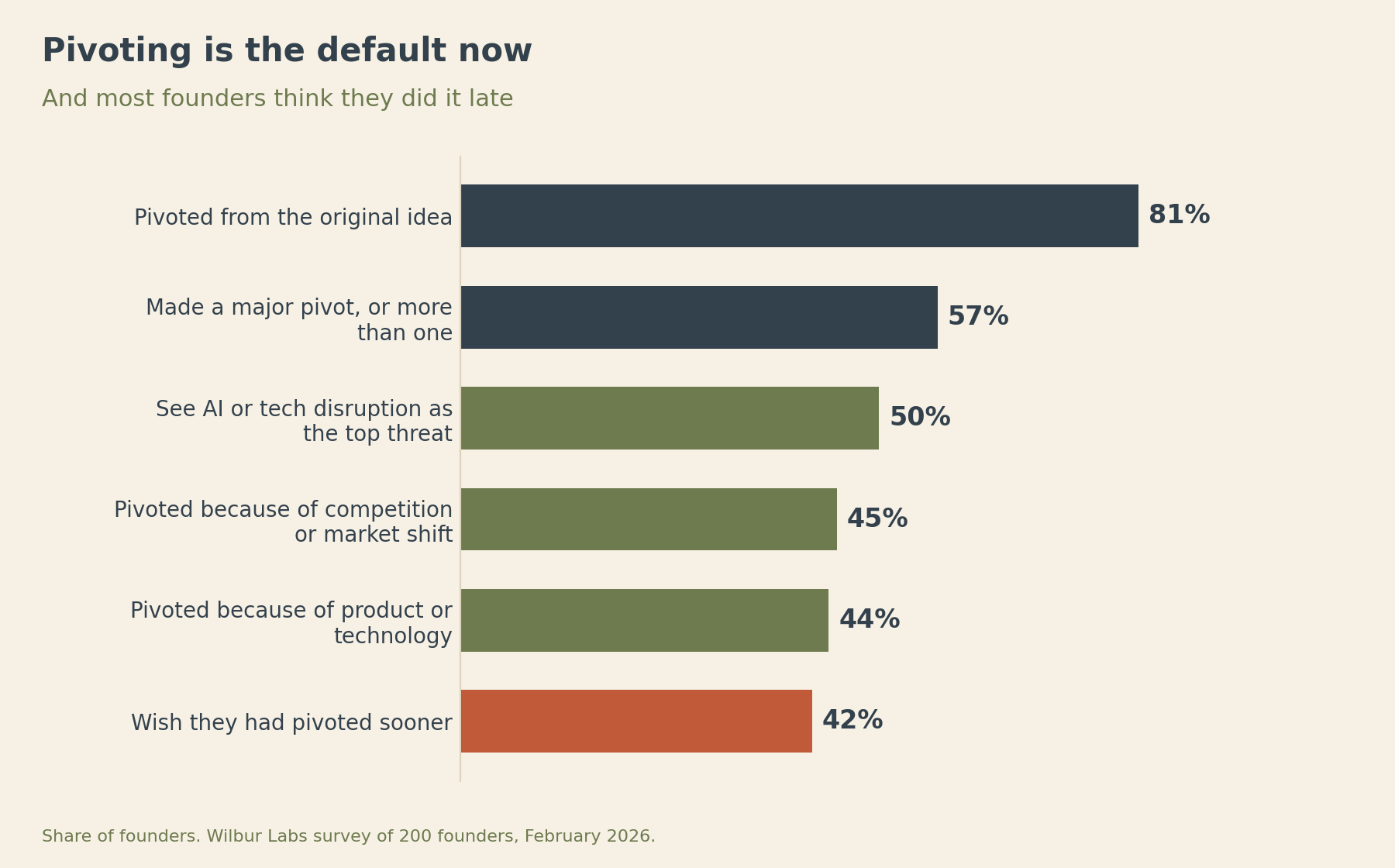
Two more numbers from the same survey matter for what comes next. When asked why they pivoted or failed, founders pointed almost equally to competition and market shifts (45%) and product or technology issues (44%). And half of them named technological disruption, including AI, as the top threat to their company. In 2023, the top reason was running out of money.
By 2026, money dropped to 25%, and the market moved to the top. That’s a different kind of pivot trigger, and it was the first thing to change.
Three things that changed about pivoting since 2022
Every pivot guide you’ve read assumes three things: building the new thing takes months, the trigger is “customers didn’t want the old thing,” and your investors are part of the decision.
All three have shifted.