


👋 Hey, Sahil here - welcome back to Venture Curator, where we explore how top investors think, how real founders build, and the strategies shaping tomorrow’s companies.
Big idea + report of the week :
Which companies are producing next unicorn founders?
Is geography becoming more important in the AI era?
Why are so many 2021 venture funds underperforming?
Frameworks & insightful posts :
Y-Combinator advice: What should founders build as AI moves into the real world?
What did 7,200 developers reveal about AI coding?: The State of Web Dev AI 2026 report.
Get access to 150+ premium archive posts, 100+ startup & VC resources, investor databases, fundraising templates, and exclusive startup research - all in one place.
FROM OUR PARTNER - CYTONICS
Could This Company be Big Pharma’s Next Acquisition?

Big Pharma’s spent decades and $1B trying to find the cure for osteoarthritis, without luck. But soon, their focus may shift to Cytonics, the company that believes it has a solution.
Their next-gen therapy cleared Phase 1 safety trials and is moving to the next phase.
Historically, Pharma companies acquire biotechs near this point, when efficacy data exists but no price is set. Take BMS’s $74B acquisition of Celgene, for example*.
While nothing’s guaranteed, an uncured $560B disease is exactly what acquirers look for.
These are the final days to join 7,500+ shareholders and invest in Cytonics.
*Comparisons to acquisitions are for informational purposes only
This is a paid advertisement for Cytonics Regulation CF offering. Please read the offering circular at https://invest.cytonics.com
Forward-looking statements are subject to risks and uncertainties. There is no guarantee of performance. Past performance does not predict future results. All investments involve risk, including loss of principal.
WORK WITH US
🤝 Partnership With Us
Get your product in front of over 125,000+ audience - Our newsletter is read by thousands of tech professionals, founders, investors and managers worldwide. Get in touch today.
START WITH
🧠 Big idea + report of the week
Which companies are producing next unicorn founders?
For years, the “PayPal Mafia” was considered the ultimate startup factory. Many of Silicon Valley’s most successful founders had worked at PayPal before launching billion-dollar companies. But that pipeline is changing fast.
Recently, Ilya Strebulaev from Stanford GSB analysed the backgrounds of 4,357 unicorn founders and found that a new generation of companies is now producing the next wave of billion-dollar entrepreneurs.
One of the biggest shifts is where future founders are coming from. The old leaders have lost ground:
PayPal’s odds of producing a unicorn founder dropped from 12.0x before 2016 to 1.7x today.
LinkedIn fell from 6.0x to 1.1x.
Apache Software Foundation and Qualcomm also saw similar declines.
Meanwhile, newer technology companies have become the strongest founder pipelines:
OpenAI now has the highest odds ratio, with alumni being 14.7x more likely to become unicorn founders than a random sample.
Check Point and D.E. Shaw also rank among today’s strongest founder-producing organisations.
Google, Facebook, and MIT have all become significantly stronger launchpads for new founders over the past decade.
The research also highlights another consistent pattern:
great startup teams are usually built from existing relationships, not cold introductions.
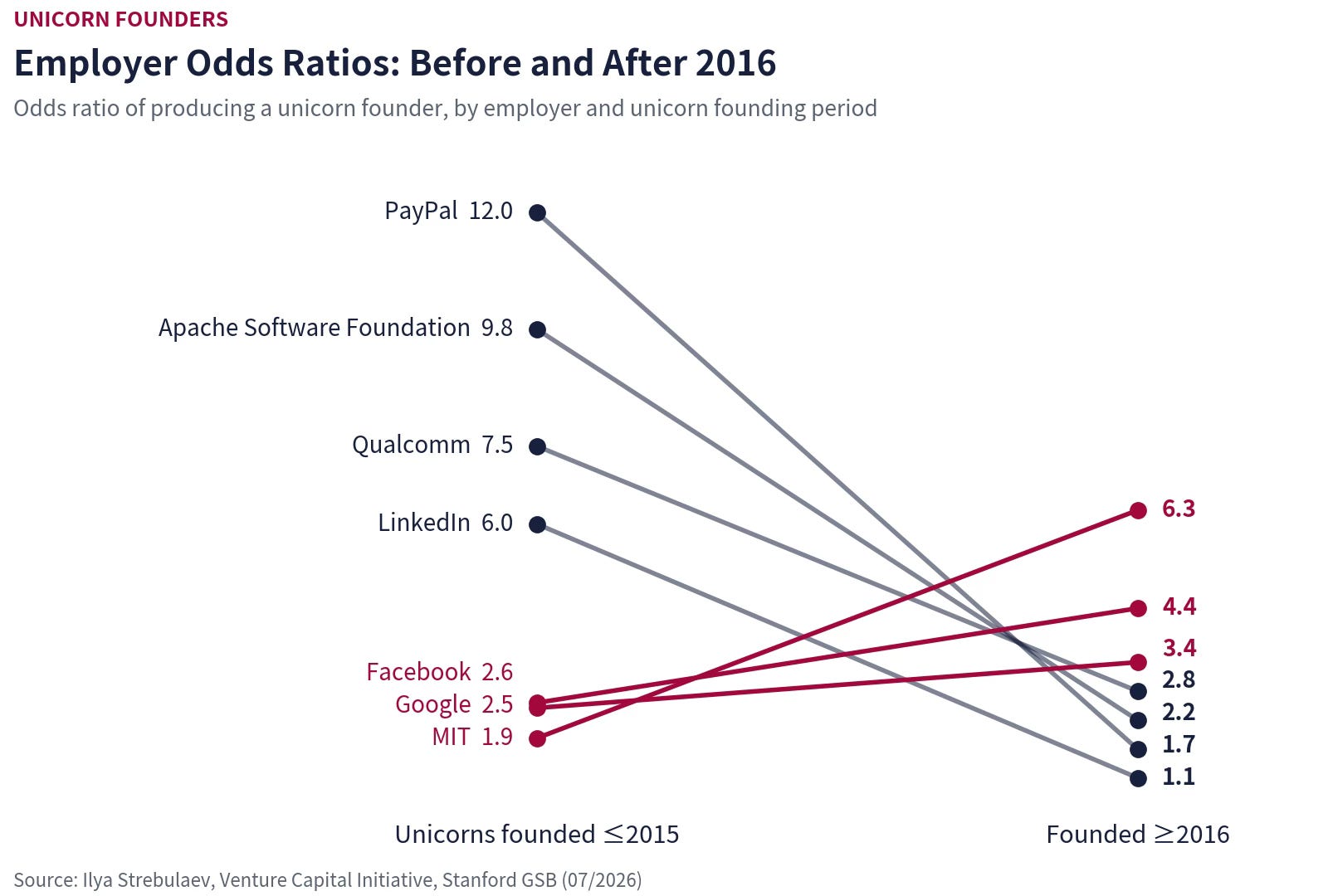
Among 1,377 US unicorns with multiple founders, nearly 69% of founding teams had previously worked or studied together. Shared workplaces were even more common than shared universities, suggesting that strong professional relationships often become the foundation for successful startups.
The takeaway isn’t that working at one of these companies guarantees success. Rather, the best founder factories tend to give people three advantages: they solve difficult problems, work alongside exceptional talent, and build lasting relationships with future co-founders.
As the AI era unfolds, today’s high-growth AI companies may become tomorrow’s equivalent of the PayPal Mafia, producing the next generation of billion-dollar founders.
Is geography becoming more important in the AI era?
For years, many people predicted that remote work would make location irrelevant. The thinking was simple: if great companies can be built from anywhere, capital would eventually spread everywhere.
The latest data suggests the opposite is happening.
Carta analysed $124 billion invested into U.S. startups between July 2025 and June 2026, ranking startup ecosystems by where companies are headquartered. Instead of venture capital becoming more distributed, the AI cycle is pulling even more money into a handful of cities.
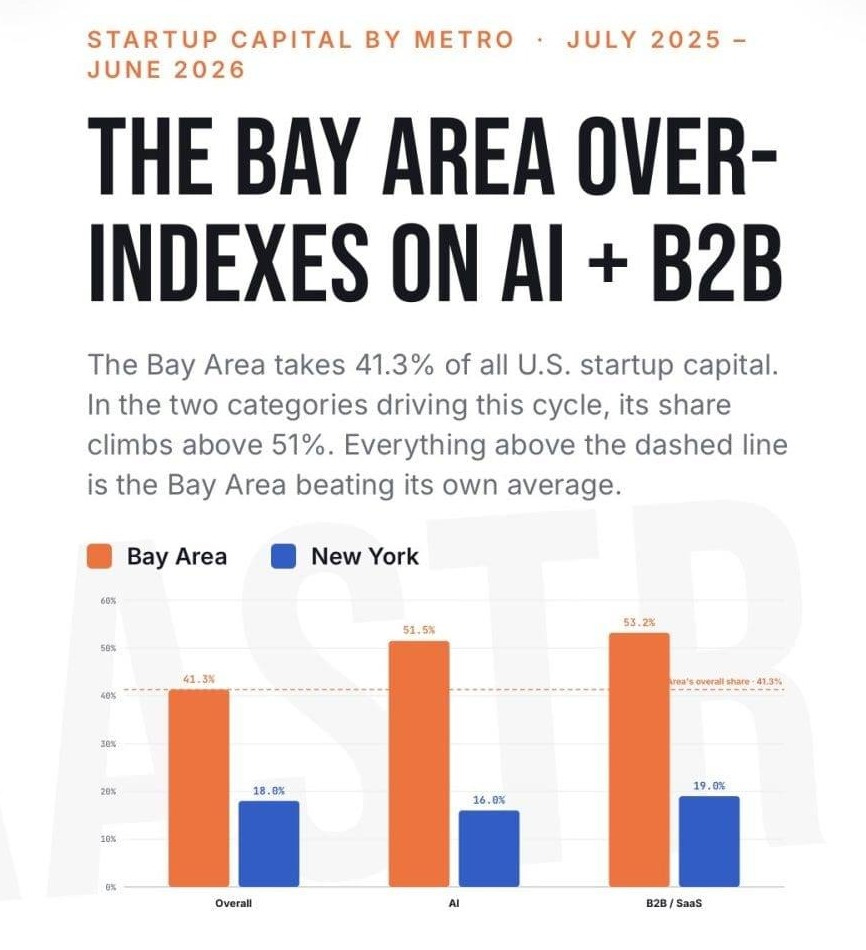
The Bay Area alone attracted 41.3% of all U.S. startup funding, or $51.3 billion, more than double New York’s 18% share.
But the real story appears when looking at AI and B2B.
The Bay Area captured 51.5% of every AI venture dollar and 53.2% of every SaaS/B2B dollar invested during the period. That means more than half of all capital flowing into the two sectors driving today’s venture market ended up in a single metro.
The concentration becomes even more striking when New York is added.
Together, the Bay Area and New York account for 67.5% of AI funding and 72.2% of B2B funding. In other words, nearly seven out of every ten venture dollars invested into B2B startups are flowing to companies headquartered in just two ecosystems.
The leaderboard also reveals that startup ecosystems are becoming increasingly specialised.
While the Bay Area dominates AI, SaaS, biotech, healthcare and hardware, New York overwhelmingly leads fintech, capturing 58.9% of funding in the category. Boston remains a strong biotech hub, while cities like Austin and Los Angeles appear in specific sectors but at much smaller shares.
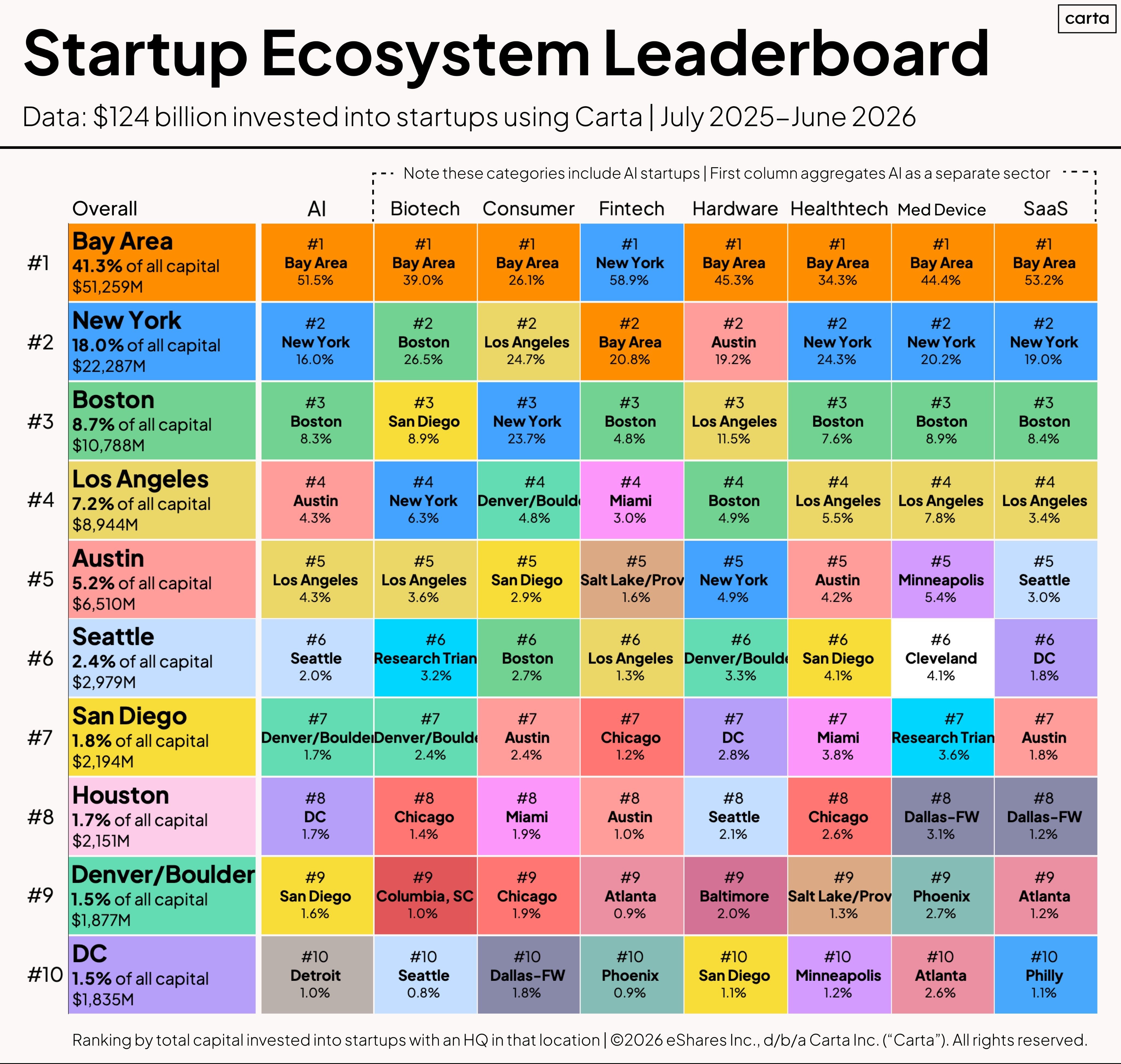
The numbers reinforce an important pattern:
Venture Capital follows ecosystems where talent, customers, founders and experienced investors are already concentrated.
AI infrastructure talent continues to cluster around the Bay Area, while financial services expertise remains heavily concentrated in New York.
For founders, this doesn’t mean you must move to San Francisco to build a successful company. Great companies will continue to emerge everywhere.
But if you’re building an AI or B2B startup and planning to raise institutional capital, geography is still part of the fundraising equation. Being close to customers, investors, and other ambitious founders creates more opportunities for introductions, hiring and fundraising momentum than many founders assume.
The AI era isn’t making venture capital more evenly distributed. If anything, it’s making the biggest startup ecosystems even stronger.
Why are so many 2021 venture funds underperforming?
For years, venture capital operated on a simple promise.
Invest in the next generation of startups, wait patiently, and eventually the winners will return the entire fund multiple times over.
But what happens when almost everyone invested at the same time, at the same peak valuations?
Peter Walker from Carta recently analysed performance data across 2,689 US venture funds, and one chart stands out.
The 2021 vintage is struggling.
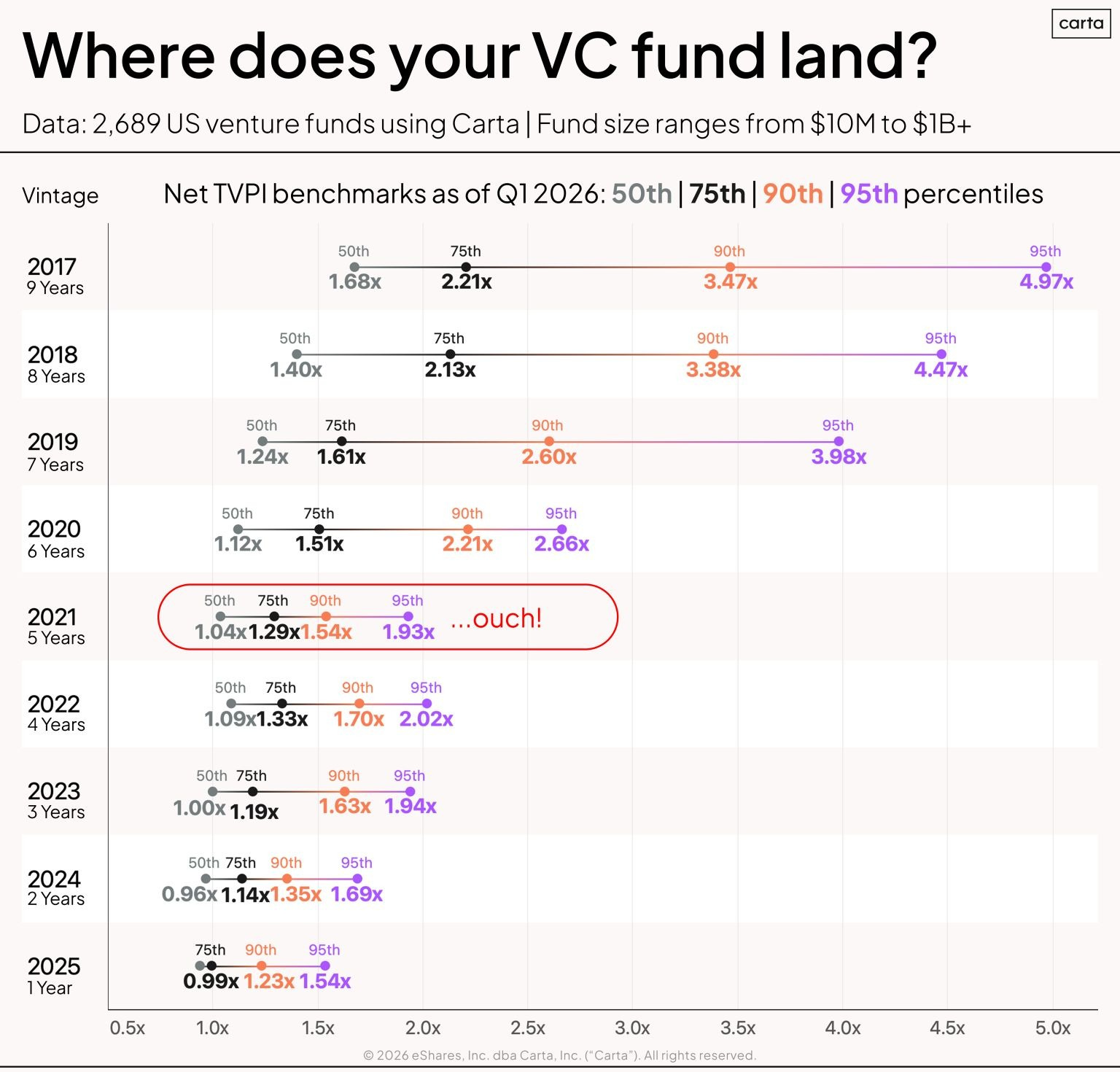
Five years into its life cycle, the median 2021 venture fund sits at just 1.04x Net TVPI.
In simple terms, the average fund has barely created value beyond the capital it invested.
Some of the numbers are striking:
The median 2021 fund sits at 1.04x.
Even the top 25% of funds have only reached 1.29x.
The top 10% of funds are at 1.54x.
The top 5% of funds have reached 1.93x.
That might sound reasonable until you compare it with older vintages.
The 2017 cohort tells a very different story.
At roughly the same stage of maturity, the median 2017 fund reached 1.68x, while the 90th percentile reached 3.47x.
Perhaps the most surprising comparison:
The 95th percentile fund from 2021 (1.93x) is still below the 75th percentile fund from 2017 (2.21x).
In other words, some of today’s best-performing funds would have looked merely above average a few years ago.
So what happened? Walker points to four forces colliding at the same time.
Record numbers of investors entered venture during the boom.
Startup valuations reached historic highs.
Interest rates reversed sharply in 2022.
AI emerged as a major platform shift shortly after many 2021 funds had already deployed capital elsewhere.
The result was a perfect storm.
Many investors bought into companies at peak prices just before capital became more expensive and public market multiples compressed.
The venture industry is still working through that adjustment.
Interestingly, newer vintages appear to be recovering.
The 2022 vintage, despite launching during a difficult fundraising environment, is already showing stronger numbers. Its 90th percentile sits at 1.70x, while the top 5% have crossed 2.0x.
That suggests the problem may not be venture capital itself. It may simply be that 2021 was one of the most expensive moments in startup history to put money to work.
The broader lesson is an uncomfortable one.
Venture returns are often determined long before a company exits.
They’re heavily influenced by the price investors pay on the day they enter.
And for many funds raised during the 2021 boom, that entry price may prove to be the defining story of the entire vintage.
FEATURED POSTS
📄 Must Read Post
What happens when a VC reference-checks a founder (And who they actually call).

👋 Hey, Sahil here - welcome to today’s edition of Venture Curator, where we break down how great startups grow, how top investors think, and what’s shaping the future of tech.
How to get investors interested months before you raise (with the exact emails that get replies).

👋 Hey, Sahil here - welcome to today’s edition of Venture Curator, where we break down how great startups grow, how top investors think, and what’s shaping the future of tech.
How to get a warm intro to VC without a network? (The ranking system most founders don't know exists.)

👋 Hey, Sahil here - welcome to today’s edition of Venture Curator, where we break down how great startups grow, how top investors think, and what’s shaping the future of tech.
SOMETHING MORE
🧩 Frameworks & insightful posts
Y-Combinator advice: What should founders build as AI moves into the real world?
AI is no longer limited to chatbots, copilots, and software tools. It is beginning to shape how children learn, how physical work gets managed, how companies stay compliant, how defence systems operate, and even where future data centres may be built.
The problem is that most startup activity still clusters around familiar AI use cases. Hundreds of teams are building similar agents, while some of the largest and hardest markets remain underserved because they require deeper domain knowledge, hardware, regulation, or new infrastructure.
Y Combinator recently shared its Fall 2026 Requests for Startups, outlining the areas where its partners believe ambitious founders should look next. The list is less about adding AI to existing products and more about rebuilding important systems around intelligence from day one.
Some of the strongest ideas include:
The Primer: A deeply personalised AI tutor that grows with a child, beginning with reading, writing, and arithmetic before gradually helping them develop reasoning and independent thinking.
Multiplayer AI: Shared agent workspaces where several employees can watch, guide, and collaborate with the same AI agent, instead of every employee working inside isolated chat threads.
A cloud for small software: Infrastructure for the lightweight internal tools people can now create with coding agents. The ambition is to make custom software as easy to deploy and share as a Google Doc.
New operating systems for physical work: Platforms designed to coordinate humans, robots, wearables, and AI agents across construction, maintenance, logistics, and field operations.
AI for an aging population: Voice assistants, monitoring systems, care-coordination tools, and robotics that help older adults remain independent while reducing pressure on families and caregivers.
Proving you are human: A new internet trust layer that verifies whether the person behind a call, message, review, or transaction is real without forcing everyone to surrender their privacy.
AI-native compliance infrastructure: Systems that monitor regulatory changes, generate reports, maintain audit trails, and reduce the growing cost of operating across multiple jurisdictions.
Self-maintaining APIs: Agents that detect when an API changes, identify affected customer code, and automatically open a pull request containing the required fix.
YC is also asking founders to explore defence technology, low-cost interceptors, offshore data centres, crypto rails for agentic commerce, consumer AI products for billions of people, and new systems for collecting physical-world data.
What stands out is that the most promising opportunities are not necessarily another AI interface.
They sit inside difficult workflows where information is fragmented, labour is expensive, infrastructure is outdated, and existing software was designed for a world run entirely by humans.
The next generation of large AI companies may therefore look less like chatbots and more like education systems, compliance networks, industrial operating systems, defence infrastructure, and shared workplaces where humans and agents operate together.
What did 7,200 developers reveal about AI coding?: The State of Web Dev AI 2026 report.
A few years ago, AI coding tools were mostly autocomplete on steroids.
Today, they’re becoming a core part of how software gets built.
The team behind the State of Web Dev AI 2026 surveyed more than 7,200 developers to understand how AI is changing software development. One finding stood out immediately:
Just one year ago, developers said AI generated about 28% of their code on average. Today that number has climbed to 54%.
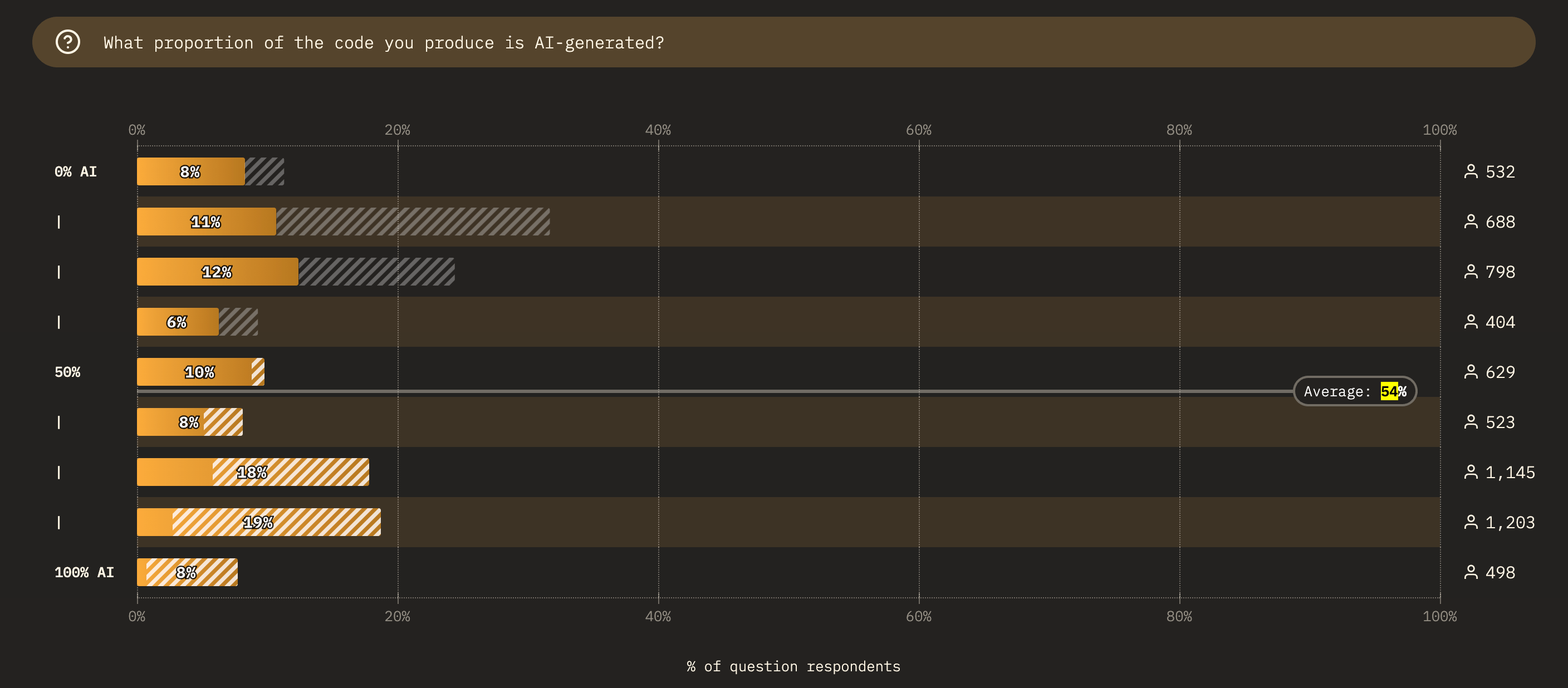
In other words, the average developer now produces more code with AI than without it.
The biggest growth came from developers who say more than 75% of their code is AI-generated. At the same time, the number of people using AI “constantly” while coding doubled year-over-year.
But the more interesting shift is not just how much AI is being used.
It’s how developers are choosing to use it.
Coding agents are replacing chatbots
The early AI era was dominated by chat interfaces. Developers copied code into ChatGPT, asked questions, received suggestions, and manually implemented changes.
Now a new category is emerging: coding agents.
Among all coding tools surveyed, Claude Code received the highest positive sentiment score, ahead of OpenAI Codex and GitHub Copilot.
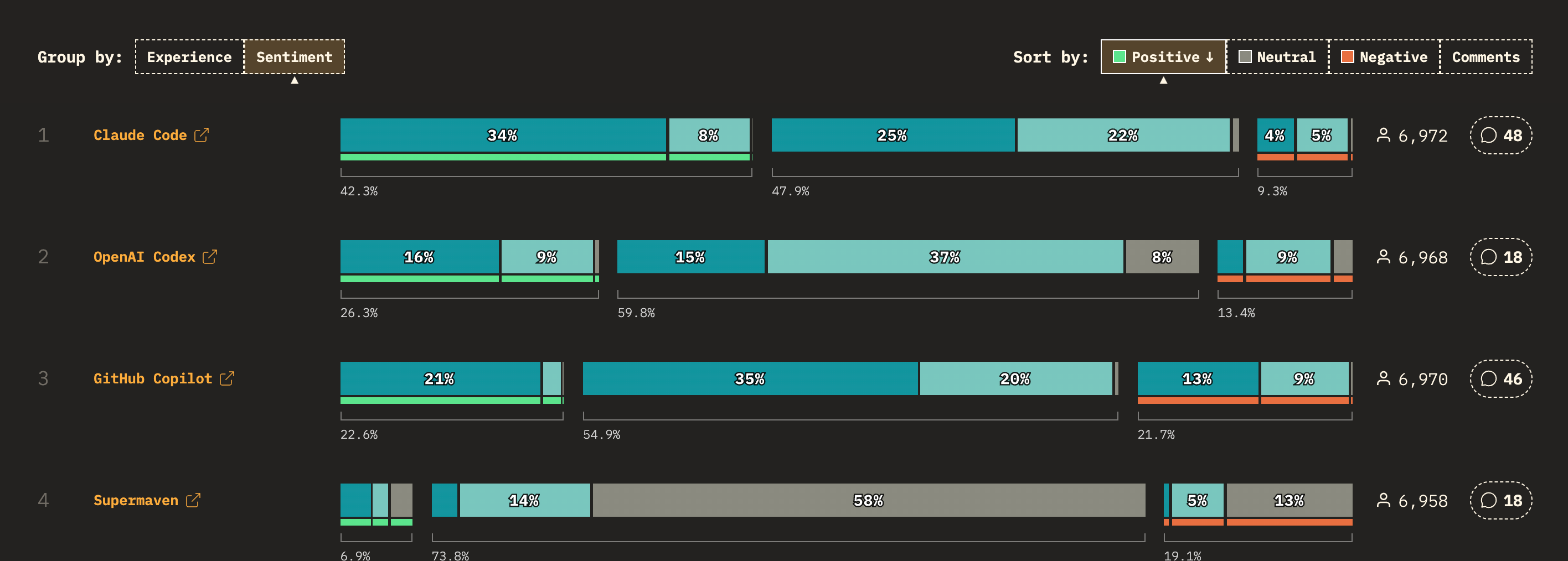
Instead of simply answering questions, these agents can navigate repositories, edit files, execute tasks, and work across larger parts of a codebase.
The interface is shifting from “ask AI a question” to “assign AI a task.”
That’s a very different product category.
Claude is winning where developers spend money
ChatGPT remains the most widely known AI product. But when respondents were asked which AI tools they actually pay for, Claude ranked first.
More developers reported paying for Claude than ChatGPT, Gemini, Copilot, Perplexity, or any other AI product.
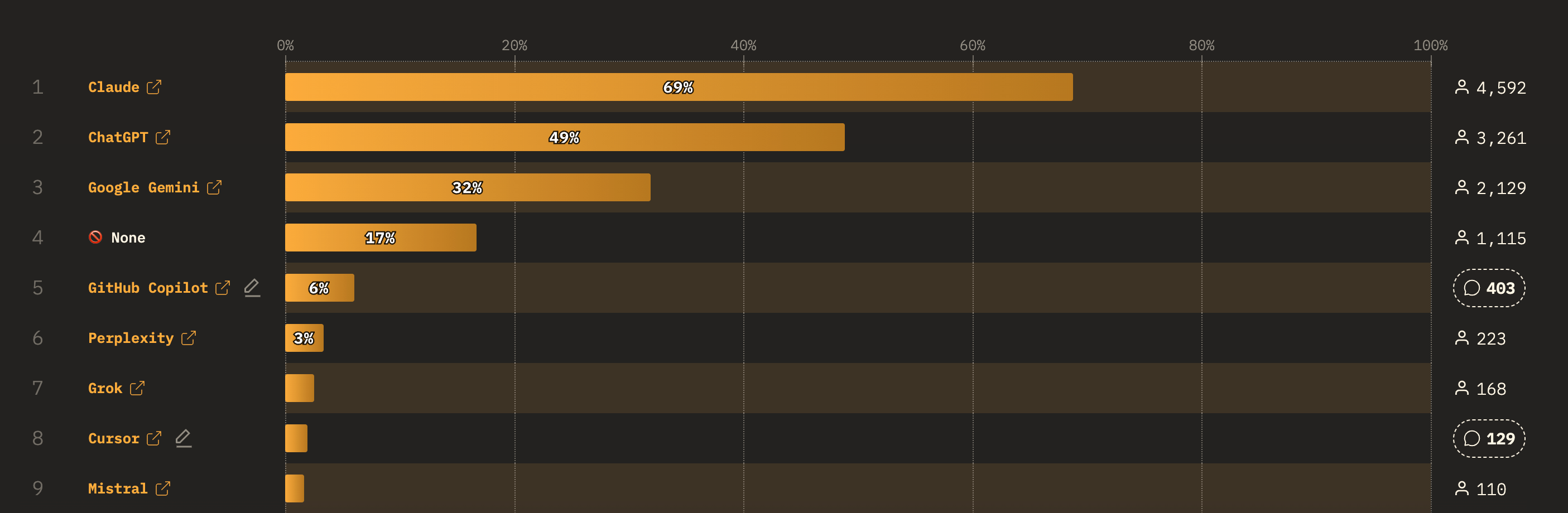
This matters because consumer popularity and willingness to pay are not the same thing.
Developers appear to be rewarding products that directly improve workflow productivity rather than general-purpose assistants.
It’s one reason why Anthropic has been gaining momentum inside engineering teams over the past year.
Developers are spending more on AI
The era of cheap AI is slowly ending. As adoption grows, AI companies are becoming more aggressive about monetisation.

The survey shows growing numbers of developers spending between $50 and $500 per month on AI tools.
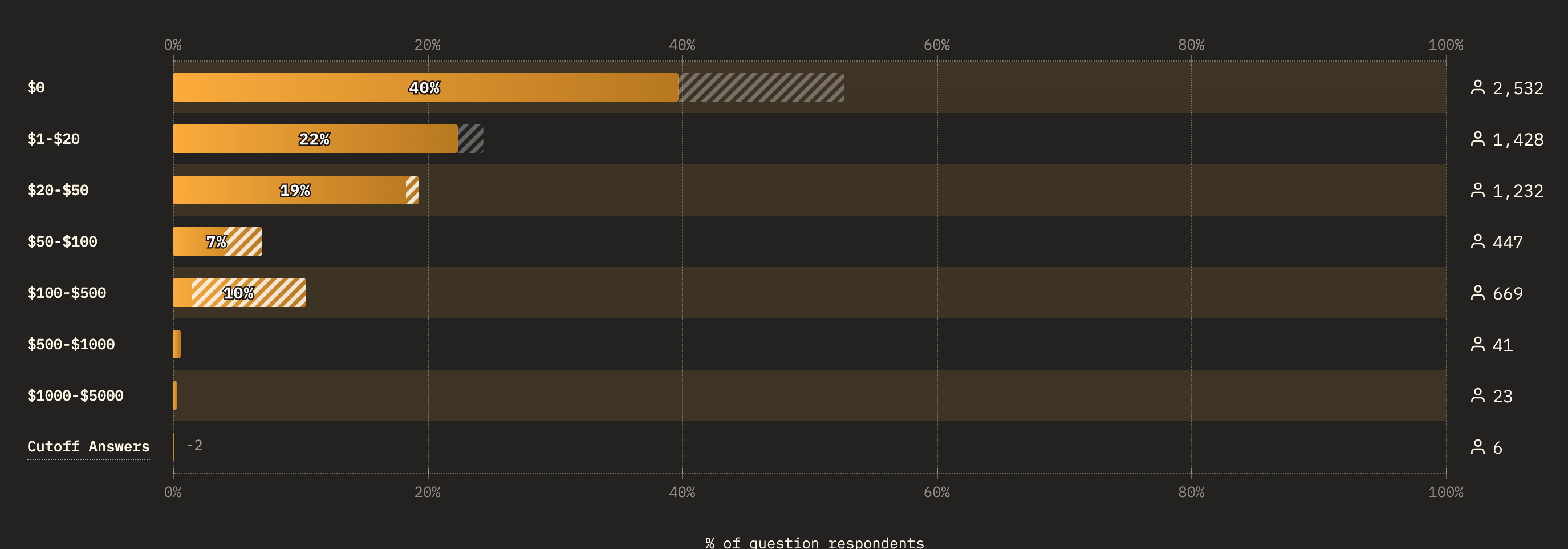
Many teams now view AI subscriptions the same way they view cloud infrastructure, GitHub, or productivity software: a standard operating expense.
The question investors are asking is whether this spending growth can eventually justify the enormous valuations assigned to AI companies.
Developers aren’t convinced. A majority of respondents either agreed or strongly agreed that we’re currently living through an AI bubble.
The biggest fear isn’t technology. It’s jobs.
Despite widespread adoption, developers remain worried about what comes next.
Job displacement ranked as the most concerning AI risk, ahead of military applications, environmental impact, security risks, and AI-generated misinformation.
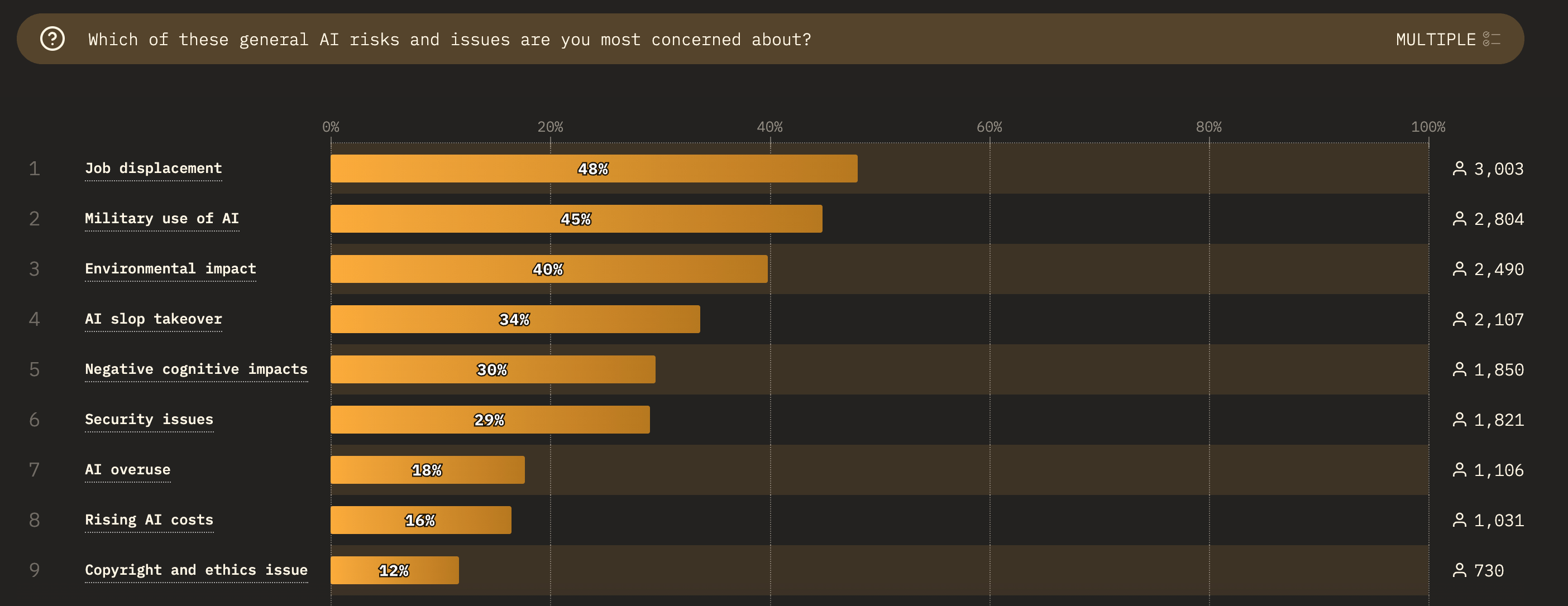
The concern isn’t necessarily that AI can already replace engineers. It’s that managers may eventually believe it can.
That distinction matters. Technology adoption often changes labor markets long before technology fully replaces labor.
AI still has a trust problem
For all the progress made by modern models, developers continue to report the same core frustration.
Hallucinations remain the number one pain point. Respondents also highlighted poor code quality, lack of context, privacy concerns, and rising costs as major issues.
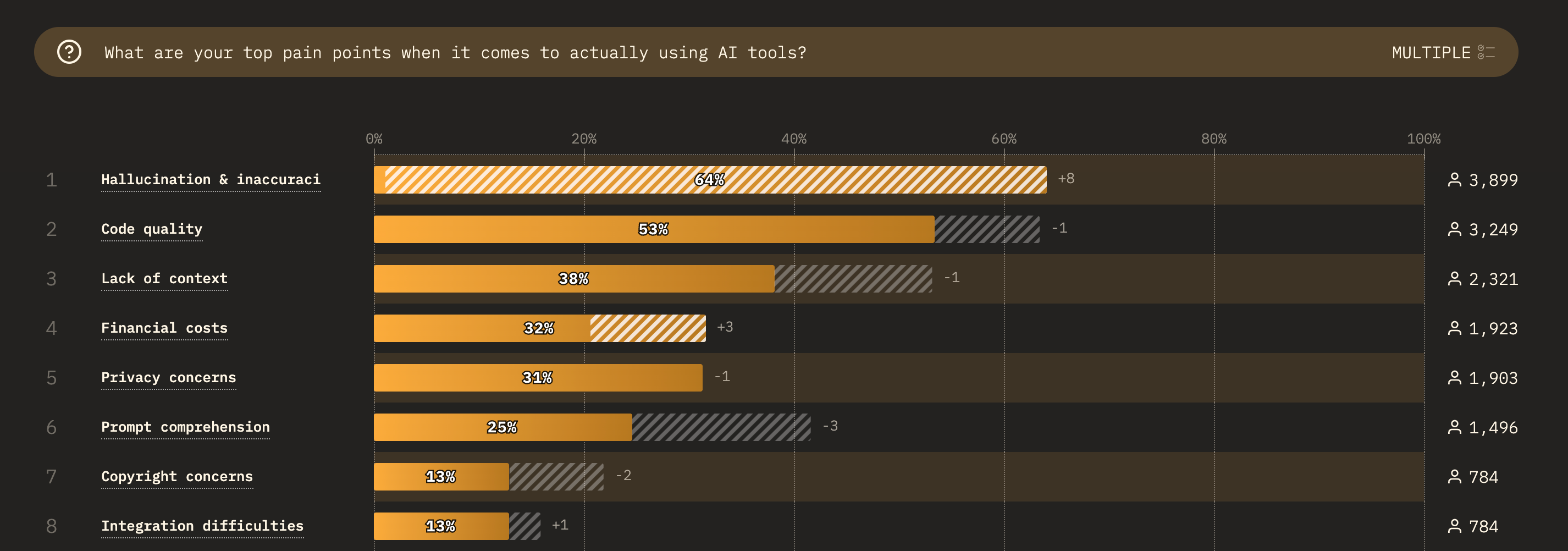
The industry has largely solved the “can AI generate code?” question. The next challenge is solving “can developers trust the code it generates?”
That may end up being a far bigger challenge than model intelligence itself.
What this signals
The most important takeaway from this year’s survey is that AI adoption is no longer a future trend. It’s already happening.
Developers are generating more than half their code with AI, paying for AI tools at increasing rates, and integrating coding agents directly into their workflows.
The debate is shifting away from whether AI will become part of software development.
The real questions now are:
Which AI companies capture the developer workflow?
Can AI businesses justify their valuations through monetization?
And how much of software engineering eventually becomes agent-driven?
Those questions will define the next chapter of the AI industry.
📬 Upgrade to Venture Curator Premium
Get access to 150+ premium archive posts, 100+ startup & VC resources, investor databases, fundraising templates, and exclusive startup research - all in one place.
NEWS RECAP
🗞️ This week in startups & VC
New In VC
Founders Fund, a San Francisco-based venture capital firm, hired former OpenAI VP of Product Policy Ryan Beiermeister as a partner. (Link)
ReefHaven Ventures, a San Diego, CA-based early-stage venture capital firm, launched. (Link)
Dimension Capital, a New York-based venture capital firm founded by Zavian Dar, Adam Goulburn, and Nan Li, raised $800 million for its third fund. (Link)
New Startup Deals
Runta, a San Francisco, CA-based AI agent runtime infrastructure company, raised $20M in Seed funding. (Link)
Sonata, a New York City-based AI-powered preventive healthcare platform, raised $7M in Seed funding. (Link)
Apaluma, an Albuquerque, NM-based regulatory intelligence platform, raised $5.55M in Seed funding. (Link)
Crystalys Therapeutics, a San Diego, CA-based clinical-stage biopharmaceutical company, raised $130M in Series B funding. (Link)
Candid Health, a San Francisco, CA-based autonomous revenue cycle automation platform for healthcare providers, raised $120M in Series D funding. (Link)
Assort Health, a San Francisco, CA-based AI agents platform for managing patient journeys, raised $120M in Series C funding. (Link)
TODAY’S JOB OPPORTUNITIES
💼 Venture capital & startup jobs
All-In-One VC Interview Preparation Guide: In partnership with a leading investor group, we have created an all-in-one guide for aspiring VCs. Don’t miss this. (Access Here)
Visiting Engineer - AI fund | USA - Apply Here
Investment Associate - Global Health Corporation | USA - Apply Here
Investment Associate / Analyst - Flashpoint VC | USA - Apply Here
VC Investment Intern - First Momentum Venture | USA - Apply Here
Investment Associate - Antler | UK - Apply Here
Investment Manager / Principal - Edenred Venture - Apply Here
Executive Assistant - Playground Capital | USA - Apply Here
Analyst - ICONIQUE Capital | USA - Apply Here
Finance Director - AI Fund | USA - Apply Here
Senior Investment Manager - Sagana | India - Apply Here
Head of Fund Accounting - Stepstone Group | USA - Apply Here
Associate or Senior Associate - Bessemer Partner | USA - Apply Here
VC Fellow - V11 | Remote - Apply Here
Investment Analyst - Forum Venture | Canada - Apply Here
Portfolio Analyst Intern - Motion Venture | Singapore - Apply Here
Investor - Superseed | UK - Apply Here
Fund Controller - Alleygroup | USA - Apply Here
Associate - Engine Venture | USA - Apply Here
AI Engineering Lead - Palermo Advisor | USA - Apply Here
Partnership With Us
Get your product in front of over 125,000+ audience - Our newsletter is read by thousands of tech professionals, founders, investors and managers worldwide. Get in touch today.
Upgrade to Venture Curator Premium
Get access to 150+ premium archive posts, 100+ startup & VC resources, investor databases, fundraising templates, and exclusive startup research - all in one place.
(Subscribe to Venture Curator Premium and get 20% off forever.)
I keep seeing Indian startup investors repeat the 2021 mistake—chasing hype at peak valuations.
The same pattern plays out in mutual funds: buying last year's top performer.
Entry price discipline applies whether you're backing a startup or a SIP.