

👋 Hey, Sahil here - welcome back to Venture Curator, where we explore how top investors think, how real founders build, and the strategies shaping tomorrow’s companies.
Big idea + report of the week :
Why is Venture Capital breaking records while fundraising still feels so hard?
Why do 70% of startup employees walk away from their vested equity?
Frameworks & insightful posts :
Which layer of the AI Stack will capture the most value? - Chamath’s Six-Layer AI Investing Stack
How should AI startups sell to enterprises? (a16z’s Lighthouse vs. Landgrab Framework)
What did OpenAI learn from analysing 800,000+ work-related ChatGPT messages?
Get access to 150+ premium archive posts, 100+ startup & VC resources, investor databases, fundraising templates, and exclusive startup research - all in one place.
FROM OUR PARTNER - FRAMER
🤝 Launch your site faster than ever with Framer - now with Agents that make every part of your workflow effortless…

Framer is the pro website builder for creators, teams, and businesses that care enough to get every detail right.
Now with Agents that work alongside you across the full website workflow: designing new pages, managing your CMS, editing content, and adding SEO all without leaving the tool where the real site lives. Trusted by teams at companies like Miro and Perplexity
Agents bring speed and scale; you bring taste, judgment, and control. Together you can:
Build and iterate faster: generate sections, refine layout and styling, and ship updates in minutes.
Scale content with confidence: update CMS collections, localise copy, and keep metadata consistent across pages.
Stay production‑ready: reviewable changes, collaboration, and safeguards that help teams ship without handoffs.
Launch your site with Framer today →
WORK WITH US
🤝 Partnership With Us
Get your product in front of over 125,000+ audience - Our newsletter is read by thousands of tech professionals, founders, investors and managers worldwide. Get in touch today.
START WITH
🧠 Big idea + report of the week
Why is Venture Capital breaking records while fundraising still feels so hard?
The headline numbers make it look like venture capital is having another 2021-style moment. Startup valuations are climbing, mega-rounds are everywhere, and more companies are reaching $10 billion valuations.
But underneath that boom is a much more concentrated market.
PitchBook data shows that 19 U.S. startups became decacorns in 2026 through July 21, meaning they reached valuations of at least $10 billion. That has already surpassed the 18 new decacorns created during all of 2025 and puts 2026 on pace to beat the previous record of 22 set in 2021.
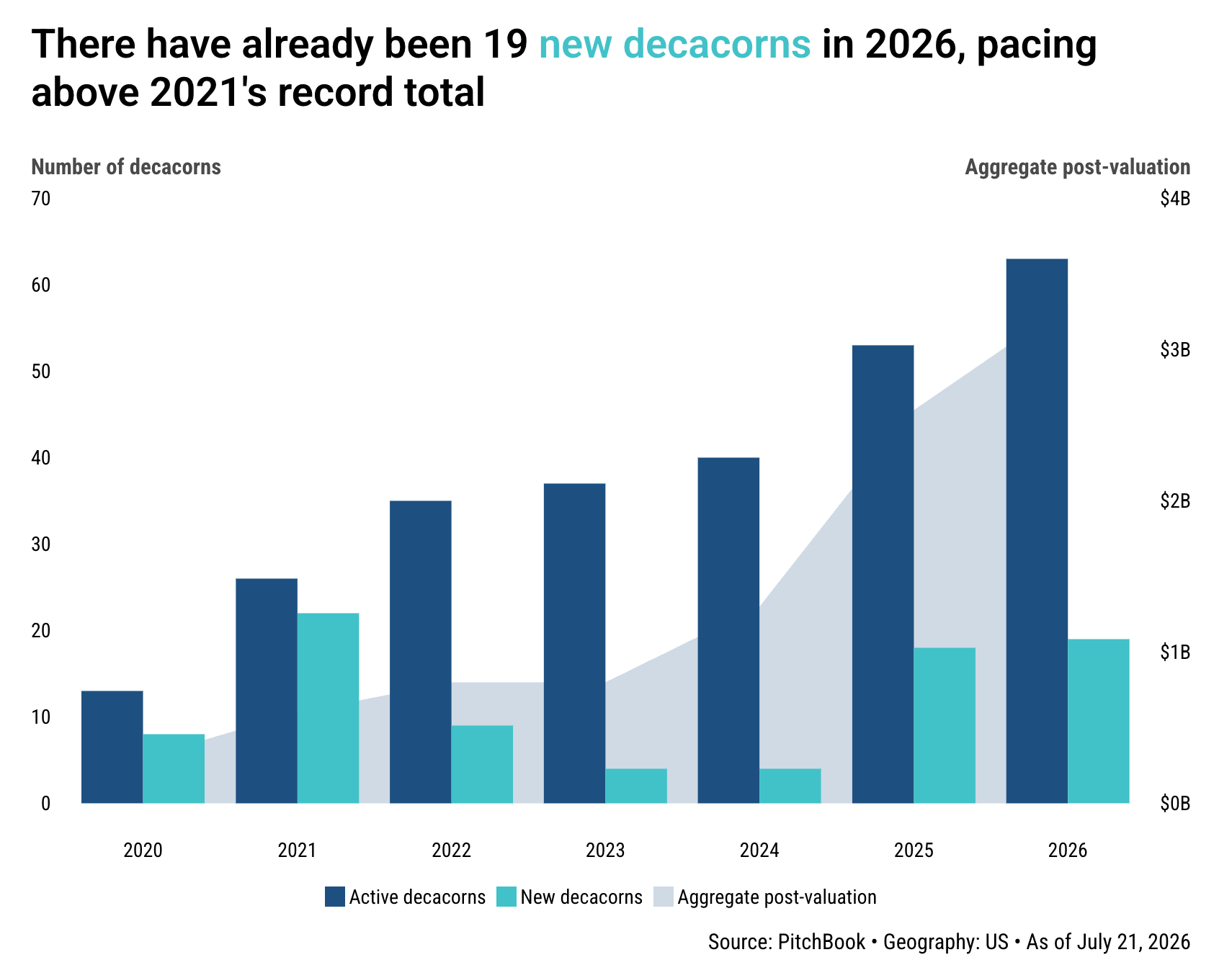
There are now 63 active U.S. decacorns, compared with 53 in 2025 and just 26 in 2021.
What makes this cycle different is where the capital is going.
During the first half of 2026, VCs invested $412.7 billion into startups, already exceeding the $319.2 billion invested during all of last year. But mega-deals, rounds of at least $100 million, represented an extraordinary 87.5% of that capital.
AI is driving much of the concentration. AI startups attracted $355.9 billion between January and June, representing roughly 86% of all U.S. venture investment during the period.
That capital is helping create a new generation of enormous private companies. SambaNova Systems became a decacorn after raising $1 billion at an $11 billion valuation. Shield AI, Cerebras, Clear Street, ElevenLabs, Harvey and Notion are among the other companies that crossed the $10 billion threshold this year.
There is an interesting dynamic behind these numbers. Investors aren’t simply funding more startups. They’re increasingly placing much larger bets on a smaller group of companies they believe can become category leaders.
AI makes that strategy particularly visible. Building frontier models, chips and infrastructure can require enormous amounts of capital, while the market is moving quickly enough that investors may prefer backing companies that have already demonstrated scale rather than spreading capital across dozens of smaller bets.
There is another reason these private valuations can keep growing: companies no longer need an IPO to provide some liquidity. Tender offers and secondary transactions increasingly allow founders, employees and early investors to sell portions of their holdings while companies remain private.
Strong late-stage startups can therefore delay going public while continuing to raise at progressively higher valuations.
But not every new decacorn looks the same. Some have substantial revenue and years of operating history. Others are reaching enormous valuations while still early in commercialisation or burning heavily to establish a position in fast-moving markets. The $10 billion label increasingly tells you how much investor conviction exists, not necessarily how mature the underlying business is.
For founders, that distinction matters. Record venture investment does not necessarily mean fundraising has become easier. Much of the new capital is being absorbed by a relatively small number of AI and late-stage companies. For everyone else, the market can remain highly selective even while aggregate funding statistics look spectacular.
The strange reality of the 2026 venture market is that record amounts of capital and a difficult fundraising environment can exist at exactly the same time.
Why do 70% of startup employees walk away from their vested equity?
Startup equity is often sold as one of the biggest reasons to join an early-stage company. Take a lower salary, help build something valuable, and if the company succeeds, your options could become meaningful wealth.
But there is a big gap between receiving stock options and actually owning the shares.
Peter Walker shared Carta data tracking the percentage of vested employee options that returned to startup option pools because employees did not exercise them before expiration. The numbers show how much startup equity employees ultimately leave behind.
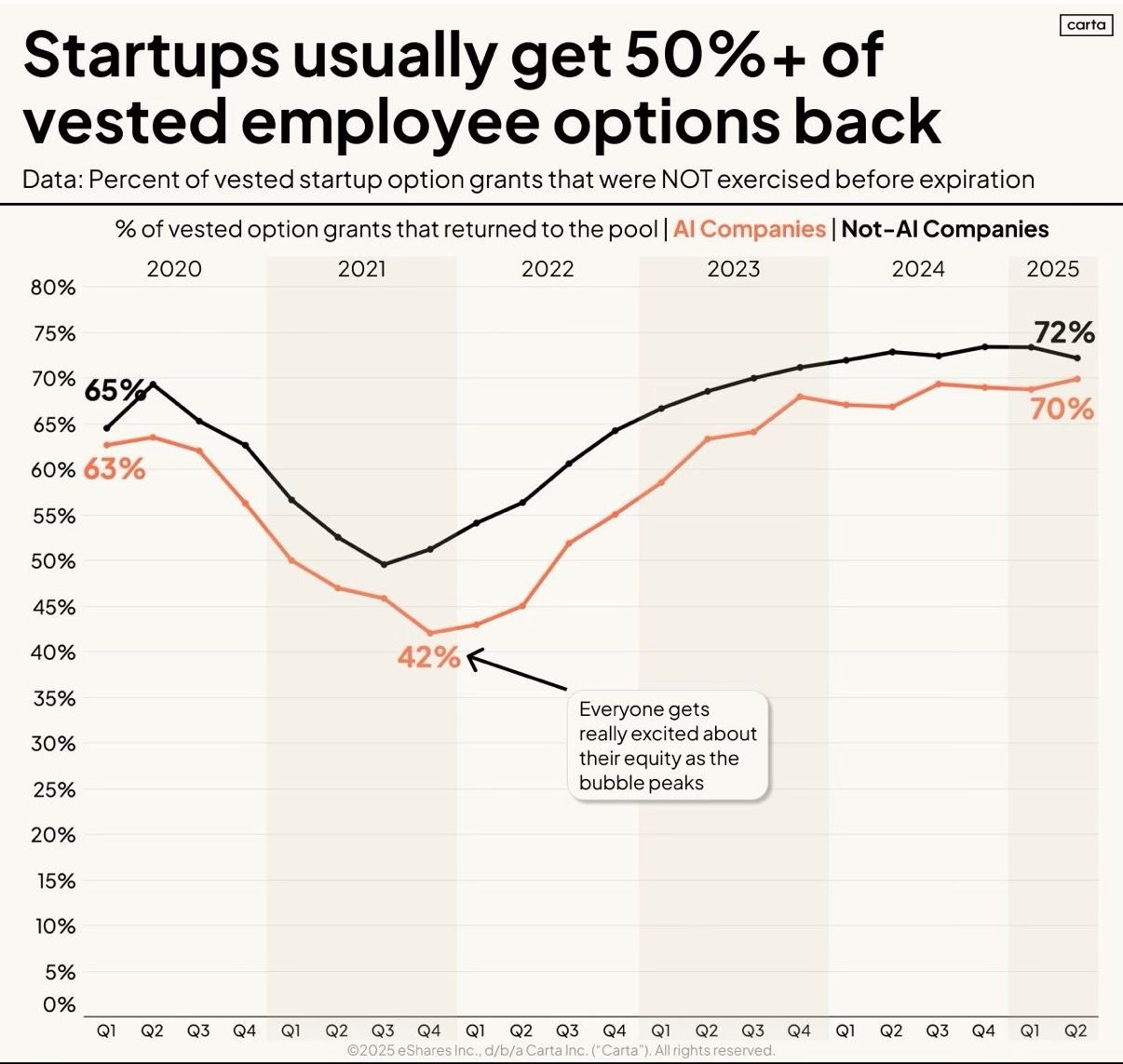
In 2025, more than 70% of vested options went unexercised when employees left their companies. By the latest point shown in the data, the figure was roughly 70% for AI companies and 72% for non-AI companies.
That means startups are effectively getting a large portion of already vested employee equity back.
The historical trend is interesting too. At AI companies, the percentage of options returning to the pool fell from roughly 63% in early 2020 to just 42% around the peak of the 2021 startup boom. Employees had much stronger reasons to exercise when valuations were soaring, fundraising was abundant, and IPOs or secondary sales felt much closer.
As the market changed, the behaviour reversed. By 2024 and 2025, the non-exercise rate had climbed back toward 70%.
There are several reasons employees walk away from vested equity. Some don’t realise they need to exercise after leaving. Others cannot justify paying the exercise price and potentially facing taxes for shares in a private company. And even employees who believe in the company still have to ask a difficult question: when will I actually be able to sell these shares?
That last point matters because startup options are not cash. An employee can spend real money today to exercise shares while waiting years for an acquisition, IPO or secondary transaction that may never happen.
The AI boom hasn’t fundamentally changed this either. Despite huge secondary transactions and rapidly rising valuations at some high-profile AI companies, Carta’s broader data shows AI and non-AI companies ending up remarkably close, at roughly 70% and 72% respectively.
There is an important lesson here for founders designing compensation packages. A large option grant can look generous on paper while delivering little value if employees cannot afford to exercise it or don’t understand how it works. Longer exercise windows, better equity education and opportunities for employee liquidity can sometimes matter almost as much as the headline size of the grant.
And employees should probably evaluate startup equity differently too. The number of options in an offer letter tells you very little by itself. Exercise price, ownership percentage, dilution, exercise window, company valuation and realistic paths to liquidity determine whether those options might eventually become meaningful.
Startup equity can create extraordinary wealth. But Carta’s data is a useful reminder that vesting equity and realising value from equity are two very different things.
FROM OUR PARTNER - FORTYGUARD
🤖 FortyGuard AI Hackathon’26 - Build the World’s Temperature AI

Build with 2-metre resolution urban heat data - 50 billion data points daily, normally enterprise-only - free for two weeks.
FortyGuard Hackathon’26 is a free, fully online global hackathon where developers, data scientists and climate tech builders create real AI applications on FortyGuard’s hyperlocal temperature data, solving real city, infrastructure and public safety problems.
Compete solo or in teams of up to 3 across seven tracks for $6,000 in cash, NVIDIA GPUs, incubation and internships. Start building something that helps the world stay cool.
FEATURED POSTS
📄 Must Read Post


SOMETHING MORE
🧩 Frameworks & insightful posts
Which layer of the AI Stack will capture the most value? - Chamath’s Six-Layer AI Investing Stack
AI is attracting enormous capital, but not every layer of the stack will produce equally attractive returns. As models improve and become increasingly interchangeable, some of today’s most valuable businesses could face commoditization while value moves elsewhere.
Chamath Palihapitiya recently shared his six-layer AI investing framework for thinking about where that value could accumulate:
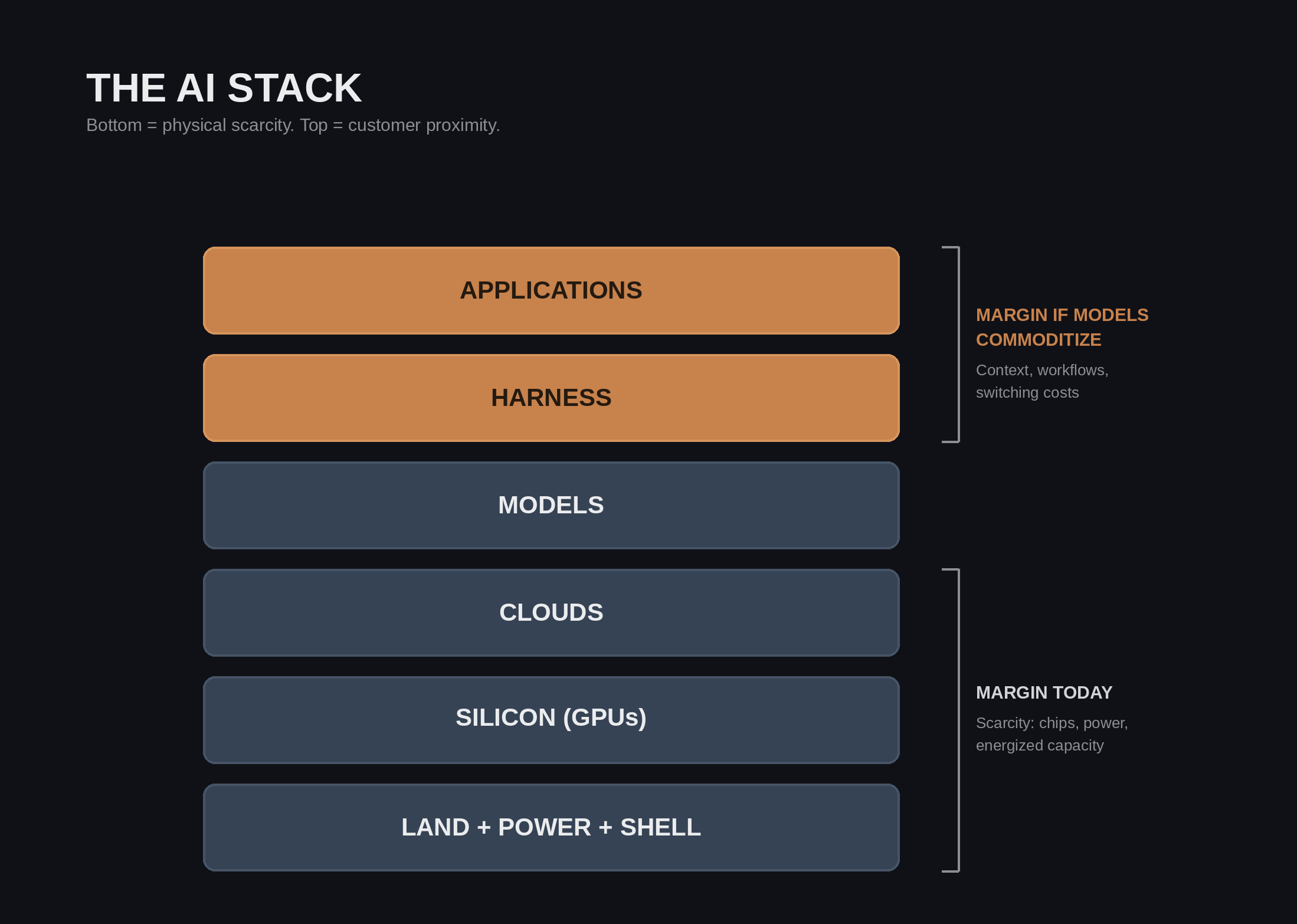
Land + power + shell: The physical foundation of AI infrastructure. As data centres consume more electricity and face permitting constraints, energised land and reliable power could become increasingly scarce and valuable.
Silicon (GPUs): Huge value exists here, but building a new chip company has become extraordinarily difficult. Manufacturing precision, capital requirements, performance expectations, and supply-chain dependencies create enormous barriers for startups.
Clouds: Potentially lucrative, but expensive and technically complex to build. As AI infrastructure becomes more regulated, identity, KYC, security, and compliance requirements could make operating these platforms even harder.
Models: The most uncertain layer. If models continue improving while becoming easier to switch between, differentiation and margins could compress even as overall token consumption keeps growing.
Harnesses: Potentially one of the most interesting layers. A harness connects models with an enterprise’s proprietary context - its data, workflows, evaluations, rules, and internal knowledge - while allowing the underlying model to be swapped when something better appears.
Applications: Another potentially durable layer. AI could move enterprise software away from standardised, one-size-fits-all SaaS toward software customised around each company’s proprietary workflows and knowledge.
The framework points to an interesting barbell.
At the bottom of the stack, value comes from physical scarcity: land, electricity, chips, and infrastructure.
At the top, value comes from customer proximity and proprietary context: workflows, data, business rules, and software deeply embedded inside an organisation.
The middle - particularly models - could face greater commoditization as capabilities converge and switching becomes easier.
For founders and investors, this creates a useful way to think about AI opportunities: either own something genuinely scarce, or build something so deeply embedded in the customer’s workflow that replacing it becomes difficult.
How should AI startups sell to enterprises? (a16z’s Lighthouse vs. Landgrab Framework)
Founders often assume landing a prestigious enterprise logo is the best way to sell AI: win one big customer, turn it into social proof, and use that credibility to unlock everyone else.
But that can also waste months chasing a logo your actual buyers don’t care about.
Joe Schmidt and Julian Marx from a16z argue that AI companies should think about enterprise sales through two strategies: Lighthouse and Landgrab.
Lighthouse: Use when buyers face high risk and need proof before adopting something new. A few respected customers can unlock an entire market. Harvey’s early adoption by major law firms is a good example.
Landgrab: Use when buyers already understand the problem and purchasing risk is lower. Here, ROI matters more than prestige. Companies like Decagon and Stuut benefited from moving quickly, proving the economics, and selling broadly rather than waiting for a handful of marquee logos.
The framework comes down to two questions:
How exposed is the buyer?
If choosing the wrong vendor could create regulatory, reputational, or career risk, they want credible proof that others have gone first.
Does social proof travel?
In tightly connected markets like law or finance, one respected customer can influence hundreds of similar buyers. In fragmented markets, that logo may mean almost nothing.
That creates four possible GTM motions:
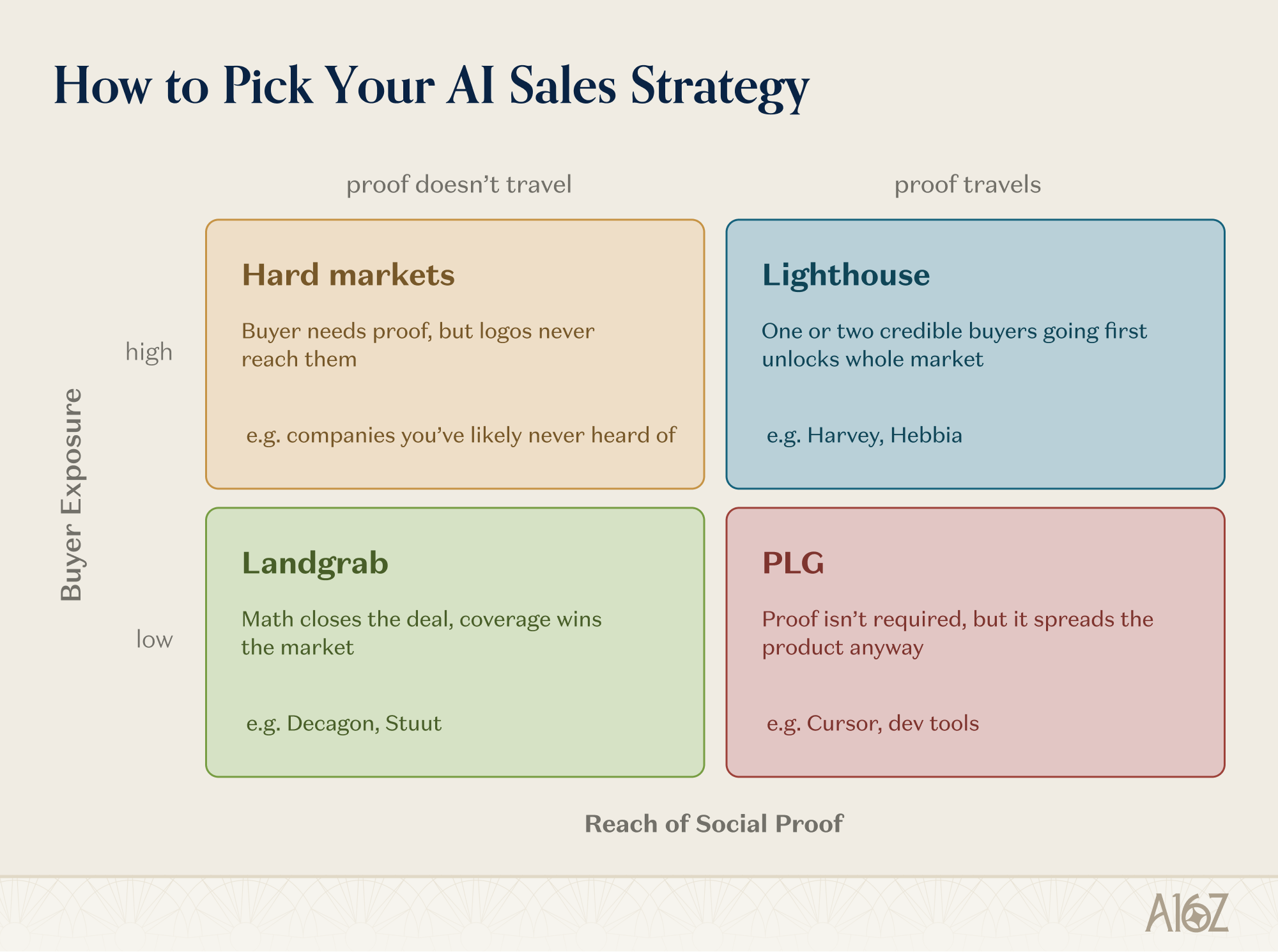
High exposure + proof travels → Lighthouse
Low exposure + proof doesn’t travel → Landgrab
Low exposure + proof travels → PLG can work
High exposure + proof doesn’t travel → a difficult market
One useful signal is how customers behave during sales. If they ask “Who else uses this?”, you probably need a lighthouse. If they mostly ask “How much money will this save me?”, speed and distribution may matter more.
And these strategies aren’t permanent. A startup can win a few lighthouse customers to establish credibility, dominate that vertical, and then switch into landgrab mode once buyers stop asking who went first.
So as an AI founder: don’t chase famous logos by default. Figure out whether your buyer needs proof or math - then build your sales strategy around that.
What did OpenAI learn from analysing 800,000+ work-related ChatGPT messages?
Most jobs are built around specialisation. Marketers handle marketing, engineers handle technical work, finance handles analysis, and legal handles contracts. When something falls outside your role, you usually hand it to another team.
AI is starting to change that.
New research from OpenAI Economic Research analysed more than 800,000 work-related ChatGPT messages in the U.S. and found something interesting: workers are increasingly using AI to perform tasks that traditionally belonged to entirely different occupations.
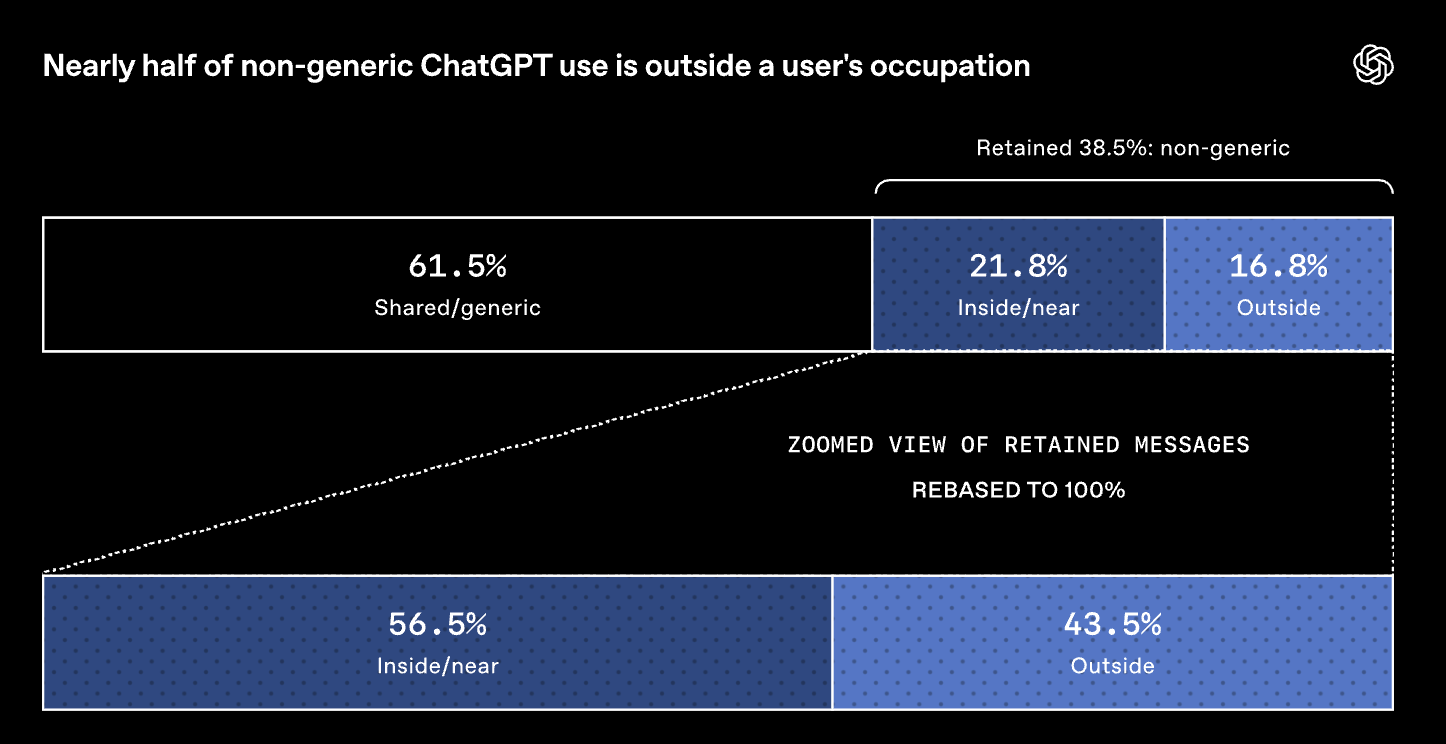
43.5% of occupation-specific AI use crosses job boundaries.
Once generic tasks like writing and summarising are removed, nearly half of specialised work done with AI belongs to another occupation.
Some roles are becoming much more generalist.
Outside-occupation tasks account for 77% of occupation-specific messages from customer experience workers, 75% for designers, 69% for HR, 56% for legal, and 53% for marketers.
Marketing and engineering skills are spreading everywhere.
Workers across departments are using AI for things like creating marketing material, financial calculations, technical troubleshooting, and other work that previously required specialist help.
Small teams may benefit the most.
Task crossover is higher in smaller organisations, suggesting AI lets employees solve problems themselves instead of waiting for another department or specialist.
The bigger shift isn’t simply that AI makes existing jobs faster.
It may change what a job actually contains.
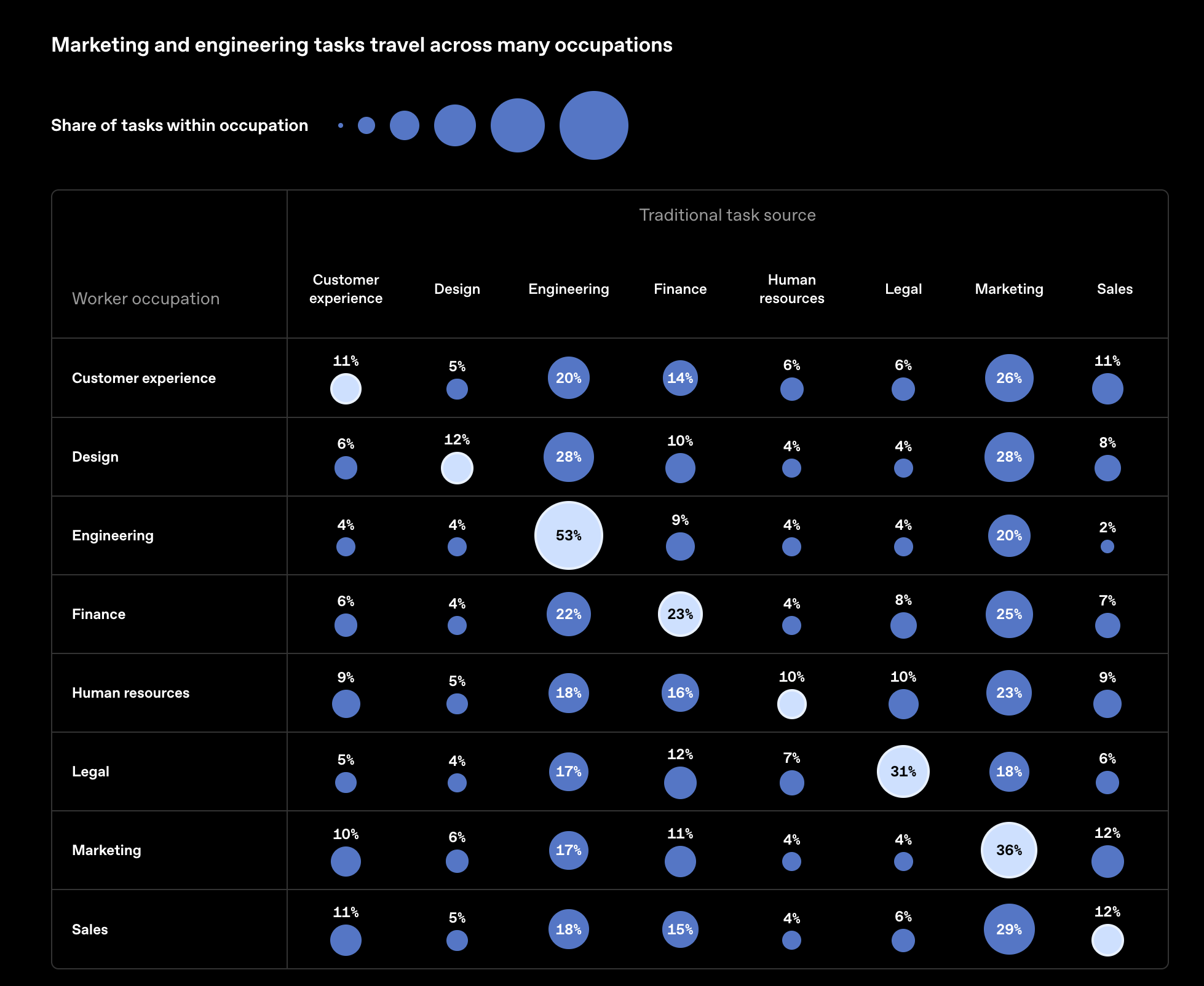
A salesperson can analyse customer data. A marketer can troubleshoot a website. A small-business owner can draft copy, review a contract, and perform basic financial analysis.
That means the future organisation may have fewer rigid boundaries between functions and more people who use AI to operate across several disciplines.
For founders, this is worth watching closely: some of the biggest AI opportunities may come from eliminating the handoffs between teams, not simply automating the work inside one team.
📬 Upgrade to Venture Curator Premium
Get access to 150+ premium archive posts, 100+ startup & VC resources, investor databases, fundraising templates, and exclusive startup research - all in one place.
NEWS RECAP
🗞️ This week in startups & VC
New In VC
Index Ventures, a London and San Francisco-based venture capital firm, raised $2 billion across three new funds. (Link)
U.S. Venture Partners, a Menlo Park, CA-based early-stage venture capital firm, is raising up to $400m for its 14th fund. (Link)
Jump Capital, a Chicago, IL-based early-stage venture capital firm, raised $350m for its eighth fund. (Link)
Align Ventures, a NYC-based venture capital firm investing in consumer brands and technologies, closed its Early-Stage Fund II at $125m. (Link)
New Startup Deals
Proxy Foods AI, a Washington, DC-based food and beverage R&D platform, raised $6M in Seed funding. (Link)
Intelligence, a San Francisco, CA-based developer of the AI design benchmarking platform Design Arena, raised $7.9M in Seed funding. (Link)
Decade, a São Paulo, Brazil-based AI-native wealth advisory platform, raised $85M in Seed funding. (Link)
Aavalynx, a London, UK-based AI-powered risk and capital management platform for enterprise dispute resolution, raised £1.5M in Pre-Seed funding. (Link)
Marquee, a New York City-based developer of an AI-powered decision platform for professional sports organisations, raised $4M in Seed funding. (Link)
Harmony, a New York City-based AI-powered enterprise service management platform, raised $34M in Seed funding. (Link)
TODAY’S JOB OPPORTUNITIES
💼 Venture capital & startup jobs
Looking to Break Into VC? Must be subscribed to our other newsletter - BREAK INTO VC for more tips and VC job updates.
Senior Associate - Yamaha Motor Venture | USA - Apply Here
Associate or Senior Associate - Bessemer Partner | USA - Apply Here
VC Fellow - V11 | Remote - Apply Here
Portfolio Reporting Team Lead - Cerity Partner | USA - Apply Here
Associate - Mount Judi Venture | USA - Apply Here
Technical Investment Operations Associate - Alpaca VC | USA - Apply Here
VC Research Lead - Murph Capital | Remote - Apply Here
Trade Operations Analyst - RA Capital | USA - Apply Here
Portfolio Management Associate - Cerity Partner | USA - Apply Here
Partner 36, Corporate Controller - a16z | USA - Apply Here
Investment Associate - Cerity Partner | USA - Apply Here
Head of Finance - Hivemind Capital Partner | USA - Apply Here
Senior Associate, Talent Sourcing - Redesign Health | India - Apply Here
Program Manager - Community - Plug and Play | USA - Apply Here
AI Workflow Engineer - Alpaca VC | USA - Apply Here
Investment Analyst - Forum Venture | Canada - Apply Here
Partnership With Us
Get your product in front of over 125,000+ audience - Our newsletter is read by thousands of tech professionals, founders, investors and managers worldwide. Get in touch today.
Upgrade to Venture Curator Premium
Get access to 150+ premium archive posts, 100+ startup & VC resources, investor databases, fundraising templates, and exclusive startup research - all in one place.
(Subscribe to Venture Curator Premium and get 20% off forever.)