


👋 Hey, Sahil here - welcome back to Venture Curator, where we explore how top investors think, how real founders build, and the strategies shaping tomorrow’s companies.
Big idea + report of the week :
Who actually finds venture’s outliers? Here’s what the data shows.
Nine years later, Most VC funds still haven’t returned the money. What happens next?
Frameworks & insightful posts :
Where is the biggest money in AI: Frontier Models or the Middle Market?
How much should your startup actually spend on AI? Here’s what the data shows.
Why has venture due diligence got worse for deep tech?
Get access to 150+ premium archive posts, 100+ startup & VC resources, investor databases, fundraising templates, and exclusive startup research - all in one place.
FROM OUR PARTNER - BEZEL
💰 AI labs could pay your company $100K to $3M for data you already have.
Bezel (YC-backed) helps you partner with labs that buy anonymised operational data from companies like yours.

Your operational workflows, documentation, processes, and internal knowledge like Slack are extremely valuable. Now you can start a new recurring income stream for your business in less than a month while maintaining privacy.
We’re looking to partner with companies that have more than 20 employees and have existed for more than a year. Our partners have already paid out over $200 million for this data.
START WITH
🧠 Big idea + report of the week
Who actually finds venture’s outliers? Here’s what the data shows.
Venture investors are usually taught that this is an outlier business. A handful of companies nobody saw coming produce most of the returns, so the firms with the biggest teams, the widest networks and the most capital should be best placed to find them.
But new research from Dan Grey at Odin, built on Dealroom data, suggests the biggest firms are now the least likely to back a company that looks different from everything else getting funded.
Grey scored every company in the 2023-25 seed portfolios of five megafunds (a16z, General Catalyst, Lightspeed, NEA and Accel) and a selected group of top-ranked emerging managers on how rare it was. Rarity was measured on business (industry, model, customer, geography) and technology, against every seed-funded company from 2018 to 2025. The most unusual fifth was counted as outliers.
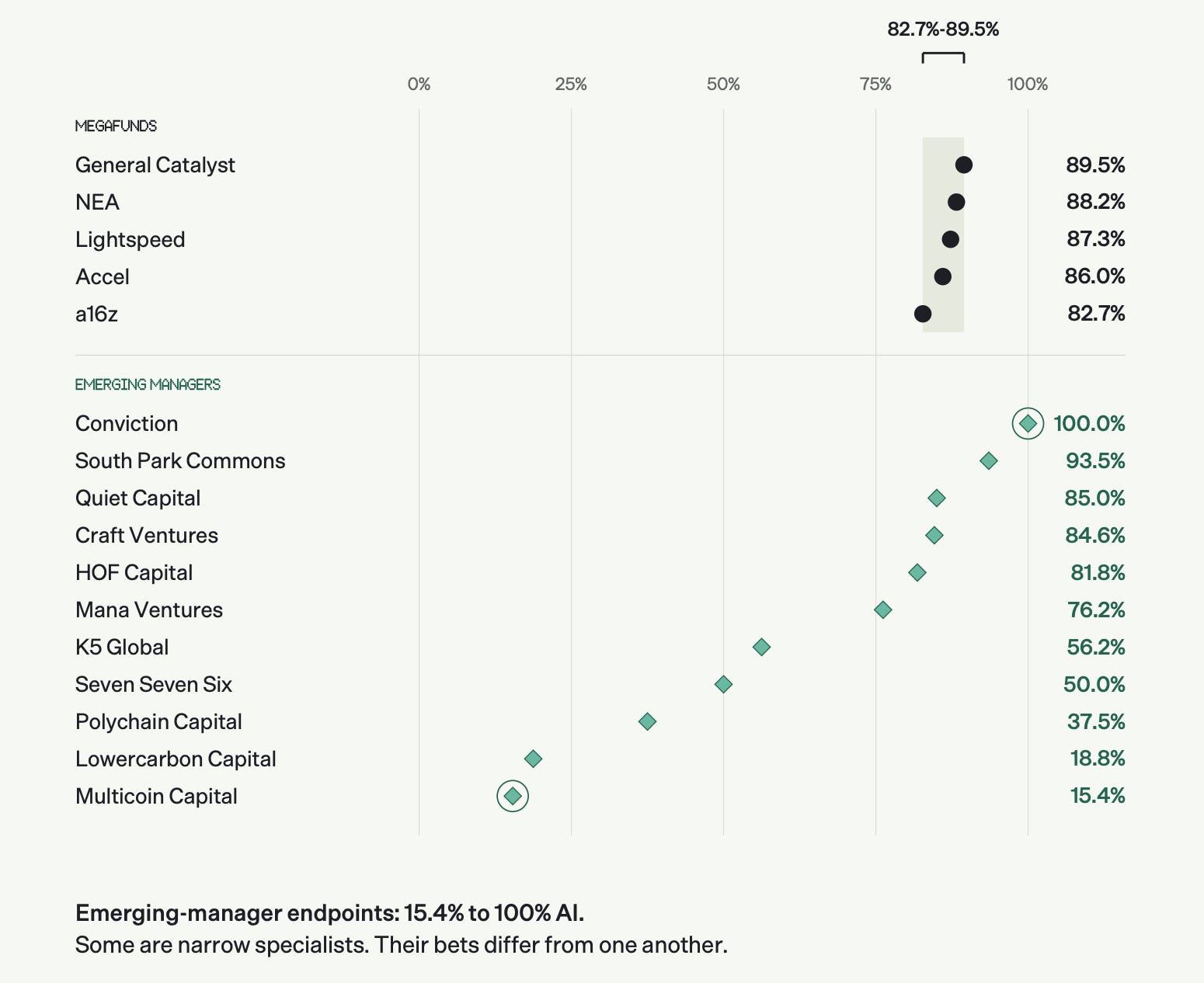
Emerging managers put 24.7% of their scorable seed rounds into outlier profiles (49 of 198). The megafunds put 11.5% there (32 of 278). About twice the share.
The gap doesn’t come from every small fund being a contrarian. Plenty of emerging managers are as AI-heavy as the megafunds: Conviction is 100% AI, South Park Commons 93.5%. The range comes from specialists with different mandates, like Lowercarbon at 18.8% AI and Multicoin at 15.4%.
That’s why pooling matters. Combine five unlike emerging-manager books and concentration typically falls by 22.6%. Combine the five megafunds and it falls by 2.0%, because all five already sit between 82.7% and 89.5% AI. Only 2 of 462 possible emerging-manager combinations failed to beat the megafund group.
There’s a reason this matters beyond portfolio statistics. Research on financing risk has long argued that whether investors expect later capital to be available shapes which experiments get a first check at all. Odin is careful to say its data doesn’t prove that mechanism. But if the largest pools of capital only back what is already widely fundable, a company outside that consensus depends on someone else to take the first bet.
So does this mean emerging managers are better at picking winners?
No. “Outlier” here means rare among funded companies, not more innovative and not more likely to succeed. Adding founder background to the scoring narrows the gap to 19.8% versus 14.4%. The emerging-manager group is a selected cohort, not the whole market. And smaller funds have their own herd moments: blockchain made up 46.7% of their earlier rounds before falling to 20.9%.
And this is where investors need to be careful.
If your thesis is that returns come from outliers, another brand-name allocation mostly adds more of the same bet. A basket of genuinely different mandates adds range. But range alone isn’t the case for writing the check. Odin’s own test is what a fund adds that’s missing from your existing portfolio, at what fees and carry, with what ownership after dilution, and with what follow-on risk.
The real question isn’t which fund is biggest. It’s which funds are actually looking where nobody else is, because on this data, that’s increasingly not the same list.
Nine years later, Most VC funds still haven’t returned the money. What happens next?
Founders are usually taught to think of their VC as patient capital. Venture is a long game; the fund is built to wait for the big outcome, and nobody on the cap table is in a hurry for cash.
But new data from Carta’s Q2 2026 VC Fund Performance report suggests that patience is running thin for a lot of funds, because most of them still haven’t paid their own investors back.
Carta tracked net DPI, the cash a fund has actually returned to its LPs for every dollar they put in, across roughly 3,000 US venture funds that started investing between 2017 and 2026.
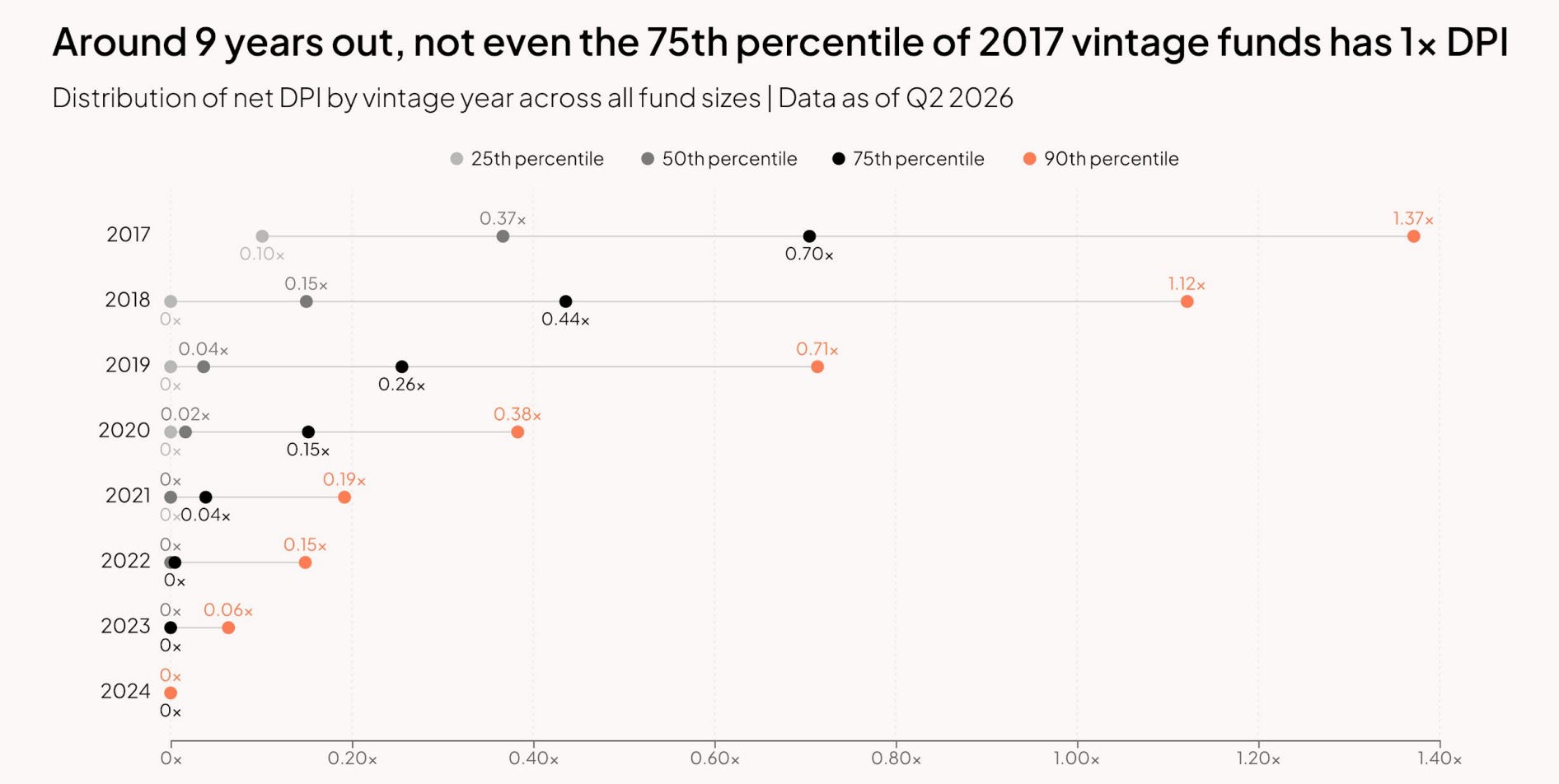
Funds that started in 2017 are now about nine years old, close to the end of a typical ten-year fund life. The median one has returned just 0.37x in cash. Even a top-quarter fund is only at 0.70x. Only the top 10% have handed back more than LPs put in, at 1.37x.
It gets worse with younger funds. The median 2018 fund has returned 0.15x, and the median 2019 fund 0.04x, or 4 cents on the dollar after seven years.
The value is there on paper. The median 2017 fund is worth 1.72x on its books, but only about a fifth of that has come back as cash. The rest is still locked in private companies that haven’t been sold or listed.
There’s a second detail that explains why this is hard to see from the outside. Most of these funds have paid out something: 86% of 2017 funds and 70.4% of 2018 funds have returned at least some cash. So almost every fund can tell its LPs that distributions have started. Very few can say they’ve returned the money.
So why should a founder care about their investor’s fund math?
Because the clock on your investor’s fund is not the same as the clock on your company. A fund nearing the end of its life, still owing its LPs real cash and trying to raise its next fund, has strong reasons to want liquidity soon. That pressure can show up as a push toward an earlier sale, a sale of its stake in a secondary, or more caution about putting reserve money into your next round.
And this is where founders need to be careful.
None of this means your investor will act against you. Funds can extend their life, and many top firms have strong reasons to keep backing their winners. Carta’s data shows the cash gap, not how every fund will behave. But the vintage of the fund that wrote your check is now a real input, not a footnote. A partner investing from a 2017 or 2018 fund is sitting in a very different spot from one investing from a fresh 2025 fund.
The real risk isn’t that your investor needs liquidity. It’s not knowing which fund your money came from, how much cash it still owes its own backers, and how that might shape their advice on your next raise or your exit.
📄 Must-Read Post


SOMETHING MORE
🧩 Frameworks & insightful posts
Where is the biggest money in AI: Frontier Models or the Middle Market?
Most AI coverage fixates on the frontier: the newest, smartest, most expensive model from each lab. But Tomasz Tunguz at Theory Ventures makes the case that the market that actually matters is the middle tier, and the spending data backs it up.
The mid tier already takes about 40% of AI spend and 30% of tokens.
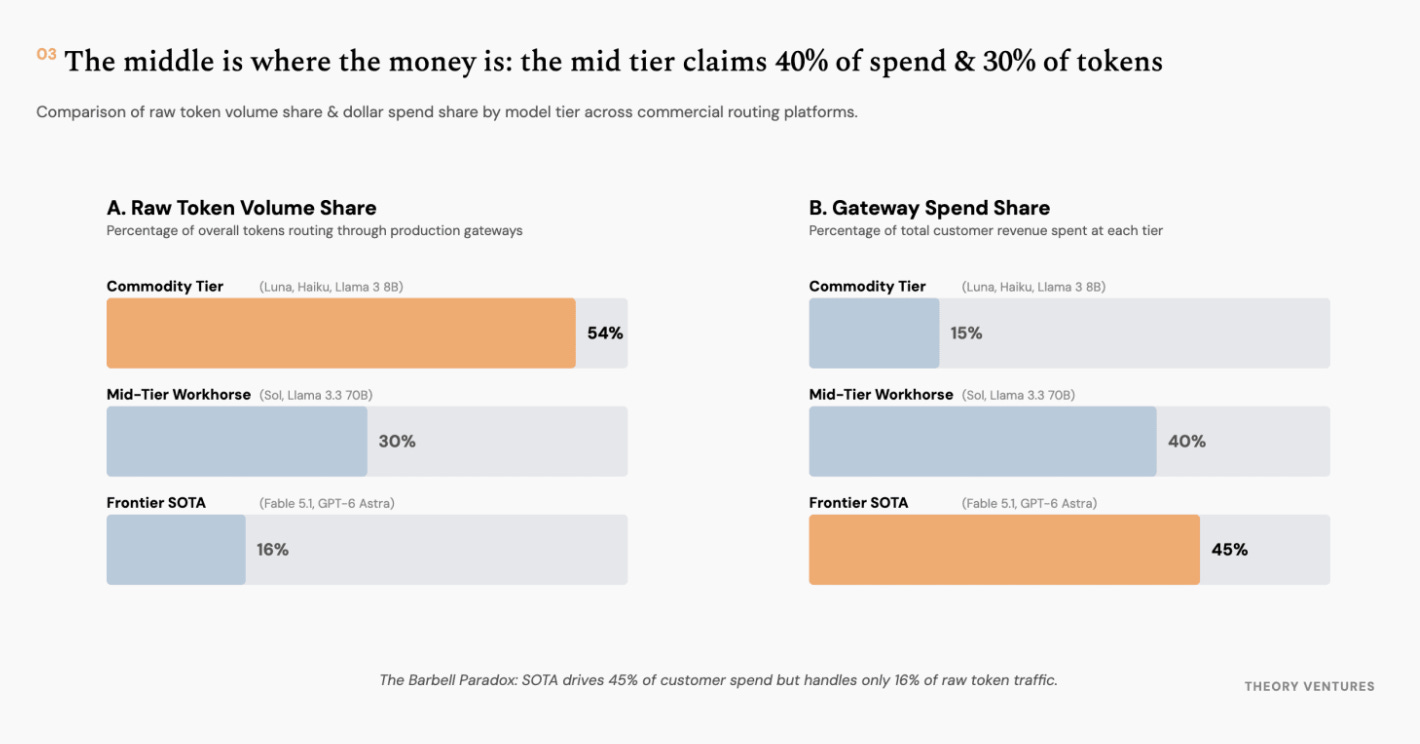
The frontier, by contrast, is thin. Anthropic’s most capable model, Fable 5.1, took just 3.7% of gateway spending in its first twelve days. Its predecessor peaked at 13.2% before falling to 4.9% a month later, once Opus 5 shipped at half the price. Among large corporate accounts, frontier models’ share of token consumption dropped from 53% in early August to 45% by September.
That’s where the price war is being fought too. When Anthropic cut prices on a new model in September, OpenAI matched the cut roughly 90 minutes later. The Opus line had sat at $5 input and $25 output per million tokens across four straight versions before that cut. At the low end, OpenAI cut Luna’s price by 80% in July and by another 50% in September.
Three forces keep pushing mid-tier prices down:
Lab rivalry. Labs now match each other’s cuts within hours, not quarters.
Open-weight models. On gateways that publish their data, open models run the majority of token volume at an 86% discount to the blended price of closed models.
Fine-tuning. Cursor’s Composer 2, fine-tuned from the open-weight Kimi K2.5, cut overall cost 86% versus its previous in-house model. Harvey cut cost per cell 55% against Sonnet 5 while scoring higher than Fable 5.
The reason this keeps happening is structural. What a business needs from AI, summarizing a contract or classifying a support ticket, barely changes year to year. The cost of the intelligence that meets that bar keeps falling fast. So the tier that clears a fixed requirement gets cheaper every quarter, and most real work sits in that tier, not at the frontier.
Demand looks less like a pyramid with the frontier on top and more like a bell curve with a fat middle, where buyers care about intelligence per dollar, not peak capability. The open question is whether that middle eventually becomes a commodity. If it does, the economics of the entire AI market shift with it.
For anyone building on top of these models, it’s worth asking which tier your product actually needs. Paying frontier prices for mid-tier work is now one of the easiest margins to give away.
How much should your startup actually spend on AI? Here’s what the data shows.
Ask most founders what they spend on AI, and you’ll get a confident number: a few thousand a month across ChatGPT and Claude seats, a Cursor bill, a creeping API line. It sounds precise. It isn’t, because it adds together three kinds of spending that have nothing in common except the vendor category.
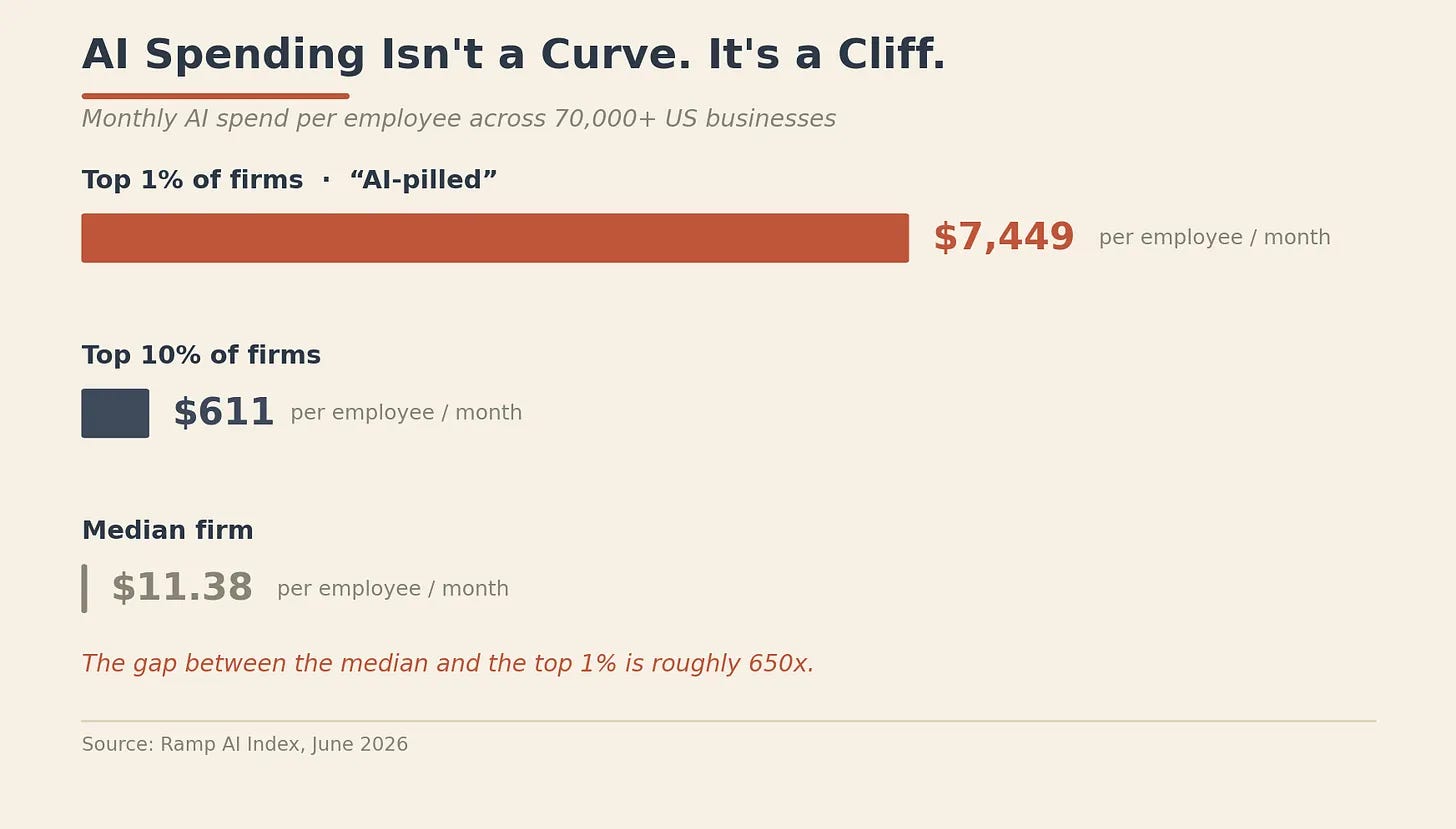
Ramp’s payment data across 70,000+ US businesses shows how split “using AI” has become.
The median company spends $11.38 per employee per month. The top 10% spend $611.
The top 1% spend $7,449, roughly 650x the median. And when Ramp linked that spending to Revelio Labs’ workforce records across 21,559 companies, the companies spending heavily grew headcount 10.2% over two years, with entry-level hiring up 12%.
Low-intensity adopters showed no significant change at all.
So spend more. But on what?
Most founders judge their AI bill against their software budget, because the charges sit next to Figma and Notion on the statement. That’s the wrong denominator. A growing share of AI spend doesn’t replace software. It replaces people. The support agent is competing with the support hire, not with your SaaS stack.
Run it on a typical seed-stage company: 12 people, about $180K a month in payroll, $4K a month on AI. Against the software budget, $4K looks heavy. Against payroll, it’s 2.2%. Same number, opposite conclusion.
The fix is to split AI into three budgets, each judged against its own number:
Payroll-line AI (support, SDR and coding agents) is judged against the salary of the hire you didn’t make. If you can’t name that hire, it doesn’t belong here.
Productivity-line AI (seats, notes and writing tools) is judged by usage. If usage has decayed by month two, cancel it.
COGS-line AI (tokens and API calls inside your product) is judged by gross margin at 10x volume, and it has to sit in COGS in your books.
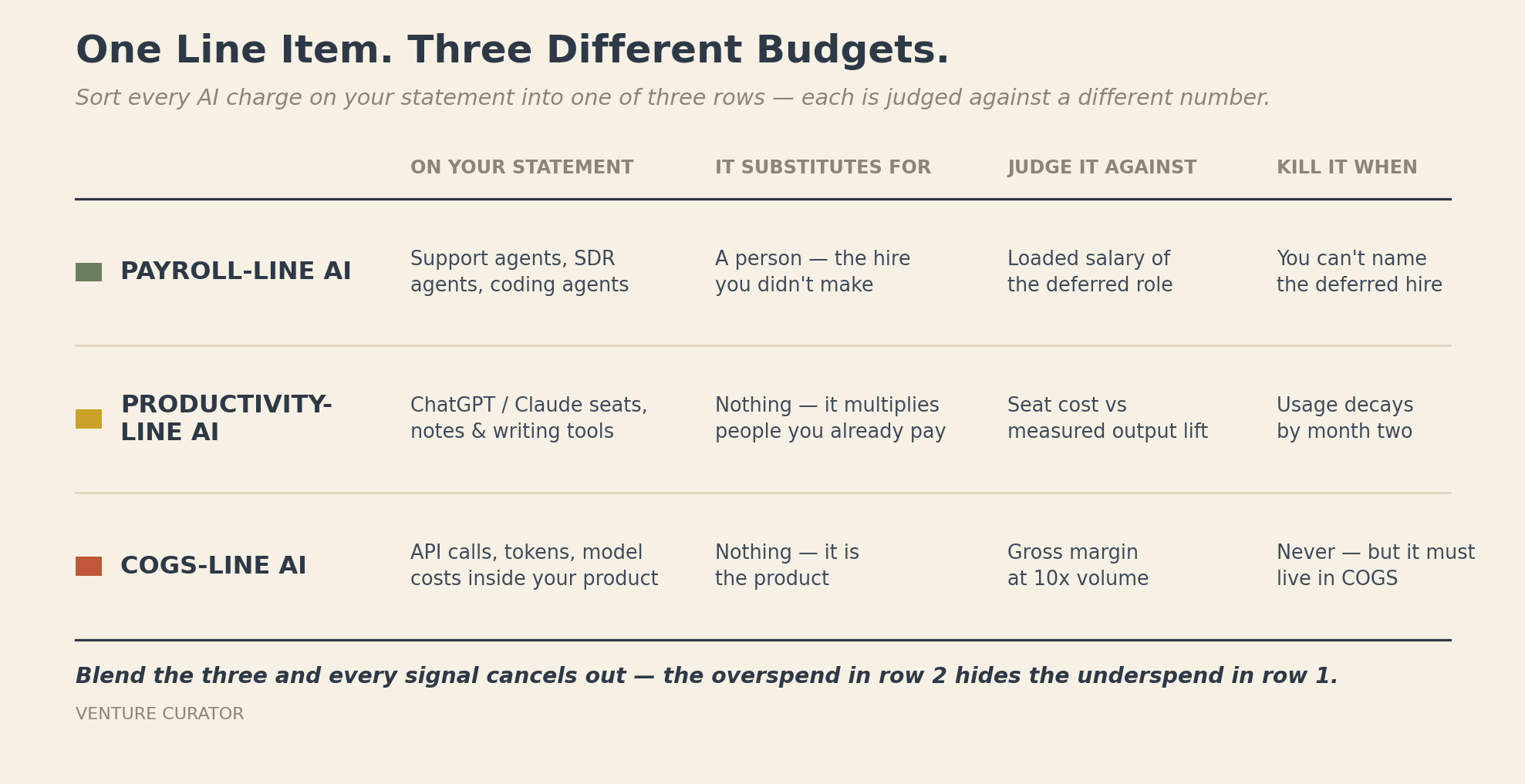
Blend the three and every signal cancels out. Overspending on seats makes the total look bloated, so founders hold back on agents, which is exactly where the returns are. The top 1% aren’t winning because they spend more. They’re winning because their spend is sorted: heavy where AI replaces labour, strict where it just speeds people up, and watched by margin where it lives inside the product.
We broke down the full sort, including a 30-minute audit you can run on your own statements this week, in What should your AI spend actually be measured against?
Why venture due diligence got worse for deep tech?
You’d expect the hardest technology to get the hardest scrutiny. A quantum computer, a fusion reactor or a new chip architecture either works under the laws of physics or it doesn’t, and checking that takes real expertise.
But Marin Ivezic at PostQuantum argues the opposite has happened: the bigger and more technical the deal, the less likely anyone independent has checked whether the science holds up.
It isn’t that investors got lazy. Several structural changes stacked on top of each other.
The expert layer disappeared.
Investors used to get independent technical judgment from bank research teams that employed specialist analysts. When Europe’s MiFID II rules in 2018 forced research to be paid for separately from trading, that model shrank, European equity research reportedly fell around 20%, and specialist analyst headcount at major banks dropped.
Expert networks, now a roughly $2.5 billion business, filled part of the gap. But they only work if you already know which expert to ask and what to ask them. In a frontier field, that’s exactly the knowledge a generalist investor doesn’t have.
The money moved to generalists.
In 2025, private quantum investment hit $4.9 billion, up 192%. The biggest investors were BlackRock and Nvidia, not specialist quantum funds. Sovereign wealth and pension money increasingly backs these rounds too, and one survey of sovereign funds found 58% lacked the resources to lead a deal. Capital that can’t run its own technical review ends up relying on someone else’s.
The lead’s name replaced the review.
A reputable lead investor certifies a company for everyone who follows. Followers assume the lead checked the physics, but they can’t see that review or verify it happened. Some rounds don’t even have that: Quantinuum’s $600 million round had no named lead at all.
Deadlines and herding reward speed over scrutiny.
US funds were sitting on a record $311.6 billion of uninvested capital at the end of 2023. A manager under pressure to deploy has more to gain from joining a hot round than slowing it down, and being wrong alongside peers does less damage to a reputation than being wrong alone.
Deep tech has no forced checkpoint.
Biotech is the useful contrast. FDA approval forces data into the open at each stage, so the industry built diligence norms around it: scientific advisory boards, specialist reviewers, staged checks.
Quantum has no equivalent gate. The most rigorous technical review of a major quantum company the piece could find came from the Australian government, released through a freedom-of-information request, not from any investor.
The results show up in the numbers.
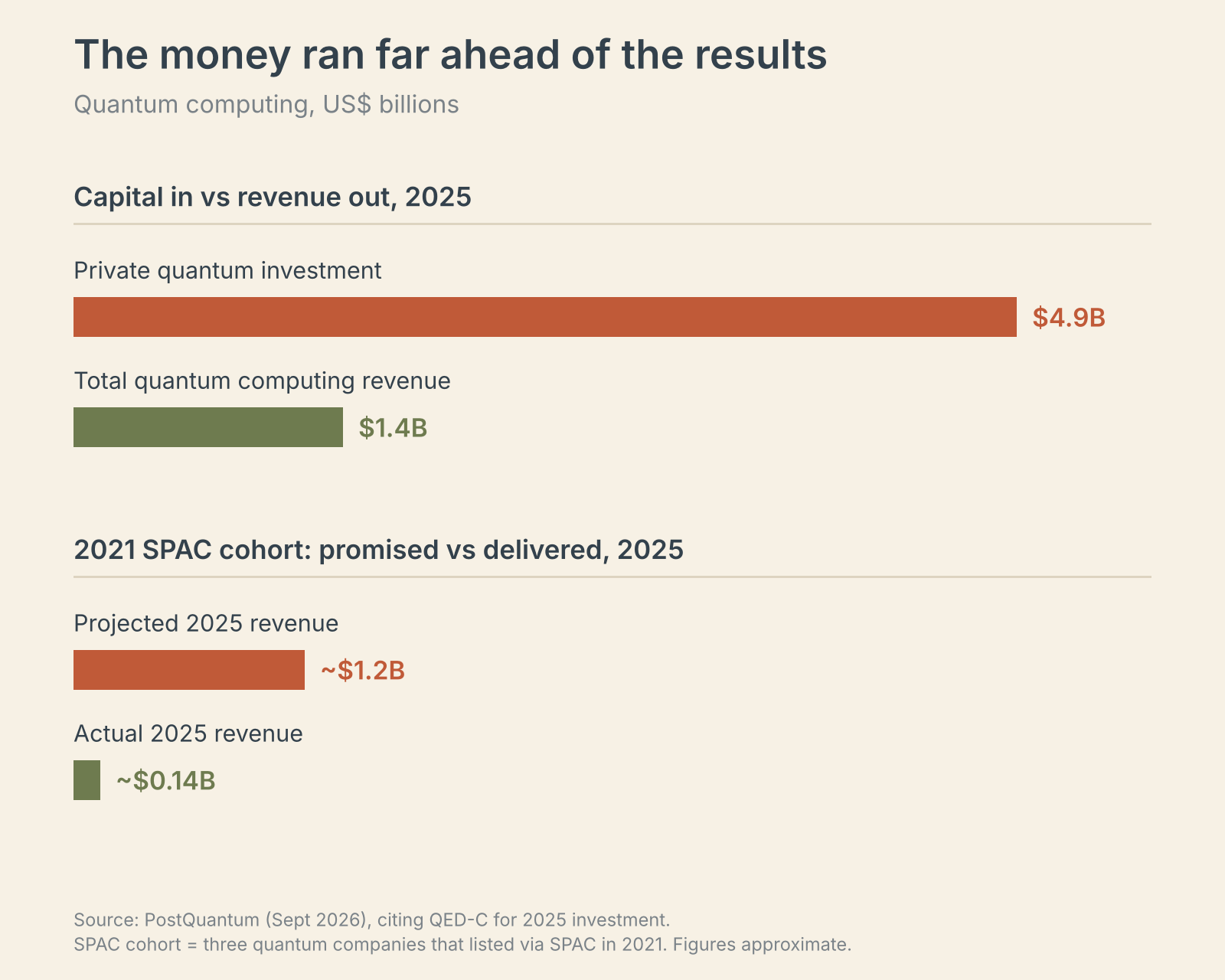
Private quantum investment of $4.9 billion in 2025 compares with about $1.4 billion in total quantum computing revenue. Three quantum companies that went public via SPAC in 2021 projected about $1.2 billion in combined 2025 revenue and delivered around $138 million. And it was short sellers, not investors, who did some of the hardest verification work in the sector.
There’s a precedent for how this ends. Venture put more than $25 billion into cleantech between 2006 and 2011 and lost over half of it, and the researchers who studied that cycle warned that sovereign and pension funds without hardware experience would be the next to fund such companies.
The proposed fix is simple: before backing a deep-tech round above a set size, LPs should require an independent technical feasibility review, one not commissioned by the fund or picked by the founder. Worth knowing, the author invests in quantum startups and runs a firm that offers this kind of review. But the core point holds regardless: in deep tech, a logo on the cap table has quietly replaced the technical check, and at these check sizes, a few weeks of independent review is cheap.
📬 Upgrade to Venture Curator Premium
Get access to 150+ premium archive posts, 100+ startup & VC resources, investor databases, fundraising templates, and exclusive startup research - all in one place.
TODAY’S JOB OPPORTUNITIES
💼 Venture capital & startup jobs
Partner - a16z | USA - Apply Here
Associate / Senior Associate - Spyre Promptech fund | India - Apply Here
Analyst - Pender Ventures | USA - Apply Here
Associate - Plug & Play Tech Center | USA - Apply Here
Associate - Harbourvest Partners | UK - Apply Here
Investment Director - Robostrategy | USA - Apply Here
Incubation Associate, Compute - Primary | USA - Apply Here
Investment Analyst - Mela Venture | India - Apply Here
VC Fellow - V11 | Remote - Apply Here
Associate Counsel - Hivemind Capital Partner | USA - Apply Here
VC Fellow - V11 | Remote - Apply Here
Tips to Break Into VC
The AI-native VC analyst: the skill funds are starting to expect
Junior VC work is changing. Market maps, first-pass sourcing, and basic research are increasingly handled by AI and data tools, which means funds are placing more value on the part tools cannot do well: judgment, signal interpretation, and finding what the databases miss.
This deep dive breaks down the five-layer sourcing stack funds use, what hiring teams now expect from junior candidates, and a 14-day project you can build using free tools to prove you can run a real sourcing system instead of just creating another startup list.
It also shows how to present the work on your CV, LinkedIn, outreach, and in interviews, including how to answer the increasingly common question: “How do you use AI in your work?”
Partnership With Us
Get your product in front of an audience of 125,000+ - Our newsletter is read by thousands of tech professionals, founders, investors and managers worldwide. Get in touch today.
Upgrade to Venture Curator Premium
Get access to 150+ premium archive posts, 100+ startup & VC resources, investor databases, fundraising templates, and exclusive startup research - all in one place.
(Subscribe to Venture Curator Premium and get 20% off forever.)