

👋 Hey, Sahil here - welcome back to Venture Curator, where we explore how top investors think, how real founders build, and the strategies shaping tomorrow’s companies.
Big idea + report of the week :
537 US unicorns are still carrying valuations from the 2021-22 boom. Are they still real?
Could calling your startup ‘AI-Native’ be hurting your valuation?
Frameworks & insightful posts :
The Barbell-ification of Software: AI is about to kill the middle of the software market.
How is your seed valuation actually decided? (It has almost nothing to do with your company).
If ChatGPT can do what your app does for free, why would anyone pay you?
Get access to 150+ premium archive posts, 100+ startup & VC resources, investor databases, fundraising templates, and exclusive startup research - all in one place.
FROM OUR PARTNER - SEMRUSH ONE
Your customers are searching on Google AND ChatGPT. Can they find you on both?
Search has changed. Ranking on Google still matters, but buyers are also asking AI tools which products to use, which companies to trust, and how different options compare.

Semrush One brings both sides into one place. You can track your Google rankings and AI mentions, see the prompts driving demand, compare your visibility against competitors, and find gaps you can actually act on.
It monitors 239M+ relevant LLM prompts globally, alongside the SEO data Semrush is already known for.
WORK WITH US
🤝 Partnership With Us
Get your product in front of an audience of 125,000+ - Our newsletter is read by thousands of tech professionals, founders, investors and managers worldwide. Get in touch today.
START WITH
🧠 Big idea + report of the week
537 US unicorns are still carrying valuations from the 2021-22 boom. Are they still real?
Founders and early employees are usually taught to treat the last round’s valuation as the scoreboard. It’s the number on the cap table, the number in the press release, and the number everyone uses to estimate what their equity is worth.
But new data from PitchBook’s Q3 2026 Quantitative Perspectives report suggests that for most of America’s unicorns, that number hasn’t been tested by the market in years.
PitchBook looked at every active US unicorn and sorted them by the year they last raised a priced round.
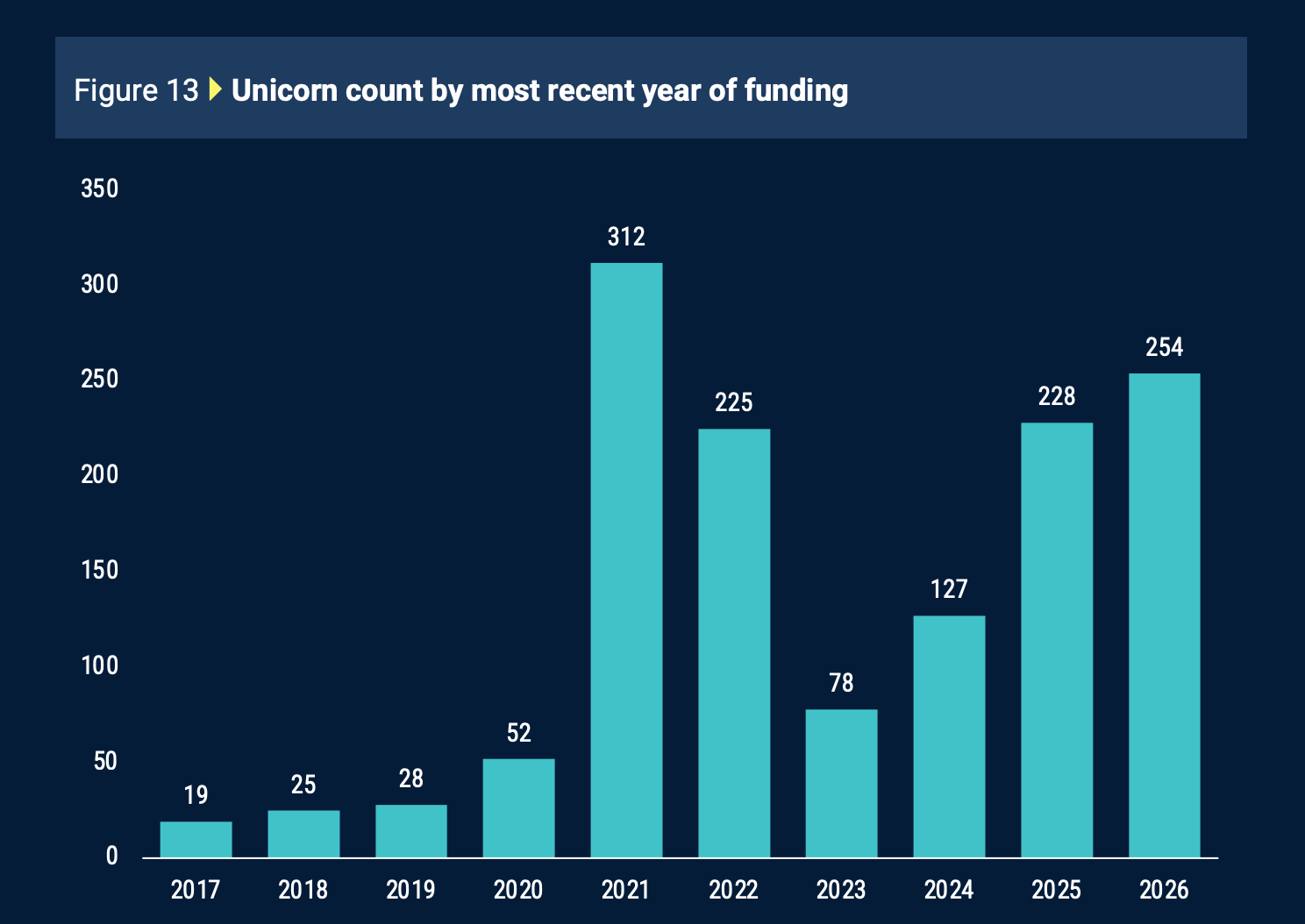
Of 964 active US unicorns, 312 last raised in 2021 and another 225 in 2022. That’s 537 companies, roughly 56% of the entire unicorn population, still carrying a valuation set during the most expensive funding market in venture history.
The cash isn’t coming back to match those marks. Venture fund distributions sit at just 7.9% of net asset value, barely half the 14.5% long-run average, and PitchBook says funds are being held back specifically by inflated 2020 to 2022 markups.
When these companies do test their price, it often doesn’t hold. Public investors are refusing to pay private market prices, Chime listed at a significant markdown from its private peak, and secondary buyers apply much steeper discounts to companies whose last round is years old than to recent raisers.
There’s a second trend hiding behind this. Many of these companies aren’t stuck because they’re failing. They’re choosing not to raise or list, because any new priced event would likely force them to confront a lower number. Staying private and quiet keeps the 2021 valuation on paper. That’s how the market ends up with record paper value and record trapped value at the same time.
So is the unicorn boom real, or mostly a number nobody has checked?
For a lot of these companies, both can be true. Some have genuinely grown into their 2021 price and would clear it easily today. But the market has no way of confirming which ones, because they haven’t raised or sold at a real price since. A four-year-old valuation isn’t a lie. It’s just unverified.
And this is where founders and employees need to be careful.
If your company last raised in 2021 or 2022, the valuation on your cap table is the most optimistic number your equity has ever had, not necessarily what it’s worth today. That matters for how you negotiate your next round, how you think about exercising options, and what you tell your team their equity means. It also matters for investors: a fund showing strong unrealised gains on these companies is reporting marks, not money.
The real risk isn’t that your valuation might be lower than it looks. It’s making decisions about raising, hiring, or exercising as if a number set in 2021 is still the price the market would pay you today.
Could calling your startup ‘AI-Native’ be hurting your valuation?
Calling yourself an AI startup can still command a valuation premium. But investors are increasingly asking a second question: how much of the company is actually defensible because of AI?
The data in this analysis suggests the market is beginning to separate companies that share the same “AI-native” label into very different buckets.
The AI premium is still real: Carta’s H1 2026 data shows AI startups at seed raising similar amounts of capital as non-AI startups while receiving roughly 50% higher valuations.
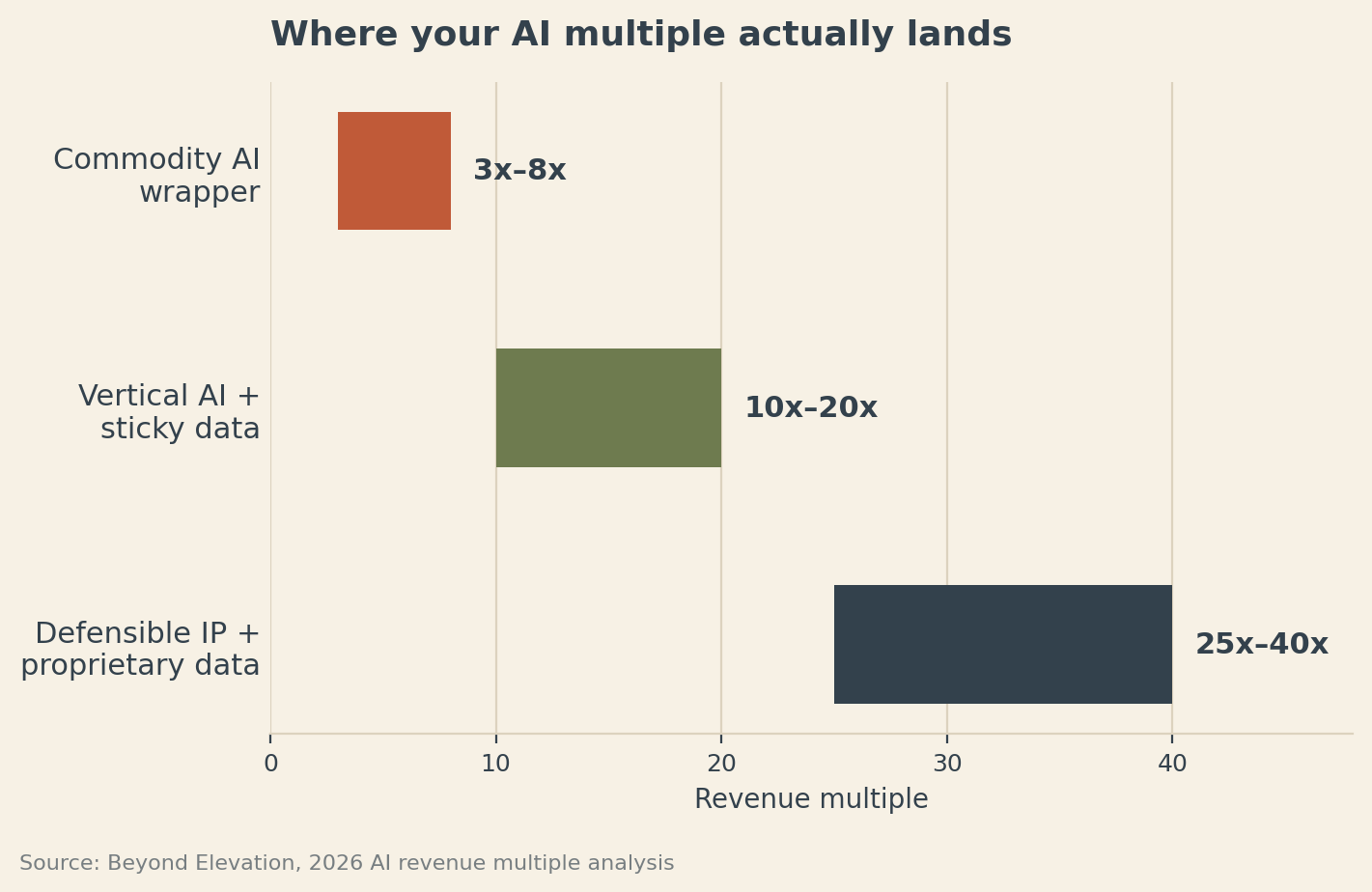
But not every AI company receives the same premium: The analysis places commodity AI wrappers around 3x to 8x revenue, vertical AI products with sticky proprietary data around 10x to 20x, and companies combining real IP with proprietary data around 25x to 40x.
The scrutiny increases as companies mature: At seed, companies without protectable IP are described as receiving a 20% to 30% markdown versus comparable companies with stronger defensibility. By Series A, the analysis puts that gap at 30% to 40%.
z890-\This helps explain why simply adding AI to a product is becoming less meaningful.
Investors increasingly want to understand what happens after you remove the AI label.
Can another startup recreate the product by calling the same foundation-model API? Does every new customer generate proprietary data that improves the product? Is the software embedded deeply enough in a workflow that replacing it becomes painful? And do the economics still work when inference volume becomes 10x larger?
Those questions point toward four areas founders should probably examine before their next fundraise: technical differentiation, proprietary data, workflow lock-in and unit economics at scale.
The practical test for technical differentiation is surprisingly simple: swap the underlying model. If replacing your primary model provider with a comparable model leaves the product almost unchanged, investors may struggle to see where the technical moat exists.
For proprietary data, user count alone isn’t enough. A stronger signal is whether increased usage creates data that makes the product measurably better over time, improving things like accuracy, resolution time or match quality.
Workflow depth provides another clue. If customers who integrate the product more deeply consistently retain and expand more, founders have actual evidence of switching costs rather than simply claiming their product is sticky.
And then there are economics. An AI product with attractive margins at today’s usage may look very different at 10x the inference volume. Modeling those economics before investors do can reveal whether the business actually becomes stronger as it scales.
That makes the evolution of the “AI-native” premium interesting.
Eighteen months ago, simply being associated with AI could materially strengthen a fundraising story. As more startups adopt the same language, investors have more reason to look underneath it.
The AI label can get you into the conversation. The increasingly valuable part is proving why what you’ve built becomes harder to copy as you grow.
📄 Must-Read Post


SOMETHING MORE
🧩 Frameworks & insightful posts
The Barbell-ification of Software: AI is about to kill the middle of the software market.
AI is making software dramatically cheaper and faster to build. That sounds great for startups, but it could also weaken some of the moats that protected software companies for decades.
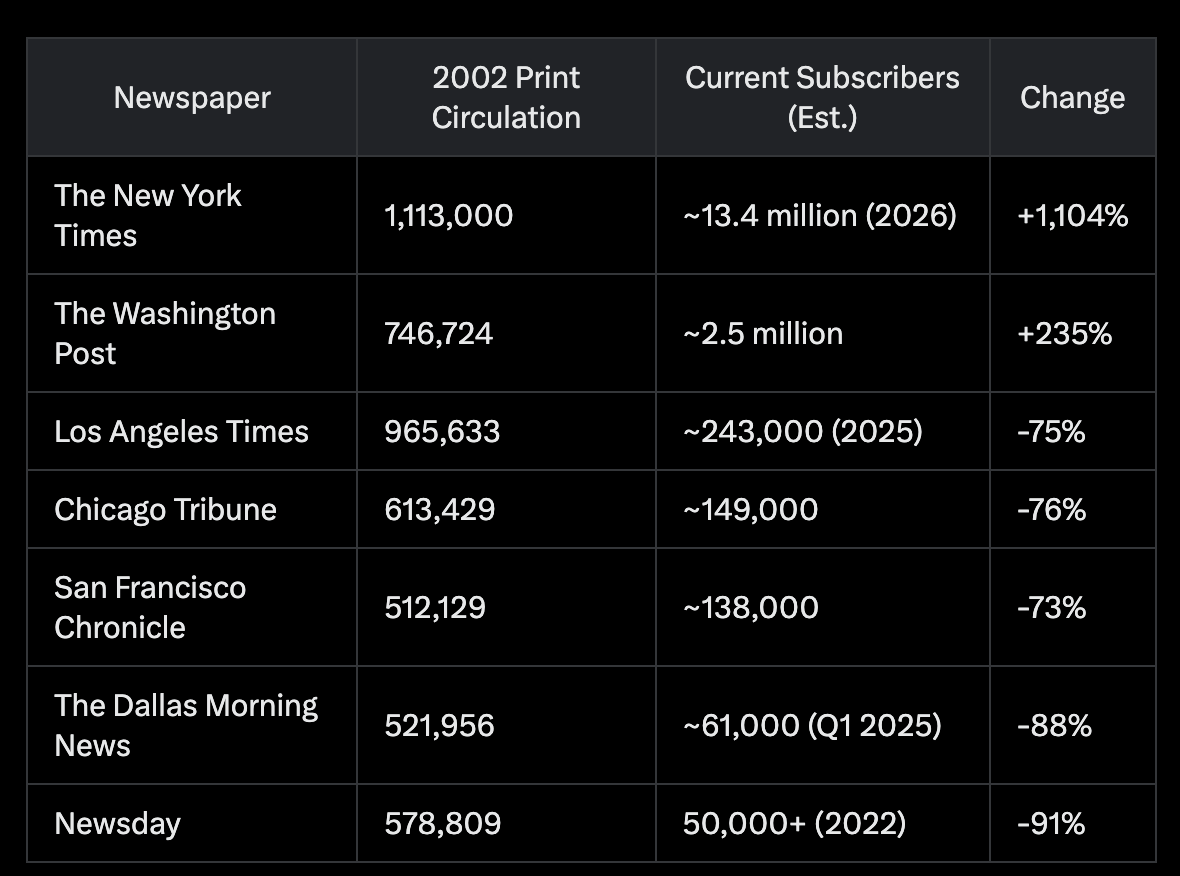
Mike Vernal from Conviction makes an interesting comparison: software may be heading toward the same “barbell” structure that transformed newspapers after the internet.

Before the internet, regional newspapers benefited from expensive distribution. Once distribution became nearly free, much of the middle disappeared. A few global publications became much larger, while thousands of independent newsletters and niche publications emerged.
Vernal argues AI could create something similar in software.
Traditional software moats often came from three things:
Building the product was expensive
Switching systems was painful, and
Integrations created strong ecosystems.
AI weakens all three. Competitors can replicate features faster, migrations can become more automated, and AI can make integrations significantly easier.
The possible result is a market with two powerful ends:
Huge platforms: A smaller number of companies could own entire buying categories such as sales, marketing, finance, HR, legal, or healthcare. Instead of selling one narrow tool, they keep expanding until they become the system customers use for almost everything.
Tiny software businesses: At the other end, AI coding tools could enable millions of people to build highly specific software for themselves, their companies, or small groups of customers. Some could grow into profitable niche businesses.
The uncomfortable middle: Mid-sized point solutions may face the most pressure. If large platforms can continuously add their features and small teams can cheaply recreate narrow products, being a standalone tool becomes harder to defend.
The Amazon analogy explains what the new moat could look like. Amazon started with something relatively easy to copy: selling books online. Its defensibility came from decades of relentless reinvestment into logistics, infrastructure, technology, and distribution.
AI may push software companies toward the same strategy: build faster, expand continuously, reinvest, and make the total product increasingly difficult to replicate.
For venture-backed software startups, that creates an interesting strategic question: If building software becomes almost free, is your moat still one great product, or everything you can build around it?
How is your seed valuation actually decided? (It has almost nothing to do with your company).
Founders often assume valuation is mainly about traction, market size, or how well they pitch the company.
But there’s another constraint most founders rarely see: the economics of the VC fund sitting across the table.
Imagine you’re pitching a $28M seed fund. It typically writes around a $600K check and wants roughly 6% to 8% ownership.
At 7% ownership, a $600K investment implies an ~$8.6M post-money valuation. At 6%, it implies $10M. So if you’re raising at an $18M valuation, that fund may simply be unable to make the investment work within its portfolio model. Pasted markdown
That creates a simple chain:
Fund size → Check size → Target ownership → Maximum workable valuation
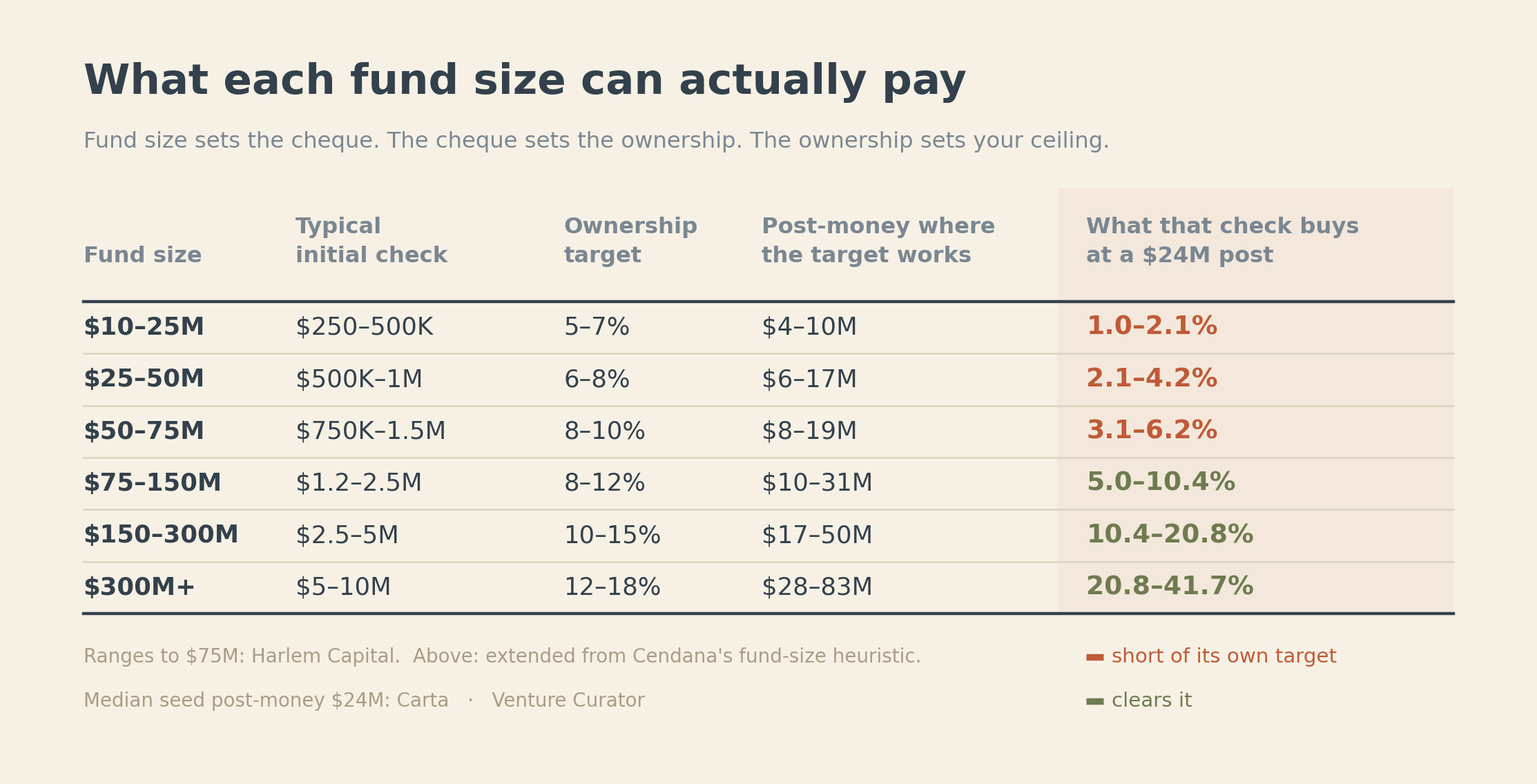
And this matters more today because seed valuations have risen. Carta’s median seed post-money valuation cited in the analysis is $24M. A $50M fund investing $1.5M at that valuation gets only 6.2% ownership, potentially below its target. Pasted markdown
This also changes how founders should think about round size.
If you tell a fund you’re raising $3M and the lead wants 15%, you’ve effectively implied a $20M post-money valuation before anyone explicitly discusses valuation.
A more useful sequence is:
Calculate how much capital you need to reach the next milestone with 18 to 24 months of runway.
Add a buffer.
That becomes your round size.
Divide it by the dilution you’re comfortable accepting.
Then target funds whose check size and ownership model can support that valuation. Pasted markdown
There’s another number founders often overlook: the option pool. A lead may ask for a 10% to 15% pool to be created pre-money, which dilutes existing shareholders before the investment lands. The analysis argues that negotiating the pool based on an actual hiring plan can sometimes matter more to founder ownership than fighting over another $1M or $2M of headline valuation. Pasted markdown
The easiest way to avoid wasting weeks with the wrong fund is to ask this on the first call:
“What’s the typical initial check for this fund, and what ownership do you usually target?”
Those two numbers let you quickly estimate whether the fund’s economics can support your round. Pasted markdown
So, don’t treat every valuation pushback as a verdict on your startup. Sometimes your company isn’t the problem. Your round simply doesn’t fit the fund’s math.
If ChatGPT can do what your app does for free, why would anyone pay you?
This is becoming one of the biggest questions for consumer app founders.
If a user can open ChatGPT, Claude, or Gemini and get roughly the same result in seconds, why would they keep paying $10 or $20 every month for a separate app?
RevenueCat’s Daphne Tideman argues that the answer isn’t simply “add more AI.” AI-powered apps are already monetizing well, generating 41% more revenue per payer and 52% better trial conversion than non-AI apps. But their 12-month retention is only 21.1%, compared with 30.7% for non-AI apps. Pasted text
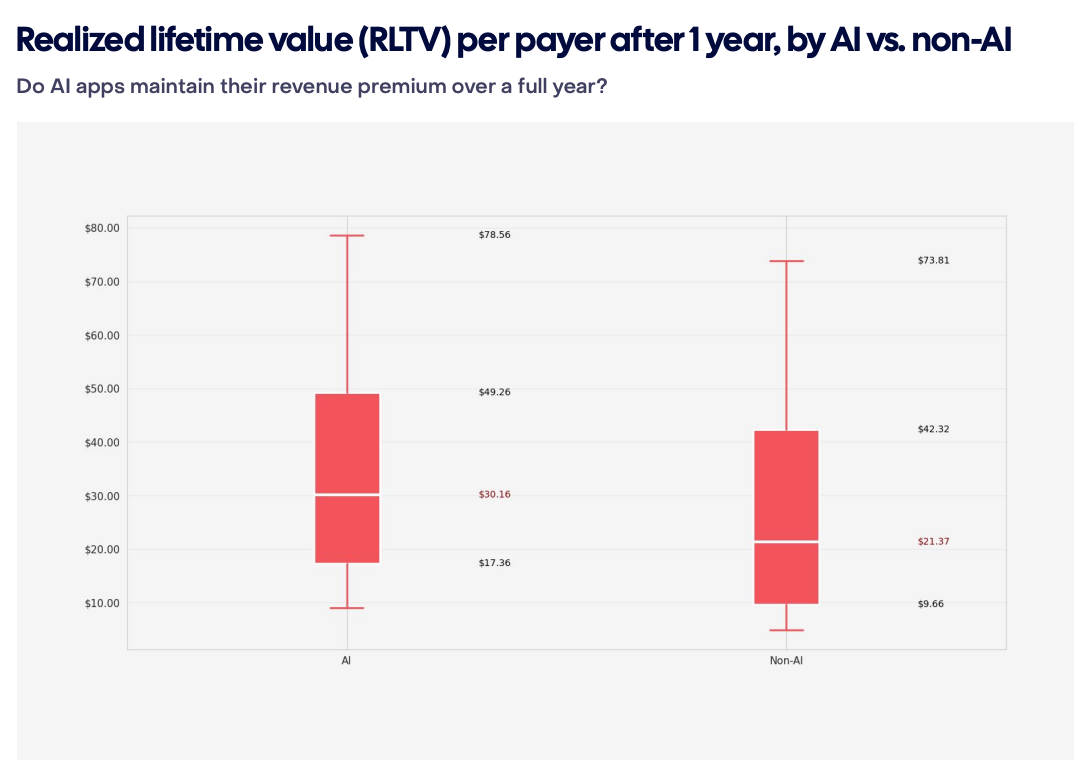
In other words: AI can get people through the door. It doesn’t necessarily give them a reason to stay.
Look at Chegg versus Duolingo.
ChatGPT can replace much of Chegg’s old homework-answer experience. But it can also teach you French, and Duolingo is still growing. In Q2 2026, Duolingo’s revenue increased 18%, daily active users grew 23% to 58.7M, and paid subscribers rose 17% to 12.7M. Pasted text
The difference is what exists around the answer.
RevenueCat suggests six things apps can build that are harder for a blank LLM chat to replicate:
Structure: Turn an answer into a complete workflow or experience.
Memory: Become more useful as the app learns about the user over time.
Habit: Use streaks, reminders, accountability, and gamification to bring users back.
Precision: Own specialized data or expertise that produces better results.
Connection: Build community, identity, personality, or emotional attachment.
Physical + digital: Combine software with sensors, devices, or real-world data. Pasted text Pasted text
Duolingo is a great example of stacking several of these together. ChatGPT can teach a language, but Duolingo has spent years building streaks, leaderboards, progression, reminders, and gamification. When Duolingo introduced leaderboards, learning time reportedly increased 17%, while the number of highly engaged learners tripled. Pasted text
There’s also a simple test founders can run: the Blank Box Test.
Open ChatGPT or another LLM, describe the exact problem your user comes to your app to solve, and compare its response with what your product delivers.
If most of your product’s value can be recreated with one prompt and one response, you have a differentiation problem. If your app adds structure, accumulated data, habit, precision, connection, or a real-world component, that’s where the moat may be. Pasted text
So, AI itself probably isn’t the moat. The stronger question for founders is: what does your product give users that an empty chat box cannot? RevenueCat’s argument is that the winners will use AI underneath the product while competing on the experience built around it.
📬 Upgrade to Venture Curator Premium
Get access to 150+ premium archive posts, 100+ startup & VC resources, investor databases, fundraising templates, and exclusive startup research - all in one place.
TODAY’S JOB OPPORTUNITIES
💼 Venture capital & startup jobs
Research Analyst - Kindred Venture | USA - Apply Here
Associate, Early-Stage Investments - Premji Invest | USA - Apply Here
Investment Director(Strategic Investment) - YZi Lab | Remote - Apply Here
Portfolio Management Associate - Cerity Partner | USA - Apply Here
Associate - Venture Capital - Artha Group | India - Apply Here
Partner 36, Corporate Controller - a16z | USA - Apply Here
Investment Associate - Cerity Partner | USA - Apply Here
Visiting Investment Analyst - Antler - Apply Here
Senior Associate - NY Life Venture | USA - Apply Here
Senior Principal - Entegris Venture | USA - Apply Here
AI Analyst - Array Venture | USA - Apply Here
SMB Program Associate - Plug and Play Tech Centre | USA - Apply Here
VC Fellow - V11 | Remote - Apply Here
Tips to Break Into VC
Does your PhD, law, research, or engineering background actually count in VC?
Sector-specific funds hire very differently from generalist VC firms. In biotech, defence, climate, and deep tech, domain expertise can be the thing that gets you noticed, but only if you position it correctly.
This deep dive breaks down what sector funds actually screen for, how specialist resumes and investment memos should look, and the realistic entry paths for PhDs, engineers, lawyers, clinicians, veterans, and industry operators.
It also includes 15+ funds and programs that hire people without traditional VC experience, plus a 60-day plan to turn your domain expertise into a credible investing profile.
Partnership With Us
Get your product in front of an audience of 125,000+ - Our newsletter is read by thousands of tech professionals, founders, investors and managers worldwide. Get in touch today.
Upgrade to Venture Curator Premium
Get access to 150+ premium archive posts, 100+ startup & VC resources, investor databases, fundraising templates, and exclusive startup research - all in one place.
(Subscribe to Venture Curator Premium and get 20% off forever.)